Medardo Rosso made small sculptures that behave like blurred photographs. Heads of children, a reading man and a cabaret singer emerge from rough lumps of wax or plaster, and the edge between face and background is hard to find. Where many sculptors of his time stressed solid contour, Rosso cultivated what the Cleveland Museum of Art calls deliberately coarse, unrefined surfaces. That choice makes him useful for anyone working with soft focus, vignette effects, atmospheric imagery or any design where the mood matters more than the outline.
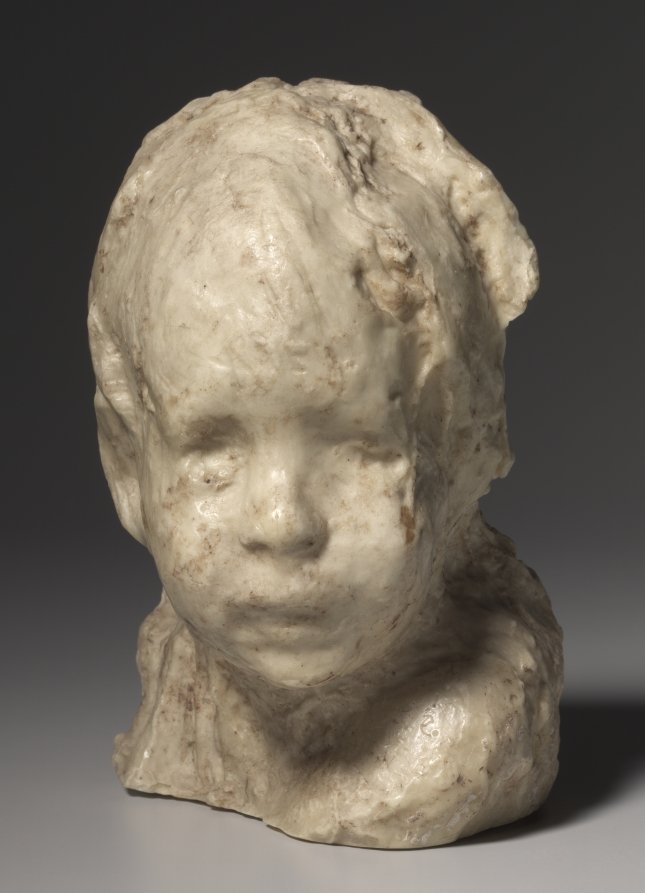
His work is limited in the public-domain record. The one object by Rosso that the major museum APIs flag as CC0 is Cleveland’s The Jewish Boy, shown below. Other works are described in text and are not described as free to use. For historic images cleared for reuse, browse the MGD museum inspiration collection.
Who was Medardo Rosso?
Cleveland gives his years as 1859–1928 and calls him Italian; Britannica and the Estorick Collection in London give his birth as 1858 in Turin. He died in 1928. The Estorick Collection says his family moved to Milan in 1870 and that he enrolled at the Brera Academy there in 1882.
Museums date his Paris years differently. The Estorick Collection says he visited Paris in 1884 and met Rodin; the Petit Palais says he came to Paris to work in 1884 and settled there in 1889; the Städel Museum places a meeting and an exchange of sculptures with Rodin in 1893. Finestre sull’Arte reports that relations between the two later cooled through argument over Impressionist sculpture. The relationship with Auguste Rodin is part of any account of Rosso, but the exact sequence depends on which source you follow.
Key works and a short career outline
- c. 1892, The Jewish Boy. Cleveland dates this wax on plaster to about 1892. It measures about 23 cm high and is inscribed on the left shoulder and inside. Cleveland’s catalogue says the artist considered it one of his most successful works.
- 1894, Uomo che legge (Man Reading). The Art Institute of Chicago holds a work with this title, dated 1894. It is not flagged public domain, so it is described in text only.
- c. 1895, Yvette Guilbert. The Art Institute of Chicago also holds this portrait, dated about 1895 and likewise not flagged public domain.
- 1906, Ecce Puer (Behold the Child). The Met’s catalogue records a bronze titled Behold the Child, dated 1906 and not flagged public domain. A Brooklyn Rail exhibition listing gives the wax-over-plaster version as about 1906, and the Finestre sull’Arte profile mentions a bronze of the same title at the Musée d’Orsay.
- Bookmaker. Sources conflict on the date of this subject. A Brooklyn Rail listing dates a bronze to 1902–03, while a Pulitzer Arts Foundation caption dates one to 1893–95. This guide therefore gives no single date.
What to look at in a Medardo Rosso sculpture
The dissolving edge. In The Jewish Boy the hairline, cheek and shoulder run into one another. The nose and mouth are the clearest forms; the eyes are barely marked. Look at how softly the light moves across the waxy surface. Cleveland’s catalogue says he used the fluid properties of wax to suggest a child’s fleeting expression and the ephemeral nature of childhood.
One viewpoint. Rosso’s heads are most convincing from the front and slightly above or below. He treated the work as an image taken from one position, much as a photographer would, and the rest of the form can be left unresolved. For a designer this suggests a useful discipline: decide who is looking and from where, and finish only what that person will see.
A surface that records its making. The bumps, thumb marks and smears are not flaws. They show wax being pressed, melted and left. The work looks as though it is still changing, which fits Cleveland’s description of a fleeting expression.
Variation as a method. The Nasher Sculpture Center notes that Rosso accepted the wax shell, normally a temporary stage in lost-wax casting, as a finished work and added plaster to reinforce it. An Oxford study of three casts of his Sick Child finds that the wax version diffuses the face in a way the plaster does not, and the Frieze account of a Rosso exhibition notes one subject existing in seven variations across plaster, wax on plaster and photographs. Rosso often varied details between casts of one subject.
Colour: measured from the museum scan
Rosso’s palette is nearly monochrome, which makes it easy to borrow. In Cleveland’s image of The Jewish Boy, the measured values are a warm cream near #cdbea4 in the lit wax, a deeper sand near #b1a491, a mid-brown near #8c7f6c in the shadowed cheek and shoulder, and a near-black grey around #2c2b2a to #4c4741 in the backdrop. These are measured from the museum’s scan of this object, not original pigments, and the backdrop is a studio setting, not part of the sculpture. Sample the image yourself with the image colour picker.
Technique: wax, plaster and bronze
Rosso used wax over a plaster core, as Cleveland’s object record states, and also had works cast in bronze, such as the Met’s Behold the Child. Unlike the usual practice, in which a wax model is a stage on the way to metal, he treated wax as a final material. That is why the objects look so close to the moment of making.
The Frieze account and a review of a CIMA exhibition, discussed in the journal 19th-Century Art Worldwide, also describe his photographs of his own sculpture. The CIMA review says the show included over 50 photographs by Rosso. In his hands, the photograph was a second version of the work, so the soft focus of a print and the soft form of the wax reinforced each other.
Medardo Rosso and Impressionism
Finestre sull’Arte calls Rosso an Impressionist sculptor, and the label points to an interest in light and the passing moment carried into three dimensions. The parallel is the effect on the surface: instead of a clear contour, a patch of light and shade that changes with the viewer’s position. For a wider look at the painters, see our guide to Impressionism. For a sculptor of the same period who built form in the opposite way, from heavy planes and a firm axis, see the guide to Antoine Bourdelle.
How designers can borrow from Medardo Rosso
- Design a soft edge on purpose. Blur, mask or fade one contour in an image or icon and keep another sharp. The contrast tells the eye where to look, as the nose and mouth do in The Jewish Boy.
- Pick one viewpoint. Fix the camera angle in a hero image or 3D render and finish only what shows. The rest can stay rough.
- Use a warm monochrome. A cream, sand and brown scheme like the one above reads as intimate and quiet. Add a single dark field around it for contrast.
- Leave the trace of the hand. Visible thumb marks, grain and irregular edges give print and packaging a sense of making that a perfect vector cannot.
- Make versions. Rosso returned to a subject in different materials. A brand mark or illustration can be tested as a sharp vector, a soft print and a photographed object, and the soft version often shows what the sharp one lacks.
- Respect the rights. Only works flagged CC0 or public domain by the museum are shown here. For anything else, check the museum’s rights notice; our guide to public domain art covers the basics (this is not legal advice).
Frequently asked questions
Who was Medardo Rosso?
Medardo Rosso (d. 1928) was an Italian sculptor, born in Turin according to Britannica and the Estorick Collection, who studied at the Brera Academy in Milan, spent years in Paris and made small heads in wax, plaster and bronze.
What is Medardo Rosso known for?
He is known for heads and figures with soft, dissolving surfaces, including The Jewish Boy (c. 1892), Ecce Puer (1906) and portraits such as Yvette Guilbert, and for using wax as a finished material.
Is Medardo Rosso’s work public domain?
Only some records say so. The Cleveland Museum of Art flags The Jewish Boy as CC0, but the Met and the Art Institute of Chicago do not flag the Rosso works they hold, so check each object’s record.
What can designers learn from Medardo Rosso?
How to use soft edges, a single viewpoint and a warm monochrome to give an image atmosphere, and how to test one idea in several versions.