Merida Brand Guidelines
The American weave.
Aa
Two constants: a clay-and-jute palette and a textural sans register. Abstract homage — not a Merida rug or wordmark.
The American weave
Merida weaves and finishes natural-fibre rugs on its own looms in Fall River, Massachusetts.
Merida is a lesson in a rare thing — an American loom — as the identity. A maker in Fall River, Massachusetts, it weaves and finishes natural-fibre rugs in-house, on its own looms, in the USA — a genuine domestic weaving operation in an industry that mostly makes abroad. A rug, woven and finished on American looms.
Its identity is the American weave. Merida’s in-house US weaving, and its focus on woven texture, are the work it is known for. A craft, made a signature. A maker that brought weaving home.
(Honest notes, so the story stays precise. Merida was reborn as a design-led American atelier under Catherine Connolly, who took over in 2007 and turned it from a commodity sisal importer into a maker; its older ownership traces through Hiram M. Samel. Everything is genuinely woven and finished in-house in the USA, in a Fall River, Massachusetts workshop — on jacquard and dobby looms and a tufting machine, by its own team of artisans — so we place it in Fall River, not Syracuse. Its focus is all-natural fibres — wool, linen, mohair, jute — and “the art of woven texture.” We keep it distinct from the Mexican city Mérida and the unrelated bicycle brand. Its rugs and name are its IP, described but never reproduced, and there is no official brand hex — these tones are an unofficial interpretation. This is design commentary and does not promote any product.)
Colour
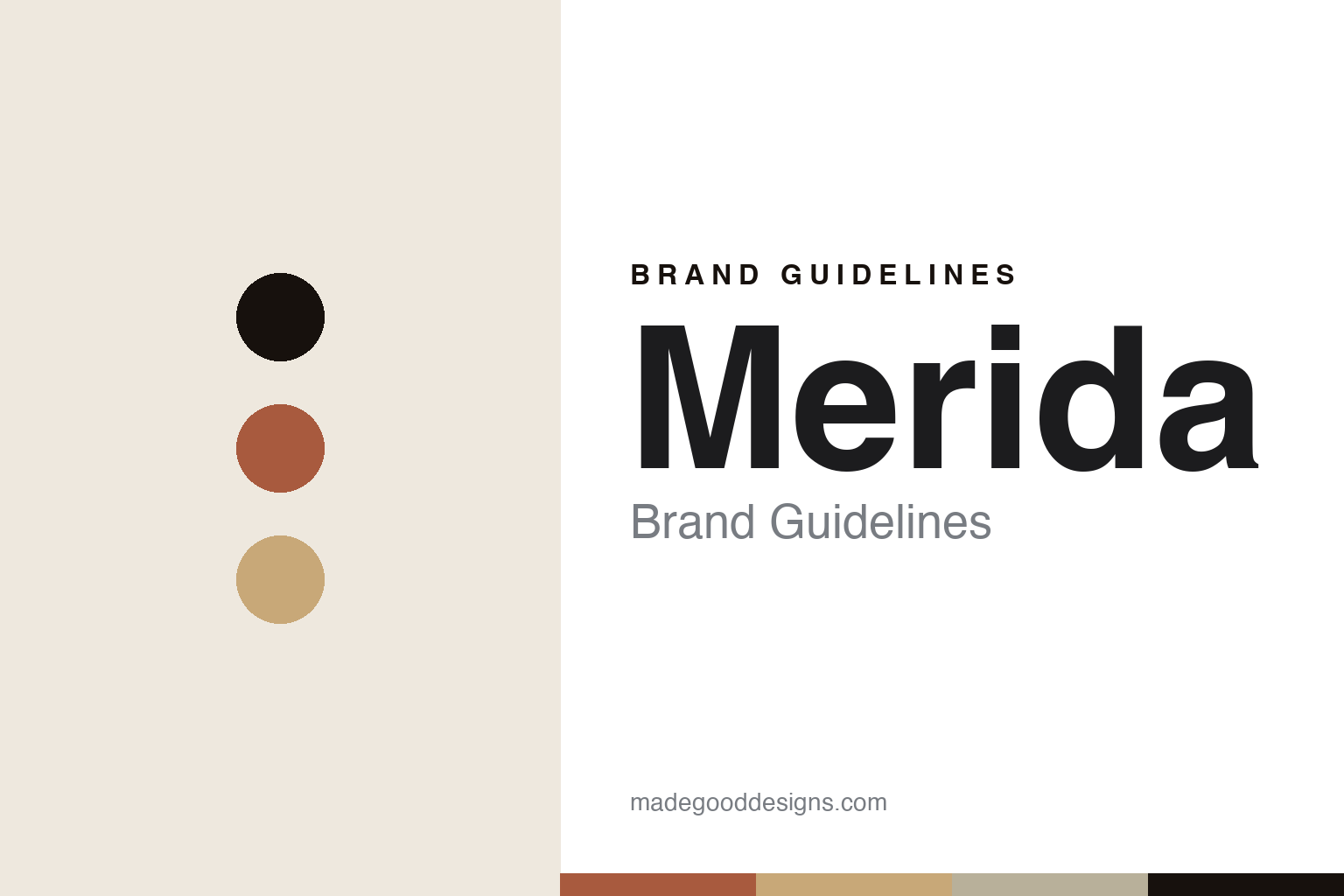
Merida lives in a clay-and-jute palette. Click a swatch to copy the hex.
Merida’s identity is natural, warm and textural — a clay, an ink, a jute, a flax, and a cream. The palette leans clay and jute: the register of natural fibre and earthy dye. It signals texture and material over flash. The honest caveat: with no published brand hex, these values are an original, unofficial interpretation, not first-party colours.
The lesson is a clay-and-jute palette signals a natural, textural identity. Merida’s world is a warm, woven, made-in-USA object. For designers, it is a reminder that earthy natural-fibre tones can carry a brand built on texture — the clay of a warm dye and the tan of jute. Because these tones can fail as small text, keep type dark and let the colour live in the accents, palette and band. The takeaways: weave at home; use natural fibre; make texture the point; and treat any single hex as unofficial.
Typography
The register is a textural sans — warm, grounded, natural.
Merida’s identity carries a warm, grounded, natural spirit — a woven object, not a printed one. A textural sans captures the mood: friendly, even and grounded, the register of a natural-fibre woven rug. Set in a clay-and-jute palette, the textural sans feels warm and grounded — exactly the personality Merida carries. It is natural rather than slick, mirroring a hand-finished, woven-texture rug. (Merida’s real rugs and wordmark are things we describe but do not reproduce, and the exact typeface is not ours to use.) Because it is not ours to use, the honest description is “a textural-sans spirit,” shown here in a stand-in. The type behaves like the maker: warm, grounded and natural.
Aa
A textural-sans spirit — warm and grounded. (Specimen set in Figtree, a textural-sans STAND-IN; NOT the Merida wordmark or any rug design.)
An American loom as identity
Merida stands for the American weave.
Merida is a lesson in making an American loom the identity. A clay-and-jute palette, a textural sans and natural-fibre rugs make in-house US weaving the whole maker — warm, grounded and natural. The loom is the differentiator. The differentiator is a genuine rarity — weaving and finishing rugs in-house in Massachusetts, on its own looms, in an industry that mostly makes overseas.
Put to work, the identity is domestic weaving as design. A maker building in this spirit would bring the making home even when it is harder, use honest natural fibres, and let texture rather than pattern be the design, so the customer buys into a woven object rather than a printed one. It would treat an American loom as a point of difference, so that where-made is part of the value. It would tell the truth about its turnaround — a company reborn, not invented yesterday. The lesson Merida teaches is that domestic weaving can build a brand: the loom gives it substance, and the American making gives it credibility. The loom is the personality, and the making is the proof.
For designers and brand-builders, Merida offers a clear takeaway: bring the loom home and weave texture. The lessons: weave in-house; use natural fibre; make texture the point; and be accurate about the story. It is also a reminder to stay precise: Merida is an American maker in Fall River, Massachusetts, reborn under Catherine Connolly in 2007, weaving and finishing natural-fibre rugs on its own US looms — with the palette here an unofficial interpretation. Merida made the American weave the maker — proof that an American loom can be the difference.
Explore & save
Keep Merida’s identity on hand — save it to a board in the Made Good inspiration library.
Merida identity set
Pin the clay-and-jute palette and the textural-sans register to your own board.