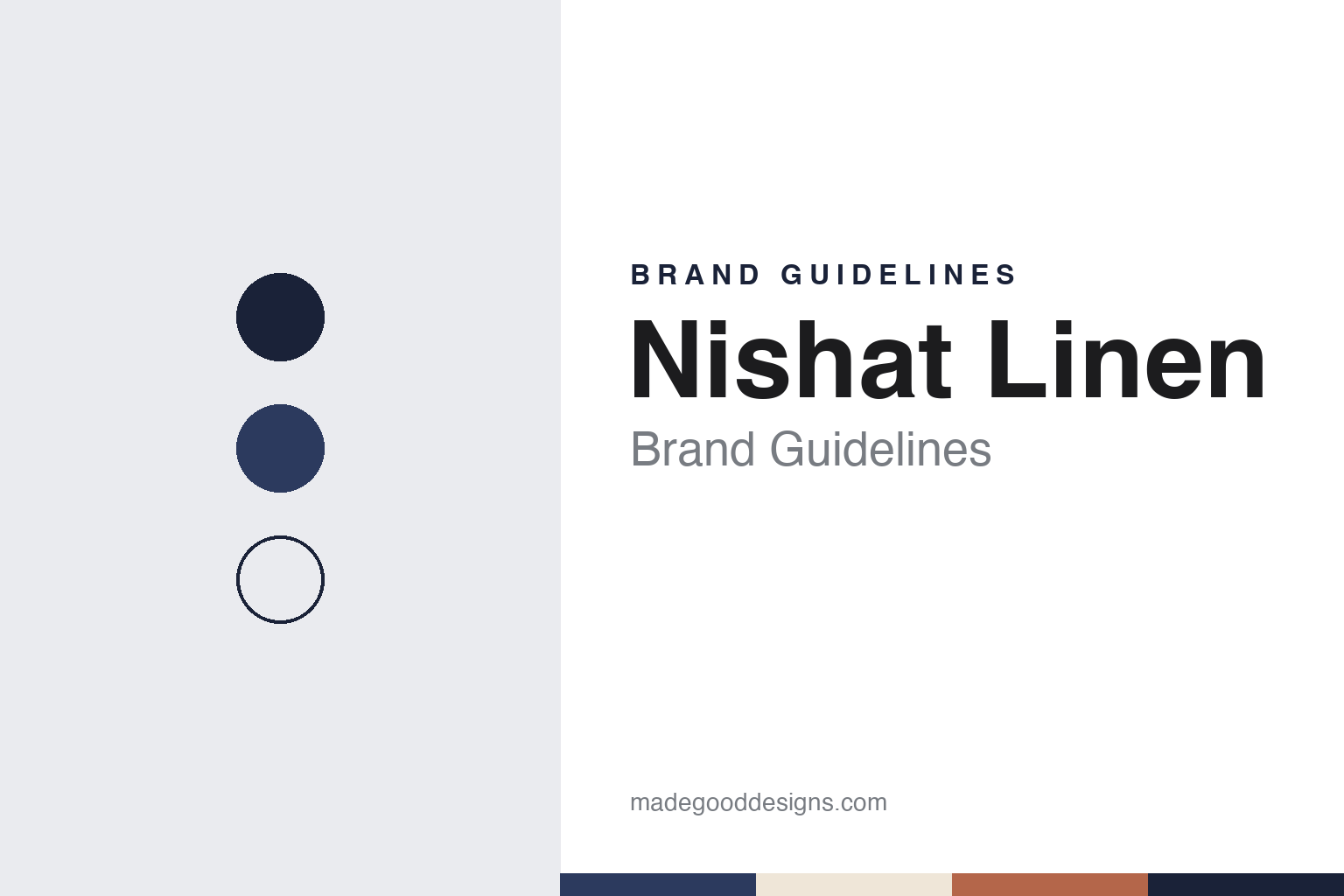
Nishat Linen Brand Guidelines
The Nishat Mills retail label that began with export bed sheets.
Aa
Two constants: a Nishat Linen indigo, sand and clay palette and a Classic serif register. Abstract homage — not a Nishat Linen product or mark; no garment, print, logo or label is reproduced.
Under the mill
A home-textile brand set up beside a Lahore mill.
Nishat Linen is the retail label of Pakistan’s Nishat Group, and it began as an offshoot of a textile mill. Profit by Pakistan Today reported in December 2016 that the business was set up in 1989 as a home-furnishing brand producing bed sheets for export, “an independent entity under the umbrella of Nishat Mills.” English Wikipedia credits its founding in 1989 to Naz Mansha, whom Profit described in the same 2016 profile as the brand’s owner and chief executive.
The parent is much older. Nishat Mills Limited says it began business in Lahore in 1951 as a partnership, was incorporated as a private limited company in 1959 and was listed on the Karachi Stock Exchange in 1961. English Wikipedia names its founders as Mian Muhammad Yahya and his brothers Mian Hameed, Mian Rafiq and Mian Ayub, and says the name “Nishat” came with the textile licence they acquired rather than being chosen by them. Mian Muhammad Mansha chairs the wider Nishat Group, according to English Wikipedia, whose listed companies span textiles, cement, power, insurance and banking.
Nishat Mills calls itself the flagship company of the group. Its website lists production in spinning, weaving, dyeing and processing, printing, denim, workwear, home textile and terry, garments and power generation, with manufacturing units in Lahore, Faisalabad, Sheikhupura and Feroze Wattwan. On the same page, updated in November 2026, it lists Nishat Linen (Private) Limited among the Nishat Group’s textile companies, and a Nishat Linen Trading LLC in the United Arab Emirates among the group’s foreign companies.
The link with the mill is also a supply line. Naz Mansha told Profit in 2016 that the brand buys its cloth from Nishat Mills at market price and is treated “like any other customer to the mills”; we give that as her account.
Colour
From bed sheets to clothes.
The move from export bed linen to fashion came early. According to Profit, the brand diversified into apparel in 1992 and opened a showroom in Pakistan that year; English Wikipedia instead dates the first Nishat retail store to 1994. Both sources agree that the shop followed the factory, and that home textiles came before clothes.
By 2016 the chain had grown well beyond one showroom. Profit reported more than 100 outlets in Pakistan, a presence in more than 50 cities and manufacturing units in five, with shops also in smaller towns such as Lalamusa, Jhelum and Rahim Yar Khan. The magazine noted that the brand calls itself the “fabric of Pakistan.”
Mansha described two habits of the business to Profit. Nishat Linen, she said, let customers buy cloth by length instead of only complete suits, so that a buyer could take a single kurta piece to wear with jeans; and its end-of-season sales were made up of that season’s leftover stock rather than a separate line. Those are her accounts of the company’s practice.
Advertising, in the same interview, mixed television and social media with billboards and magazines, because many customers still relied on print. Profit described a large billboard for the brand’s latest collection at the Cavalry Ground intersection in Lahore, and Mansha said the brand’s calendar followed festivals in each country where it trades, from Eid and Pakistan’s Independence Day on 14 August to Diwali, Nauroz and the Fourth of July.
Today the company’s website describes both stitched and unstitched clothing for women and children, with seasonal collections, and introduces KOA, a second fashion label from Nishat Linen with its own web address. The online shop is run from Lahore, and its menus now reach beyond clothing into footwear, bags, shawls and outerwear.
Typography
Design and documentation.
Pakistani and Bangladeshi fashion and retail brands present themselves through a few recurring touchpoints: the shop sign over a mall unit, the logo on a carrier bag, the seasonal look-book and the corporate page that names a founder or a parent company. Some marks point back to craft — Khaadi, for example, says the hands in its logo symbolise its heritage in handloom craft — while others set a short name in plain capitals, as Sapphire does.
The formats vary widely. Some of the brands in this group began as a single shop and grew into mall flagships at home and abroad; others are the retail arms of textile mills, and can draw on a parent’s own spinning, weaving and printing before cloth reaches a store, as Sapphire describes. Alongside them sit supermarket chains, craft-led lifestyle stores and online marketplaces, each with its own way of showing a name on a shopfront, a shelf or a screen.
Collections are named in the companies’ own terms. Lawn, prêt and unstitched fabric appear again and again in their catalogues, and the balance between them has shifted: Profit by Pakistan Today reported in 2017, from Pakistan Bureau of Statistics data, that ready-made clothes took 13 percent of household clothing spending in 2002 and 33 percent in 2016, while unstitched cloth and accessories fell from more than 68 percent to 50 percent.
Ownership is set out plainly in each guide: family-owned, founder-owned, mill-owned or group-owned, with dates where a dated source gives them. Each guide separates what independent press and official filings record from what the company says about itself, and the palettes and type pairings shown are an unofficial interpretation rather than a reproduction of any brand’s colours or marks.
Aa
A classic serif — “fabric of Pakistan.” (Specimen set in Cormorant Garamond, a serif STAND-IN; NOT the Nishat Linen logo.)
Nishat Linen
From Lahore to Dubai Festival City.
Nishat Linen went abroad in 2011. The National of Abu Dhabi reported on 12 May 2011 that the group had opened its first store outside Pakistan at Dubai Festival City: a 232-square-metre shop selling bed linen, tablecloths and curtains, supplied from the group’s factories in Pakistan through a regional warehouse in Dubai’s Al Quoz industrial area. The paper described Nishat Linen as part of the Nishat Group of Lahore, a business with interests in banking, insurance, cement and power generation.
Profit wrote in 2016 that the brand also traded in the Middle East and North America. English Wikipedia says it has stores and franchises in the United Arab Emirates, the United States, Bangladesh and the United Kingdom, and that it runs the Inglot and Swarovski franchises in Pakistan. The parent has widened its own reach too: English Wikipedia records that Nishat Mills bought the Danish company Wernerfelt A/S in January 2023, and Wernerfelt now appears among the group’s foreign companies on the Nishat Mills website.
The brand’s name still points to its first product. It is called “Linen” although its online shop today leads with clothing, and its parent remains a mill that spins, weaves, dyes and prints cloth. Its own About page opens not with the shop but with the mill, describing Nishat Mills’ spinning, weaving, processing and power generation before it turns to the clothes.
For a design guide, Nishat Linen shows how a mill’s retail arm can build an identity from the cloth itself, keeping a textile word in its name as the range moved from bed sheets into fashion. Compare Gul Ahmed, another Pakistani textile mill with its own retail chain, and Sapphire, the fashion label of Sapphire Textile Mills. For this guide we use a deep indigo, a warm sand and a muted clay with a serif, an unofficial interpretation; no product or logo is reproduced.
Explore & save
Keep Nishat Linen’s identity on hand — save it to a board in the Made Good inspiration library.
Nishat Linen identity set
Pin the Nishat Linen indigo, sand and clay palette and the Classic serif register to your own board.
Source & notes
Frequently Asked Questions
What font can I use to match the Nishat Linen look?
This guide describes Nishat Linen’s type as “A classic serif — “fabric of Pakistan.””. Its type specimen is set in Cormorant Garamond from Google Fonts as a stand-in; Cormorant Garamond is not Nishat Linen’s own lettering.
What colours are in the Nishat Linen palette?
This guide’s Nishat Linen palette is Loom indigo #2C3A5E, Night thread #1A2238, Raw sand #EFE6D8, Fired clay #B4664A and Paper #FAF7F2. The tones are the guide’s own unofficial interpretation, not official Nishat Linen hex codes.
When was Nishat Linen founded?
Nishat Linen was founded in 1989, in Pakistan. Nishat Linen is known for Home textiles, stitched and unstitched fashion.