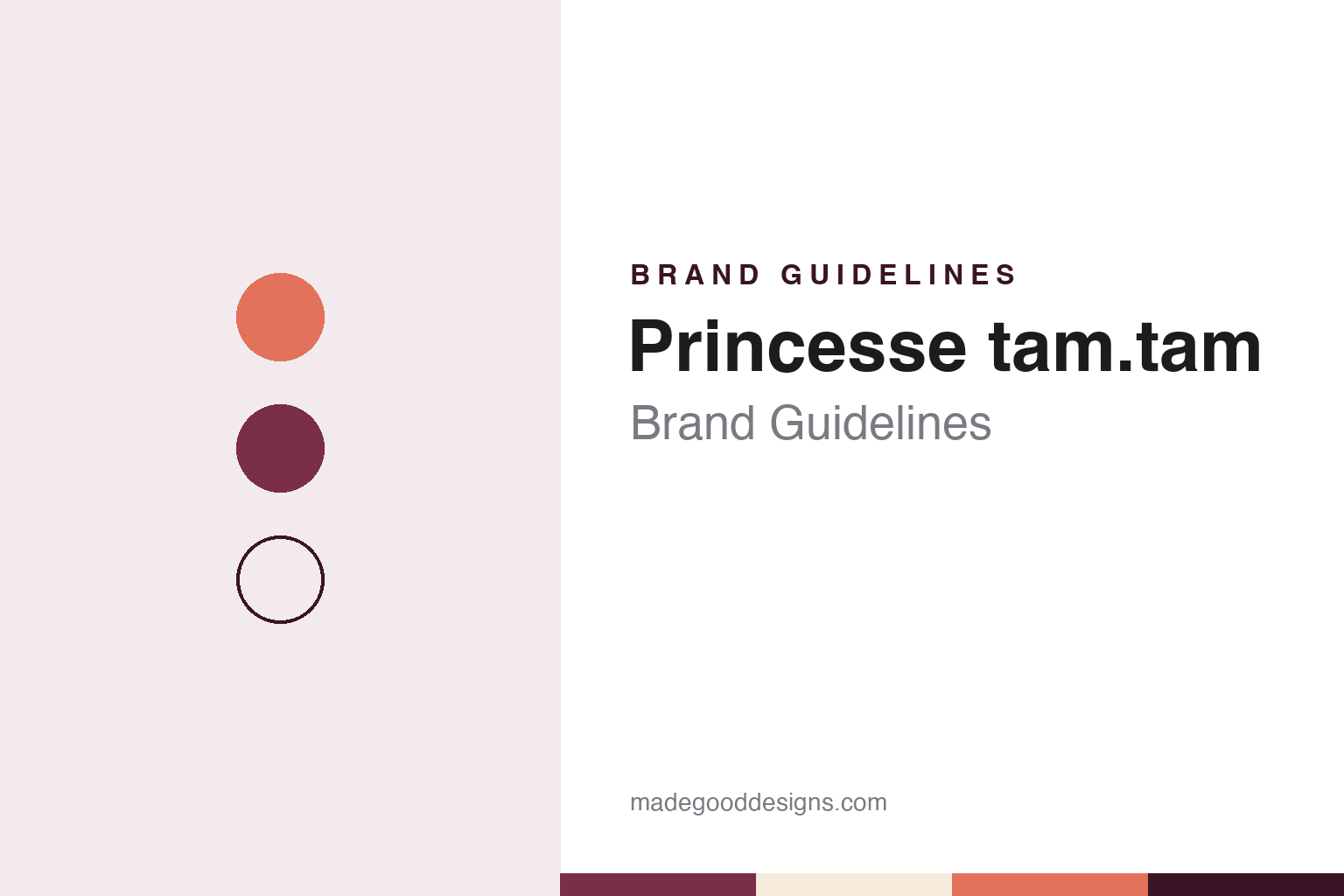
Princesse tam.tam Brand Guidelines
The Paris lingerie label started by two sisters in 1985.
Aa
Two constants: a plum, coral and cream palette and a soft literary serif register. Abstract homage — not a Princesse tam.tam product or mark; no garment, print, logo or label is reproduced.
Rue Bréa, 1985
Two sisters and a gift shop in Paris.
Princesse tam.tam is a French lingerie, homewear and swimwear brand based in Paris. French Wikipedia dates its start to April 1985, when the sisters Loumia and Shama Hiridjee opened a gift shop on the rue Bréa, in the city’s 6th arrondissement; the company behind it had been registered two years earlier, in 1983, the same article says. English Wikipedia, citing a profile published by the French foreign ministry, says the name was taken from Princesse Tam Tam, a 1935 film starring Joséphine Baker. The company writes its own name with a capital P, a full stop and a lower-case “tam.tam”, and that spelling is used throughout this guide.
The gift shop soon turned into a clothing label. French Wikipedia’s timeline gives a first Princesse tam.tam lingerie collection in 1987, a first homewear collection in 1991 and a first swimwear collection in 1993. Those three lines — lingerie, clothes for the home and swimwear — are still the three the encyclopedia lists as the company’s products. In 1996 the two founders also published a book on starting a business, Je monte ma boîte, with the Paris publisher First, according to the article’s bibliography.
The company grew by taking on licences as well as by selling its own collections. French Wikipedia says it took over the lingerie licence for the French label Lulu Castagnette in 1996, and the lingerie licences for Kookaï and Daniel Hechter in 2003. The same article, citing figures dated August 2017, gives 157 company-owned shops in France, five in Germany, five in Belgium, one in Italy and one in Monaco, plus more than 1,500 other points of sale around the world.
The business sat inside a holding company, Petit Véhicule. French Wikipedia, citing L’Expansion in 2005, says 95% of that holding was bought on 1 December 2005 by the Japanese clothing group Fast Retailing, the owner of Uniqlo. Fast Retailing’s own corporate history records that Petit Vehicule S.A.S., “the developer of the Princesse Tam.Tam brand,” became a subsidiary in February 2006. The two sources give different dates for the same takeover, and both are given here.
Colour
Prints, colour and campaigns.
Fast Retailing’s own description of the brand, on a group page last updated in October 2026, rests on two ideas: “original prints” and the line “lingerie that lets your personality shine through.” Those are company words. The page calls the result a sense of French beauty that is “refined, elegant, and also playfully innocent,” and it presents Princesse tam.tam as “a French brand that celebrates individuality.” For a designer, the useful point is that the owner describes the brand through pattern, colour and tone of voice rather than through a crest or a monogram.
Advertising has been part of that identity for a long time. French Wikipedia, citing the French marketing weekly Stratégies in 2005, says the brand worked with the photographer Jean-Baptiste Mondino between 2003 and 2005. The same source says the campaigns marked a change of image that had begun in 2001, and that in 2005 the campaign moved to a quieter, gentler tone, answering what Stratégies called a need for softness and calm at the time.
Where the pieces are made is described only in general terms. French Wikipedia says Princesse tam.tam designs its models in France and has most of them made by subcontractors, naming Morocco, Tunisia, Portugal for nightwear, the Indian Ocean — notably Madagascar and Mauritius — for corsetry, and Asia. Fast Retailing describes the line of business of its French subsidiary as “the design, manufacture and retail” of its two French brands.
The brand has also been sold well beyond its own shops. French Wikipedia lists four channels: shops under its own name, multi-brand retailers, international department stores such as Galeries Lafayette, Printemps, Selfridges and Saks Fifth Avenue, and mail order.
Typography
Lingerie chains and their shop fronts.
Lingerie and underwear chains in Europe and North America present themselves first through their shops. A short name on the fascia, often set in a simple serif or sans, is repeated on bags, boxes, tissue and labels, so the sign on the street and the parcel on the doorstep carry the same mark. Many chains keep their colour schemes to a few soft or dark tones, and when they renew a shop concept they publish the change in terms of lighting, furniture and a new range of colours.
The formats vary widely. Some chains trade from small boutiques in shopping centres and on high streets; others run larger stores built around fitting rooms and a fitting service, and some began as catalogue or online retailers before opening shops of their own, or never opened any. Shop-in-shop areas inside department stores and fashion retailers carry a brand’s fixtures and signs into someone else’s floor, and franchise partners take the same format to markets the owner does not run directly.
Ownership is just as mixed. Some chains are still run by their founders or founding families, some belong to listed retail groups that operate several chains side by side, and others have passed through private-equity owners, administrations and rescue deals. The companies usually describe these changes on corporate pages about their history, founders and owners, while trade and business press record the dates.
Collections are presented by name rather than by number: named lines that return season after season, sleepwear and loungewear ranges, swimwear, sub-brands aimed at younger customers, and services such as loyalty clubs and online shops. For a designer, these chains show how a consistent name, a narrow palette and a recognisable shop format can hold a brand together across many countries and channels.
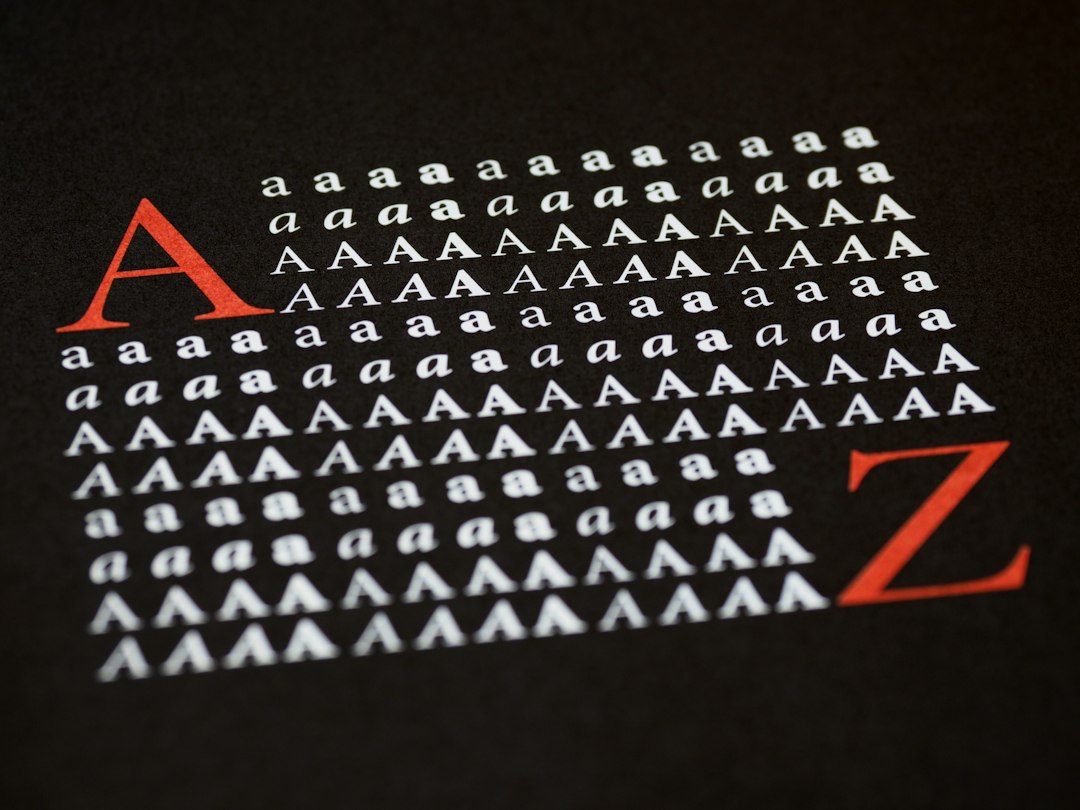
Aa
A soft literary serif for a lower-case, punctuated name. (Specimen set in Fraunces, a serif STAND-IN; NOT the Princesse tam.tam logo.)
Fast Retailing France
Restructuring, reorganisation and a smaller network.
Under Fast Retailing, Princesse tam.tam has been run alongside Comptoir des Cotonniers, a Paris women’s clothing label, by the subsidiary Fast Retailing France. Both brands have been cut back in recent years. French Wikipedia, citing Le Figaro and 20 Minutes, records a plan in March 2021 to close seven Princesse tam.tam shops and all of its department-store points of sale and to put more weight on online selling. In June 2023, according to AFP as reported by FashionUnited, the group set out a French redundancy plan, a plan de sauvegarde de l’emploi, that aimed to close 27 of Princesse tam.tam’s 69 shops in France and to remove 84 of its 235 permanent posts.
At the end of June 2025 Fast Retailing France asked the Paris economic activities court, the former commercial court, to place the two brands in redressement judiciaire, a French court-supervised reorganisation. The court agreed on 1 July 2025, FashionUnited reported the next day, citing AFP.
In August 2025 FashionUnited, again citing AFP, reported that five takeover offers published by the court registry on 4 and 5 August covered only individual shops: the tender concerned 26 stores, singly or in lots, to be run under other names, and did not include the Princesse tam.tam or Comptoir des Cotonniers brands. One offer came from the Antonelle group, owner of Kookaï and Un Jour Ailleurs, for six shops.
The brand itself is still in Fast Retailing’s hands. The group page updated on 8 October 2026 lists Fast Retailing France, in Paris, as a fully consolidated subsidiary handling Comptoir des Cotonniers and Princesse tam.tam, with 77 stores between the two brands, franchise shops included, as of 31 August 2026.
For a design guide, Princesse tam.tam shows how a lingerie label can carry its identity through print, colour and a punctuated, lower-case name. Compare Etam, another French lingerie chain, and Darjeeling, also French. For this guide we use plum, a soft coral and warm cream with a serif, an unofficial interpretation; no product or logo is reproduced.
Explore & save
Keep Princesse tam.tam’s identity on hand — save it to a board in the Made Good inspiration library.
Princesse tam.tam identity set
Pin the Princesse tam.tam plum, coral and cream palette and the soft literary serif register to your own board.
Source & notes
Frequently Asked Questions
What font can I use to match the Princesse tam.tam look?
This guide describes Princesse tam.tam’s type as “A soft literary serif for a lower-case, punctuated name”. Its type specimen is set in Fraunces from Google Fonts as a stand-in; Fraunces is not Princesse tam.tam’s own lettering.
What colours are in the Princesse tam.tam palette?
This guide’s Princesse tam.tam palette is Plum #7A2E4A, Deep aubergine #3A1424, Soft coral #E2725B, Warm cream #F6EBDD and Paper #FBF8F4. The tones are the guide’s own unofficial interpretation, not official Princesse tam.tam hex codes.
When was Princesse tam.tam founded?
Princesse tam.tam was founded in 1985, in Paris, France. Princesse tam.tam is known for Lingerie, homewear, swimwear.
Who founded Princesse tam.tam?
Princesse tam.tam was founded by Loumia and Shama Hiridjee in 1985.