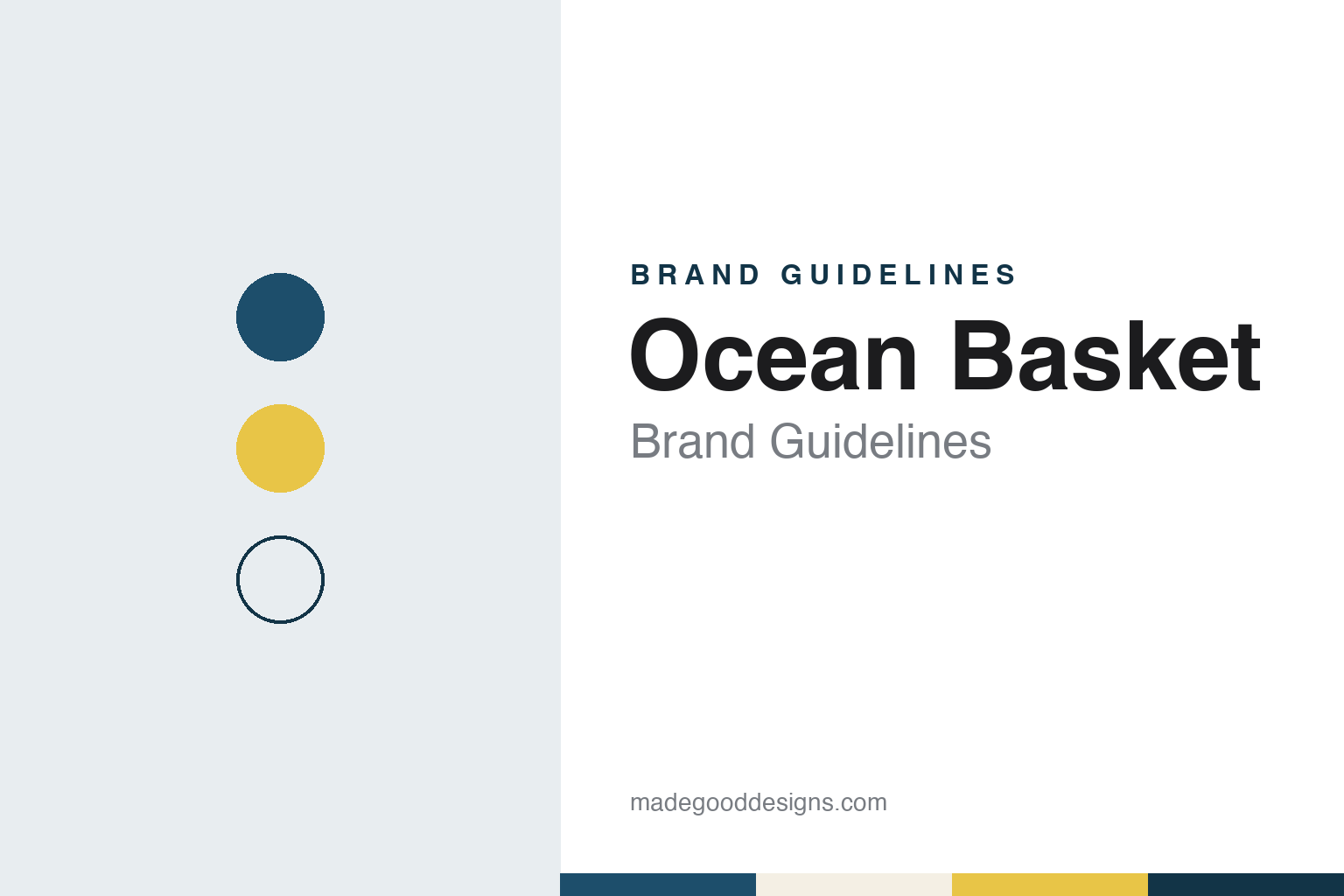
Ocean Basket Brand Guidelines
A six-table Pretoria fish restaurant that became a franchise across Africa, Europe and the Gulf.
Aa
Two constants: an Ocean Basket harbour blue and lemon yellow palette and a warm Mediterranean serif register. Abstract homage — not an Ocean Basket product or mark; no logo, menu or signage is reproduced.
Six tables in Menlyn
Two brothers, a mall unit and a fish pan.
Ocean Basket began in 1995 in Menlyn Park, the shopping centre in Pretoria. Business Day reported in May 2016 that the chain was founded by Peter “Fats” Lazarides, the son of Greek immigrant parents, and that he and his brother George opened the first restaurant together. It had six tables, the only dishes were seafood served in a pan, and customers were encouraged to bring their own wine, salads and desserts. English Wikipedia gives the same founding year and names both brothers as founders.
That bring-your-own habit came from the lease. Moneyweb reported in July 2016 that the first restaurant covered about 60 square metres and served basic dishes such as hake, calamari, kingklip and prawns, and that the landlord, protecting other food outlets in the mall, barred desserts and salads, allowed only a narrow choice of wine and soft drinks, and limited trading hours. Customers filled the gaps themselves, and the format stuck.
The founding circle is described a little more widely in other dated reports. A Bizcommunity article of July 2008 named George and Fats Lazarides, Pedro de Sambento and George Nichas as the people behind Ocean Basket, and Daily Maverick in January 2025 called De Sambento a co-founder of the restaurant group. According to Daily Maverick, De Sambento opened the chain’s Kloof Street branch in Cape Town in 1997, its first in the city and its first standalone store, in a heritage building with a courtyard; the upstairs office became the national marketing office. The menu was tested there, with new dishes chalked on a blackboard before being rolled out, which the company told the paper is how its combos and platters began. That original branch later closed, and a smaller Kloof Street Ocean Basket opened a few metres up the road in early 2025.
The company tells the story on its own site as “a family tale”, crediting the brothers’ mother as the inspiration for its Mediterranean style of generous sharing, and describing the aim of making seafood affordable at a time when it was largely a luxury.
Colour
Franchising from Pretoria to Paphos, Dubai and Almaty.
Ocean Basket grew as a franchise. Moneyweb reported in 2016 that all of its restaurants were franchised and that the business earned royalty and marketing fees; Business Day added in July 2017 that the only exception was Cyprus, where nine restaurants were company-owned. English Wikipedia names the franchisor as Ocean Basket Franchise Company (Pty) Ltd, and Business Day described the group in 2017 as privately held.
Not every early move lasted. Moneyweb reported that management decided to leave Zimbabwe in 1998 for profitability reasons, three years after the first opening. The next push abroad came a decade later. In July 2008 Bizcommunity reported the opening in Paphos, Cyprus, the chain’s first in Europe, run with a partner who already owned Western Cape branches, and said Ocean Basket had signed a master licence for Dubai; at that point the chain had 117 restaurants in sub-Saharan Africa and the Middle East.
The Gulf followed through licence partners. In February 2017 Bizcommunity reported that Ocean Basket had completed a licensing agreement with the Kuwait-based Al-Ghunaim Trading Company, joining existing markets including Dubai, Saudi Arabia, Egypt, Malta, Kazakhstan and Cyprus. Five months later Business Day reported that the chain’s first restaurant in the region had been at Dubai International airport, that it had opened eight restaurants in Saudi Arabia in under four years and three in Kazakhstan in 19 months, and that it had one restaurant each in Qatar and Malta. The same report gave 173 restaurants in South Africa and 41 outside the country.
Leadership passed beyond the founders. Business Day reported that Grace Harding took over as chief executive in 2012 after consulting for the company, and Moneyweb wrote in 2016 that the Lazarides family and Harding were steering the international business together. English Wikipedia gives 205 outlets in 18 countries in 2018 and more than 200 across 16 countries in 2026, about 125 of them in South Africa. The company’s own site lists country pages for South Africa, Mauritius, Nigeria, Zimbabwe, Namibia, Botswana, Kenya, Kazakhstan, Cyprus, the United Kingdom, Georgia, Saudi Arabia, Dubai, Qatar and Kuwait, and says it serves around 18 million guests a year.
Typography
Shopfronts, menus and franchise networks.
Africa’s restaurant and café chains present themselves through a small set of public surfaces: the shopfront and its signage, the menu with its named dishes, the delivery and loyalty apps, and the corporate pages that explain who founded a brand and who owns it now. Several of the groups in this guide run their brands as franchise networks, and their corporate sites set out franchise terms, country lists and brand line-ups beside the menus.
Ownership is often grouped. English Wikipedia describes Famous Brands, formerly the Steers Group, as a South African company founded in 1960, based in Midrand and listed in Johannesburg, which runs its restaurant brands on a franchise model. Spur Corporation traces its start to the Golden Spur, opened in Newlands, Cape Town, in 1967, and its chains include Spur Steak Ranches and RocoMamas, according to the same encyclopaedia.
Further north the pattern repeats. Simbisa Brands says it opened its first Chicken Inn in 1987 and now trades in nine African countries, running its own brands such as Chicken Inn and Pizza Inn beside franchised names. English Wikipedia describes Chicken Republic, founded in 2004, as the flagship of the Lagos-based Food Concepts, with restaurants in Nigeria and Ghana. In Kenya, café chains such as Java House and Artcaffé have passed through private equity owners, each change reported in the business press.
This guide sets out what can be checked about each brand: when and where it began, who has owned it, how many outlets a dated source counts, and how its menus, shopfronts and own websites describe it. Counts and ownership are given with their dates, and anything that rests only on a company’s own word is marked as such.
Aa
A warm serif for a Mediterranean seafood register. (Specimen set in Fraunces, a serif STAND-IN; NOT the Ocean Basket logo.)
The 2016 refresh
A new logo, phased in over five years.
The identity in use today traces to a refresh announced in May 2016. Business Day reported then that the whole corporate identity, from the logo to the decor and menu, would be redrawn, and that the look had not been updated for about ten years. Because the restaurants are owned by individual franchisees, the change was staggered: a few high-traffic city outlets were to switch straight away, while most would adopt the new identity during their routine five-yearly refurbishments up to 2021. Harding told the paper the change would apply to restaurants in every country.
Moneyweb reported two months later that the face-lift had started at new-look restaurants at Dainfern Square in Johannesburg and at the Mall of Africa near Midrand, and that the previous big makeover had been in 2006. The advertising agency House of Brave told Business Day that the new logo kept “perceptual bridges” to the old one so that customers would follow the transition, and that most of the advertising weight would go on outdoor and billboard media rather than television. The menu changed alongside the look, with a “Mediterrasian” sushi range, Japanese sushi with a Mediterranean twist, according to Moneyweb.
The verbal identity leans on the same Mediterranean idea. The company’s site describes itself as the “Mediterranean Home of Seafood” and speaks of generous portions with a creamy lemon sauce, big-hearted hospitality and “a little Mediterranean madness”. Those are the company’s own words; the colours and typefaces of the 2016 logo are not documented in the press coverage.
For a design guide, Ocean Basket shows how a franchise chain can roll a new identity through privately owned restaurants without a single switch-over date, carrying a family story and a serving dish into many markets. Compare it with the Nando’s and Spur guides, two other South African restaurant groups that went abroad. For this guide we use harbour blue, deep ink blue and lemon yellow on whitewash with a warm serif, an unofficial interpretation; no product or logo is reproduced.
Explore & save
Keep Ocean Basket’s identity on hand — save it to a board in the Made Good inspiration library.
Ocean Basket identity set
Pin the Ocean Basket harbour blue and lemon yellow palette and the warm Mediterranean serif register to your own board.
Source & notes
Frequently Asked Questions
What font can I use to match the Ocean Basket look?
This guide describes Ocean Basket’s type as “A warm serif for a Mediterranean seafood register”. Its type specimen is set in Fraunces from Google Fonts as a stand-in; Fraunces is not Ocean Basket’s own lettering.
What colours are in the Ocean Basket palette?
This guide’s Ocean Basket palette is Harbour blue #1D4E6B, Deep ink blue #123447, Lemon sauce yellow #E8C547, Whitewash #F4EFE4 and Pan black #22201D. The tones are the guide’s own unofficial interpretation, not official Ocean Basket hex codes.
When was Ocean Basket founded?
Ocean Basket was founded in 1995, in Menlyn Park, Pretoria, South Africa.
Who founded Ocean Basket?
Ocean Basket was founded by Peter and George Lazarides in 1995.


