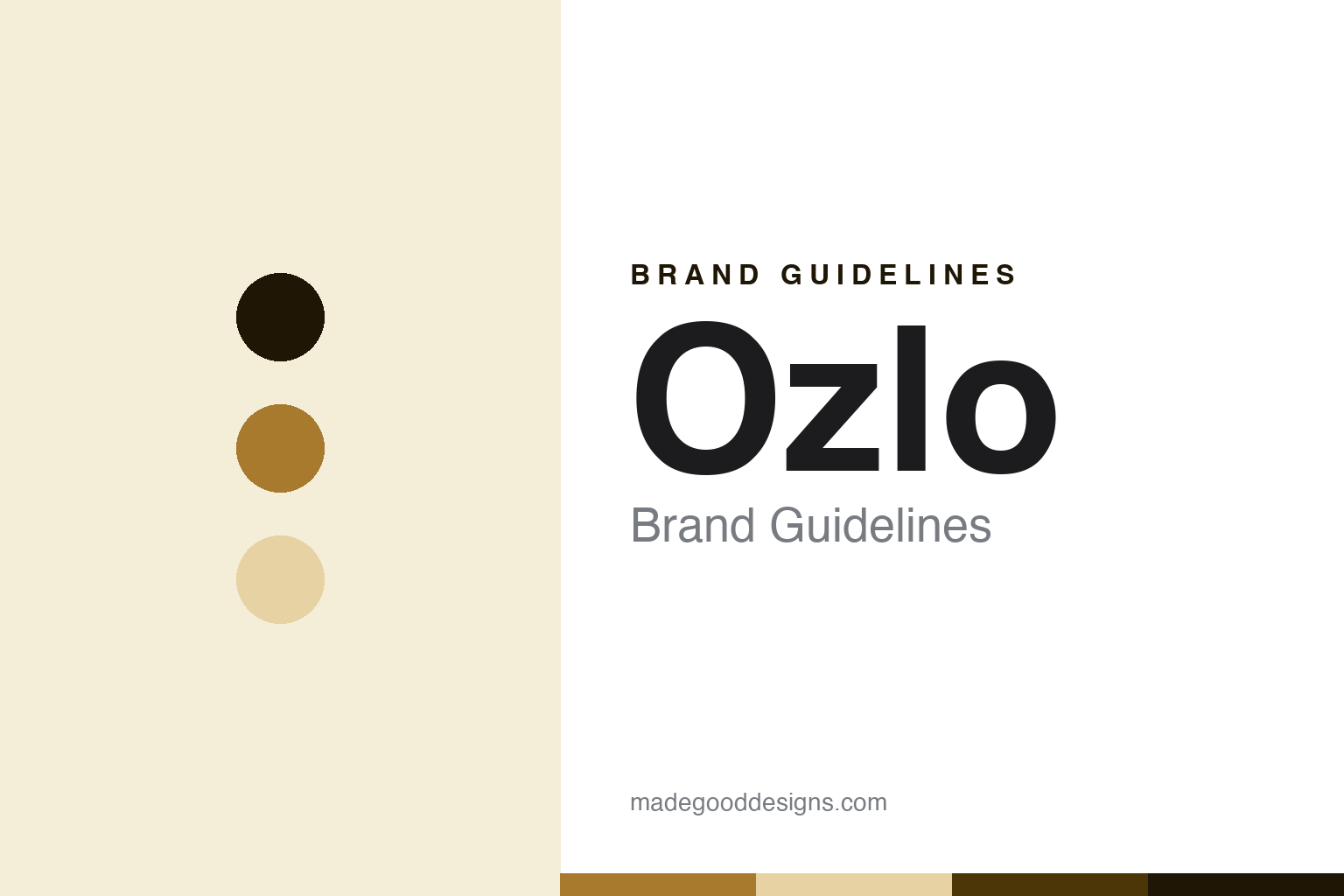
Ozlo Brand Guidelines
The sleepbuds, revived.
Aa
Two constants: an audio-amber palette and an audio-sans register. Abstract homage — not an Ozlo or Bose product or mark; no earbud, case or logo is reproduced.
The sleepbuds, revived
Ozlo is the sleep-earbud brand founded by former Bose engineers who acquired and licensed the discontinued Bose Sleepbuds technology and brought it back.
Ozlo follows Hatch as the round’s revival node — a small American company founded by engineers who had built Bose’s sleep earbuds, and who, when Bose left the category, acquired and licensed the technology to bring it back under a new name. Its answer to a round about who owns the machinery of sleep and where it is made is an unusual one: a start-up carrying forward a discontinued product’s IP, run by the very people who first made it.
Its identity is the sleepbuds, revived. The ex-Bose lineage, the licensed sleep technology and the second life of the sleepbud are the story here. The buds that came back. The sleepbuds, revived.
(Honest notes, so the Bose connection is framed precisely. Ozlo sells sleep earbuds as its heroes — tiny in-ear buds engineered for sleep, with noise masking, relaxation audio, onboard sensors and a silent alarm, using a comfortable ear-tip design carried over from the earlier product, with the latest being the Sleepbuds 2, unveiled in July 2026; we report its language as the brand’s own. On origin: Ozlo is a US company in the Boston area, founded in 2022 by three former Bose engineers who worked on Bose’s Sleepbuds, led by its chief executive N.B. Patil. On the Bose connection, precisely: when Bose exited the sleepbud category around 2023, the founders acquired and licensed the Sleepbuds research and IP from Bose for an undisclosed sum, so we describe it as an acquisition and licence of the technology, not a simple purchase, and Ozlo’s first product is a continuation of that discontinued line. On funding and launch: Ozlo is private and venture-backed, reported to have raised on the order of ten million dollars, and ran a Kickstarter to fund development before a retail launch in late 2024, with a next generation in 2026. On positioning: Ozlo describes itself as building a sleep-data platform, which we note with a neutral privacy flag. On a further application: reported work on tinnitus is not a cleared medical claim, so we hedge it. On where it is made: manufacturing is undisclosed. Its designs and the Ozlo name are IP we describe but do not reproduce, and Bose is a third-party mark we do not reproduce; there is no official brand hex; these tones are an unofficial interpretation.)
Colour
Ozlo lives in an audio amber. Click a swatch to copy the hex.
Ozlo’s identity is engineered, revived and focused — an audio amber, an ink, a pale amber, a deep amber, and a paper. The palette leans audio amber and pale amber: a warm, considered register that nods to a single-minded, engineering-led product rather than a loud logo colour. It signals the sleepbuds, revived — engineered, revived and focused. The honest caveat: with no official brand hex, these values are a warm, unofficial interpretation, not first-party colours.
The lesson is a warm amber signals an engineered, focused identity. Ozlo’s world is one product done well: the sleep earbud, brought back. For designers, it is a reminder that a warm amber and a soft pale can carry a focused, engineering-led brand — a considered tone held as an accent, not a product shot. Because a mid hue can fail as small text, keep type dark and let the colour live in the accents, palette and band. The takeaways: credit Ozlo for reviving the sleepbud; describe the Bose connection precisely as an acquisition and licence; attribute the ex-Bose founders and the Kickstarter-to-retail path; note the sleep-data positioning with a privacy flag; and hedge the tinnitus work as not a cleared claim.
Typography
The register is an audio sans — engineered, revived, focused.
Ozlo’s identity carries an engineered, revived, focused spirit — a single-product company built by the people who first made the product, not a broad brand. An audio sans captures the mood: precise, even and purposeful, the register of a focused engineering effort. Set in an audio-amber palette, the audio sans feels engineered and focused — exactly the personality Ozlo carries. It behaves like a made, precise thing rather than a loud logo, mirroring a sound-wave and a rest-band. (Ozlo’s real products and the name are things we describe but do not reproduce, and the exact typeface is not ours to use.) Because it is not ours to use, the honest description is “an audio-sans brand,” shown here in a stand-in. The type behaves like the brand: engineered, revived and focused.
Aa
An audio-sans brand — engineered and focused. (Specimen set in Archivo, an audio-sans STAND-IN; NOT the Ozlo or Bose logo or products.)
The sleep node
Ozlo stands for the sleepbuds, revived.
Ozlo sits fifth in the round as its revival node. An audio-amber palette, an audio sans and an ex-Bose lineage make one thing — the sleepbuds, revived — the whole identity: engineered, revived and focused. The licensed technology is the pitch, the founders’ history is the frame, and the second life of the sleepbud is the story. The point is a discontinued product brought back by the people who built it, in a round about who owns the machinery of sleep and where it is made.
Put to work, the identity is the brand told straight, the Bose connection precise and the applications hedged. A brand in this spirit would credit Ozlo for reviving the sleepbud, describe the Bose connection as an acquisition and licence, attribute the ex-Bose founders and the Kickstarter-to-retail path, and hedge the tinnitus work. A reader in this spirit would keep the facts right: Ozlo sells sleep earbuds with noise masking, relaxation audio, sensors and a silent alarm, latest the Sleepbuds 2 from July 2026; it is a Boston-area company founded in 2022 by three former Bose Sleepbuds engineers, led by N.B. Patil; when Bose exited the category around 2023, the founders acquired and licensed the Sleepbuds IP for an undisclosed sum, making the first Ozlo a continuation of that line; it is private and venture-backed, reported near ten million dollars raised, and went from a Kickstarter to a late-2024 retail launch; it describes itself as a sleep-data platform, a neutral privacy flag; and reported tinnitus work is not a cleared medical claim. Ozlo sits after Hatch and before Elemind. The honest editorial moves are to credit the revival, to describe the Bose link precisely, to attribute the founders and the path, and to hedge the applications.
For designers and brand-builders, Ozlo carries the sleep node: describe an inherited technology precisely — acquired and licensed, by the people who built it. The lessons: a discontinued product can get a second life, here the sleepbud; a technology connection to a former employer, Bose, is described exactly as an acquisition and licence of the IP rather than a vague link or a simple purchase; the credibility, founders who built the original, is credited; a development path from Kickstarter to retail is attributed; and a further application, tinnitus, is hedged as not a cleared claim. It is also a reminder to stay precise: Ozlo is the sleep-earbud brand that acquired and licensed the discontinued Bose Sleepbuds and brought them back — with the palette here an unofficial interpretation, and Bose a third-party mark we only describe. The hook is that continuity: the Bose Sleepbuds did not simply die when Bose left the category — three of the engineers who built them acquired the technology and revived it under a new name. Read that way, Ozlo is less a new gadget than the sleepbuds, revived: engineered, revived, focused. The lesson for a brand is that describing the inherited technology precisely and crediting the founders reinforce each other, and hedging the applications keeps the story earned. Ozlo made the-sleepbuds-revived the identity — proof that a precise account of a revival can anchor a node.
Explore & save
Keep Ozlo’s identity on hand — save it to a board in the Made Good inspiration library.
Ozlo identity set
Pin the audio-amber palette and the audio-sans register to your own board.