Pancho Fierro painted Lima’s people one at a time. A water carrier on a donkey, a veiled woman in a long skirt, a tortilla vendor with a tray on his head: each sits alone on the page, drawn in ink or pencil and filled with thin washes of colour. There is little background, no frame and often no ground beyond a pale shadow under the feet. For a designer, that is a ready-made system of character cards.
The Met holds a large group of these sheets, and this guide uses five of them, all flagged public domain in the museum’s collection data. The sections below cover what to look at, a short and carefully dated career outline, how the watercolours were made, and how to borrow the approach for illustration, packaging and interface work today.
Who was Pancho Fierro?
Francisco Fierro, known as Pancho Fierro, was born and worked in Lima and died there on 28 July 1879, according to Britannica. His birth year is not settled. The Met gives 1807, Britannica gives 1810, and Encyclopedia.com lists him as Francisco Fierro Rimac, 1803–1879. Because of that spread, this guide uses the Met’s dates for the life span and treats the birth year as approximate.
Britannica describes him as a self-taught artist. It lists maps, illustrations for theatre leaflets and murals, some in wealthy homes, among his early work, and it says his watercolours are marked by satire and humour as they record the types, customs and costumes of Lima’s residents. The Met’s collection data labels him “African Peruvian”, and the Museo de Arte de Lima, in its catalogue entry for one of his watercolours, calls him the most important artist of Peruvian costumbrismo. Costumbrismo is the artistic habit of recording local types and manners.
A good deal of his work went to travellers. Britannica says that many of his watercolours were collected by Archibald Smith for the 1853 book Lima Costumes, which is one way images like these reached readers outside Peru. For related European precedents, see our guide to fashion plates, which grew from the same appetite for dress catalogued page by page.
The Met’s Peruvian dress drawings
The Met holds a bequest from Mary Martin, received in 1938, of watercolours that it catalogues as “a group of drawings depicting Peruvian dress”, dated 1848 or ca. 1848. The sheets are small, about 23 × 20.5 cm (roughly 9 × 8 inches). Titles in the Met’s catalogue read like a casting list: a monk of the Barbones order, a baker on horseback, a woman confessing to a priest, a butcher riding a donkey, women wearing the saya, an elegantly dressed woman and her page.
What to look at in a Pancho Fierro watercolour
- The silhouette. Every figure reads in outline first. The llama and its driver, the donkey with its panniers, and the tray balanced on a head all have clear shapes that survive at thumbnail size.
- Bare paper as the background. The sheets keep the paper tone. Measured from the museum’s scan of one sheet, the paper reads around #dccab7, a warm cream that gives every figure the same quiet ground.
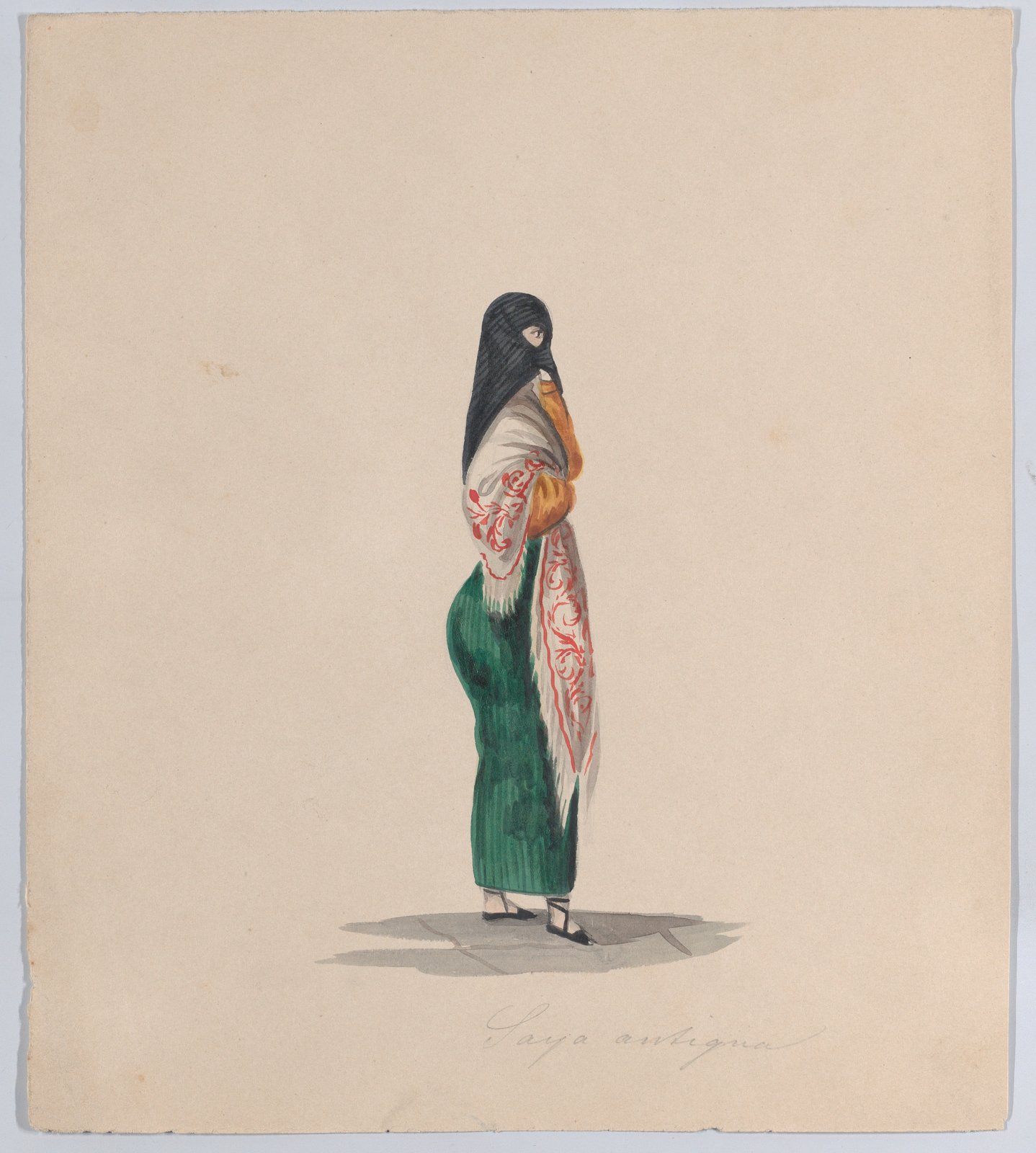
- Flat, local colour. Jackets, skirts and shawls are filled in nearly even washes. In the scan of the standing woman in the saya, the skirt measures around #314c45, a deep green, set against a pale pink and white shawl.
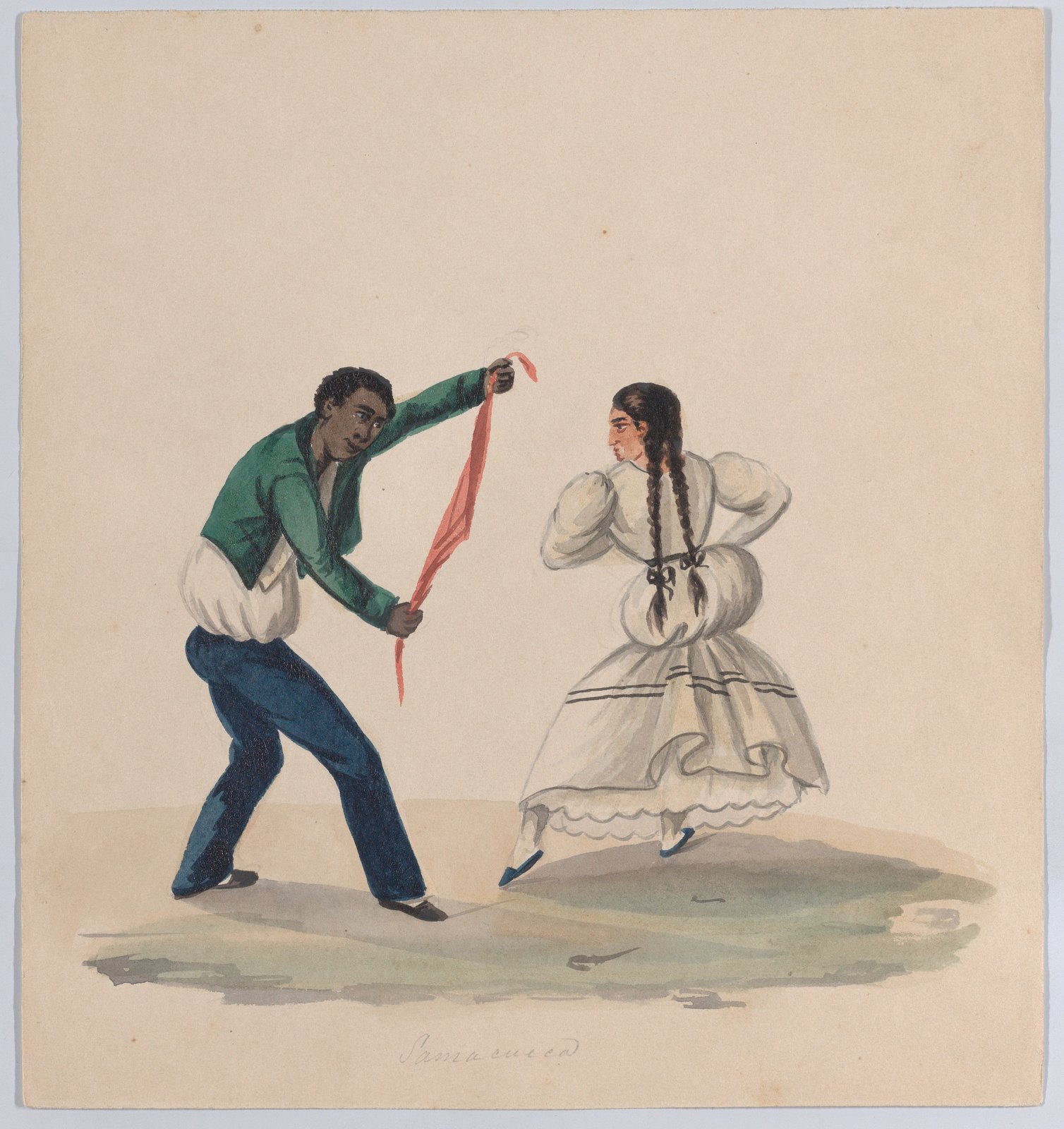
- A small, dark accent. A navy trouser or a black manto gives the figure its anchor. In the dance sheet, a navy tone around #2e3844 sits beside the white dress and the red cloth.
- The shadow. A single grey wash under the feet is enough to ground the figure without a landscape.
- Handwritten lettering. Several sheets carry a short pencil inscription at the bottom edge, a quiet caption line that does not compete with the figure.
Key sheets and subjects
- A man and woman dancing the Zamacueca (ca. 1848). Two dancers face each other at a distance, he with a cloth held out, she in a wide white skirt. The pose does the work: two bodies, a gap and a bright cloth between them.
- A tortilla vendor balancing a tray on his head (ca. 1848). The tray makes a wide horizontal over a narrow vertical figure. It is a logo-like silhouette, and a good lesson in balance.
- A woman wearing the saya standing in profile (ca. 1848). A long skirt, a manto pulled over the head and a patterned shawl. The profile pose shows the whole costume in one view.
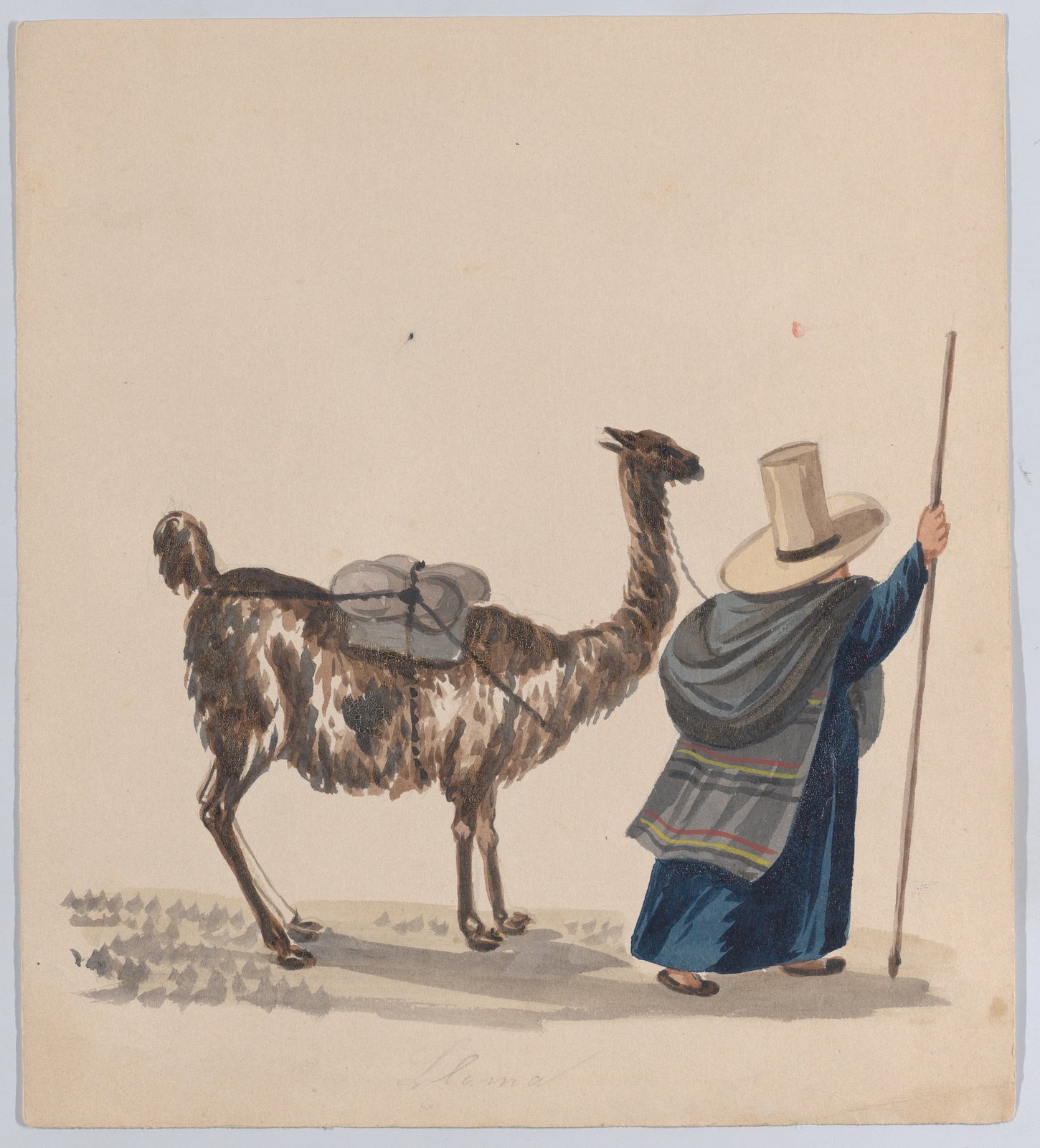
- A woman walking with a Llama (ca. 1848). The animal and the woman fill the sheet from edge to edge, with ground suggested only by short strokes of green.
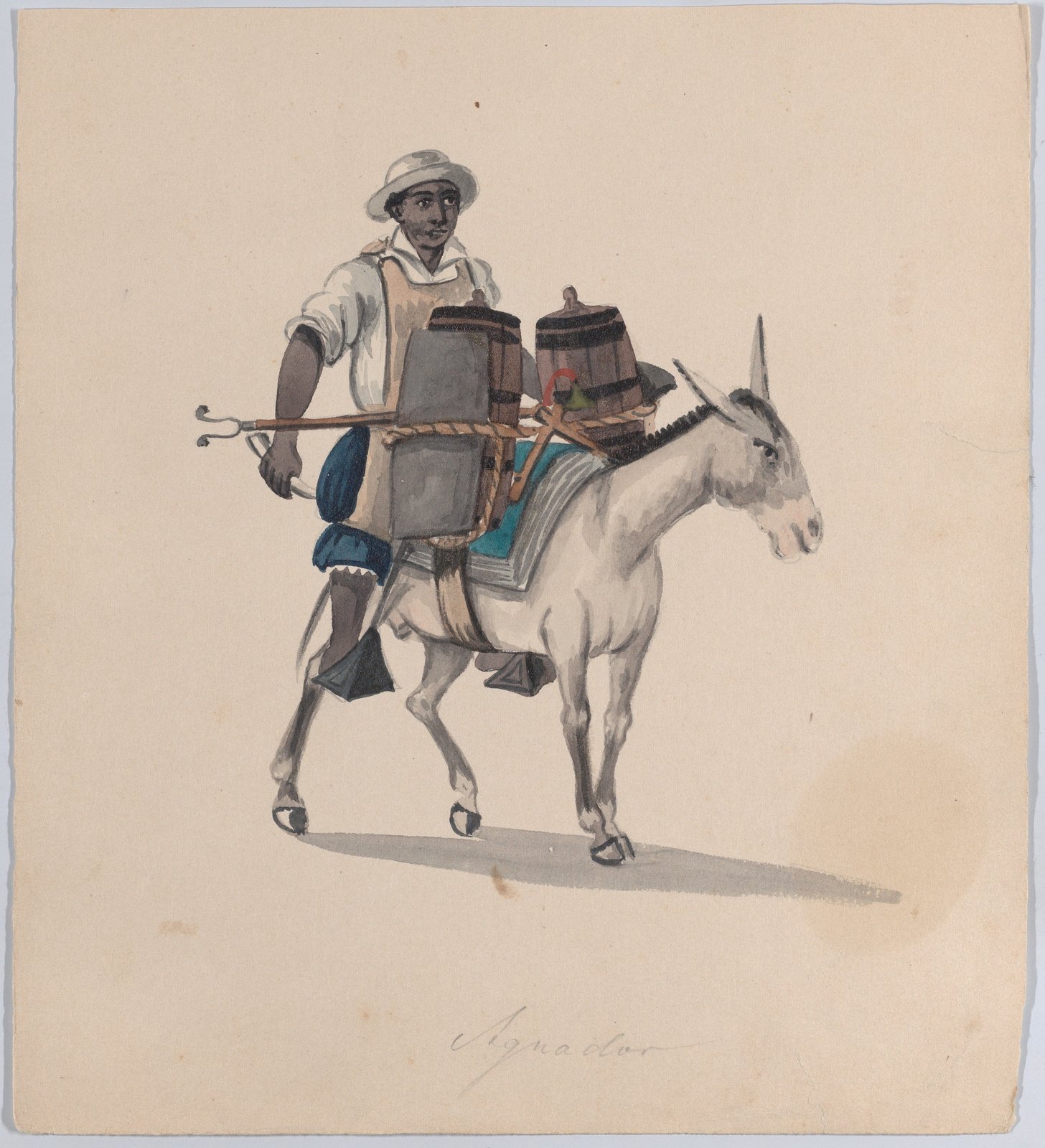
- A watercarrier riding a donkey (ca. 1848). The rider’s load of casks fills the centre of the page, so the silhouette is built from the cargo as much as the person.
The tapada and the saya y manto
A recurring subject in Fierro’s work is the tapada limeña, a Lima woman dressed so that the manto covered her head and most of her face. A Google Arts & Culture feature from the National Library of Peru describes the tapadas as women covered by a shawl or cloak, wearing a broad skirt in late colonial and early republican Lima. The saya was a long, wide skirt, described in one account as silk.
The Museo de Arte de Lima dates its Tapada limeña watercolour to about 1840, and its catalogue note says that although this dress had fallen out of use by the 1840s, Fierro kept reproducing it in his watercolours until his death in 1879. For a designer, that note is a reminder that a set of character types can become a fixed visual vocabulary, repeated because readers recognise it.

Technique: ink, wash and paper
The Met catalogues all of these sheets simply as watercolour. Looking at the scans, the method is easy to read even without a technical report: a light drawing first, then thin washes laid in flat areas, then darker accents in jackets, hair and shadow. The paper shows through in the lights, and in the white dress of the dancer the paper itself is the colour.
That is a practical lesson. Where a design needs white, let the ground be the white instead of painting it. It keeps the palette small and the set looking related.
How designers can borrow Pancho Fierro’s ideas today
- Build a character set, not a single picture. Fix the sheet size, the paper tone, the shadow and the figure scale, then vary only the costume and pose. The set holds together because the rules stay the same.
- Draw the silhouette first. If a figure only reads when it is coloured, the shape is not strong enough. Fierro’s tray, panniers and casks make each profile unmistakable.
- Use bare ground. A cream ground with one grey shadow suits menus, packaging and onboarding screens.
- Keep one dark anchor and a few bright accents. A dark navy or green, one red or pink, and a lot of cream is a workable palette. Pull exact values from a scan with our image colour picker.
- Add a small hand-lettered caption. A pencil-weight line under a character gives it a name without a label box. If you set type instead, choose a light, quiet face and keep it small.
- Treat local dress with respect. The costumbrista tradition could be affectionate, and it could also stereotype. When you borrow the format, show people as individuals with specific roles and clothes.
The same single-figure habit appears in the Mexican print tradition, and our guide to José Guadalupe Posada shows a very different, black-and-white take on popular types. For wider context on regional costume and everyday imagery, see the folk art guide.
Where to see Pancho Fierro’s work
The Metropolitan Museum of Art in New York holds the Mary Martin bequest group discussed here, and the Museo de Arte de Lima holds further watercolours, including its Tapada limeña. The 1853 book Lima Costumes collected many of his types for readers abroad. Browse more public domain images in the MGD museum inspiration collection.
Frequently asked questions
When was Pancho Fierro born?
It depends on the source. The Met gives 1807, Britannica gives 1810, and Encyclopedia.com lists 1803. Sources agree that he died in Lima on 28 July 1879.
What is Pancho Fierro known for?
He is known for watercolours of Lima’s street types, dress and customs, a body of work associated with Peruvian costumbrismo. The Museo de Arte de Lima calls him the most important artist of that tradition.
What is a tapada limeña?
A tapada was a Lima woman who wore the saya, a long wide skirt, with a manto that covered her head and most of her face. Fierro painted the dress repeatedly, and the Museo de Arte de Lima notes that he kept doing so after it had fallen out of use.
Can I use Pancho Fierro’s watercolours in my designs?
The Met flags the sheets shown here as public domain in its collection data, and the museum provides the image files. Check the object page for the current terms before using a specific image, and credit the Met.