RAK Ceramics Brand Guidelines
The Ras Al Khaimah tile maker built on plants, formats and partnerships.
Aa
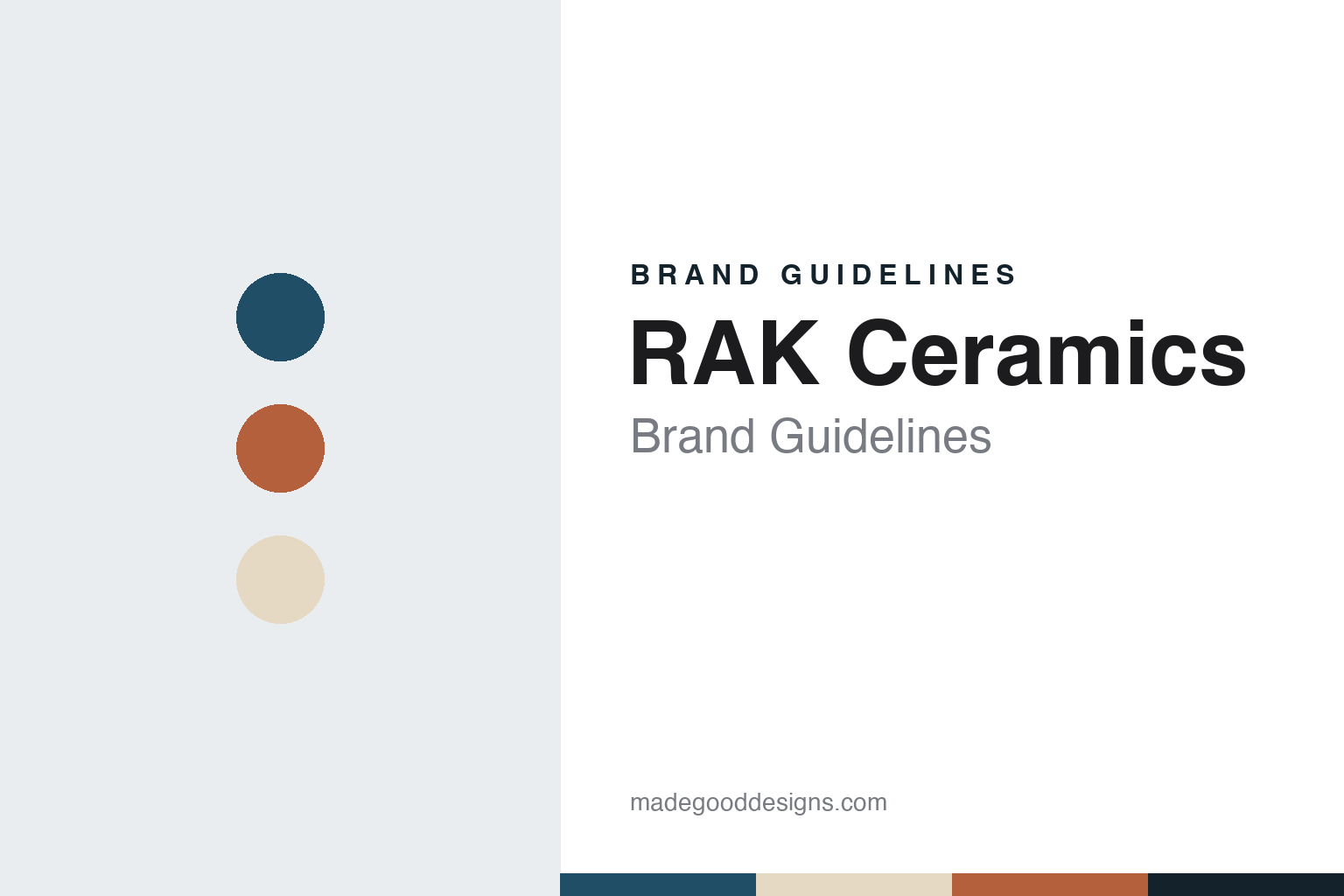
Two constants: a blue, sand and terracotta palette and a clean geometric sans register. Abstract homage — not a RAK Ceramics product or mark; no tile, logo or pattern is reproduced.
Ras Al Khaimah, 1989
A tile maker founded in the northern emirates.
RAK Ceramics was founded in 1989 in Ras Al Khaimah, one of the seven emirates of the United Arab Emirates. The company names its founder as Sheikh Saud Bin Saqr Al Qasimi, whom it describes as Ruler of Ras Al Khaimah and a member of the UAE’s Supreme Council, and English Wikipedia gives the same year and founder. Its first tile plant began operating in 1991, the company says, and its first sanitaryware plant followed in 1993.
Growth came through more plants at home and abroad. The company’s milestones list a tile plant in Bangladesh in 2000; the founding of its tableware business, RAK Porcelain, in 2004; the start of operations in India in 2006, the year its tenth tile plant in the UAE opened; and a faucet joint venture, Kludi RAK, in 2007. The same timeline records a 2010 share listing for RAK Bangladesh, and the company describes itself as listed on the Abu Dhabi Securities Exchange and on the Dhaka Stock Exchange.
Ownership widened in 2014. In June that year Khaleej Times reported that the investment firm Samena Capital, with a group of investors that included two Gulf sovereign wealth funds, had completed the purchase of a 30.6 per cent stake, taking two seats on the board; the company’s own timeline dates Samena’s arrival to 2013 and records its exit in 2021. The company’s investor pages list Falcon Investment LLC as the largest shareholder, with about a fifth of the shares, ahead of Al Rajhi Partners and the Government of Ras Al Khaimah.
The ruling family has stayed close to the board. At the time of the Samena deal the chairman was the Crown Prince, Sheikh Mohammed bin Saud Al Qasimi, who told Khaleej Times the investment opened “a new and exciting chapter” for the company; the paper also reported that RAK Ceramics had changed its rules so that citizens of Gulf Cooperation Council states were treated like UAE shareholders. The company now names Sheikh Saqr Bin Saud Al Qasimi as its chairman.
Colour
Tiles, basins, taps and plates.
RAK Ceramics makes ceramic and gres porcelain wall and floor tiles, sanitaryware, faucets and tableware. On its own figures it runs 24 plants across the UAE, India, Bangladesh and Europe and serves clients in more than 150 countries. It describes itself as one of the largest ceramic brands in the world, and in 2014 Khaleej Times called it one of the world’s biggest makers of floor tiles.
Its milestones read like a catalogue of formats. The company says it introduced RAK Slim, a tile 4.5 millimetres thick, and RAK Luminous, a tile that glows in the dark, in 2004, and launched the Maximus mega slab, a super-sized format, in 2013. It says it had supplied a billion square metres of tiles to projects by 2012. Tile collections on its website carry stone and concrete names such as Baltico, Montpellier Stone and I Sassi Matera, and the bathroom side includes ranges such as RAK-Valet, RAK-Petit and RAK-Des.
Design partnerships are a large part of how the brand presents itself. The company records a partnership with sanitaryware designers in 2019 and, in 2021, a bathroom and surface collection made with a fashion brand. Its “House of Brands” pages present collections with the fashion houses Elie Saab and Roberto Cavalli, which it describes as translating the spirit of haute couture into interiors. It also lists a first design hub in London, opened in 2022.
Faucets became a larger business through Germany. In 2022, the company says, it signed a deal to buy all of KLUDI, the German maker of kitchen and bathroom taps and shower systems; English Wikipedia adds that the deal included the 49 per cent of the Kludi RAK joint venture that RAK Ceramics did not already hold. The company now presents Kludi alongside RAK Ceramics and RAK Porcelain as one of its three brands, and its milestones also record a buyout of minority holders in RAK Porcelain the same year.
Typography
Design and documentation.
Ceramic tile makers sell surfaces that people mostly meet as rooms, so their own material leans heavily on finished spaces. Pamesa’s website, for example, offers downloadable catalogues, moodboards, “by effect” and “by space” product searches and a BIM library for architects, and Porcelanosa’s 2026 showrooms in Vila-real presented its large-format porcelain through furnished settings, Interempresas reported. Room-set photography, in which a collection is laid across a kitchen, a bathroom or a terrace, is a common way to show a range.
Naming follows the surface. Pamesa’s 2026 ranges carry names such as Heritage, Trevi and Taj Mahal, and makers sort them by finish, format and thickness. Trade reports in 2026 described Porcelanosa adding 160 cm by 160 cm floor pieces and 3 mm slabs for furniture cladding, and Pamesa grouping its new ranges into four families, each defined by the kind of material effect it shows.
Trade fairs are the other main stage. Cersaie, held at BolognaFiere in Italy, reached its 43rd edition from 21 to 25 September 2026, according to Castellón Información. Both companies built their 2026 stands as furnished settings: Pamesa called its 2026 space The Gallery, and Porcelanosa printed a magazine to guide visitors around its stand. Pamesa’s website also keeps virtual tours of its stands at Cersaie and at Cevisama from 2017 to 2022, while Porcelanosa stages its own annual show in Vila-real, which reached its 32nd edition in 2026.
Behind the collections sit corporate pages that read quite differently. They list group companies, plants, acquisitions and leadership teams, and they are often the clearest public record of who owns which brand. This guide relies on those pages only for what the companies say about themselves, and on press reports and encyclopedias for dated facts.
Aa
A clean geometric sans for a large-format maker. (Specimen set in Manrope, a sans STAND-IN; NOT the RAK Ceramics logo.)
RAK Ceramics
A 2016 identity and a factory in Saudi Arabia.
The brand’s look is set out mainly by the company itself. Its timeline records the launch of a new global brand identity in 2016. The website speaks in a short creed — “We respect, we inspire, we improve, we deliver” — and shows its tiles in hotels, restaurants, shopping centres and homes rather than as plain samples, alongside a room visualiser and a podcast called Imagine Your Space.
The company is still adding manufacturing. In August 2026 Khaleej Times reported that a new RAK Ceramics factory in Saudi Arabia was expected to start production in the second quarter of 2027, and that demand in the UAE, Saudi Arabia and Bangladesh had grown while Europe and India were weaker. In November 2026 TradeArabia, carried by Zawya, quoted group chief executive Abdallah Massaad on investment in the Saudi facility, retail expansion and higher-value products, alongside work in Europe, India and Bangladesh. The same Khaleej Times report said the group was leaning on locally sourced raw materials and alternative shipping routes, and quoted the chief executive saying it had recently received platinum-level sustainability recognition in the UAE. The company says it employs about 12,000 people of more than 40 nationalities.
For a design guide, RAK Ceramics shows how a manufacturer from Ras Al Khaimah built a brand on scale, new formats and fashion partnerships. Compare Kajaria, an Indian tile maker, and Porcelanosa, a Spanish tile and bathroom group. For this guide we use a deep Gulf blue, desert sand and a fired terracotta with a clean sans, an unofficial interpretation; no product or logo is reproduced.
Explore & save
Keep RAK Ceramics’s identity on hand — save it to a board in the Made Good inspiration library.
RAK Ceramics identity set
Pin the RAK Ceramics blue, sand and terracotta palette and the clean geometric sans register to your own board.