Raymond Duchamp-Villon made sculpture that behaves like engineering. His Horse of 1914 is built from pistons, curves and wedges rather than muscle; his Gallic Cock relief turns a national emblem into a badge of gold planes and red rays; and his façade for the Maison Cubiste applied the same angular thinking to architecture. His work shows designers how to reduce a living subject to a few mechanical forms without losing its energy.
Who was Raymond Duchamp-Villon?
The Metropolitan Museum of Art records him as French, born in Damville in 1876 and died in Cannes in 1918. The Peggy Guggenheim Collection gives his birth name as Pierre-Maurice-Raymond Duchamp, a form the Centre Pompidou also records, and places Damville near Rouen. He was the brother of the painter Jacques Villon and of Marcel Duchamp; the Nasher Sculpture Center explains that he adopted “Duchamp-Villon” as a compromise when he began his career.
He first studied medicine in Paris. The Peggy Guggenheim Collection dates his studies to 1894–98 and says illness forced him to abandon them, after which he committed to sculpture; the Nasher and The Art Story agree that he left in 1898. The Encyclopaedia Universalis traces his early style from an Art Nouveau influence, through a period working in the manner of Rodin, to Cubism.
Puteaux, the Section d’Or and the Maison Cubiste
In 1907 he moved to Puteaux, west of Paris, with Jacques Villon. Both the Guggenheim and The Art Story describe the regular gatherings of artists and critics there; the Nasher names Albert Gleizes, Fernand Léger and Jean Metzinger among the visitors. The Guggenheim adds that from 1907 he served on the sculpture jury of the Salon d’Automne, where he helped promote the Cubists. In October 1912 the brothers organised the Salon de la Section d’Or at the Galerie de la Boétie in Paris, and in 1913 his work went to the Armory Show in New York, according to both the Guggenheim and The Art Story.
The same year, 1912, brought his most direct design project. The Encyclopaedia Universalis describes the Maison Cubiste, made under the direction of the decorator André Mare for the 1912 Salon d’Automne, with Duchamp-Villon responsible for the façade, which added geometric Cubist elements to a bourgeois house. The Centre Pompidou holds a set of 36 graphite studies for the project, all dated 1912. The painter Roger de La Fresnaye also contributed to its interiors. For his brothers, see Jacques Villon and Marcel Duchamp.
Key works and where to find them
- Song, 1908/09. A carving in elm at the Art Institute of Chicago.
- Torso of a Young Man, 1910. A coloured plaster at the Art Institute of Chicago. The Encyclopaedia Universalis calls it his first truly modern work.
- Baudelaire, 1911. A head of the poet, in coloured plaster at the Art Institute of Chicago, with a base of about 1914.
- Maggy, 1912. A portrait head listed by the Nasher, the Encyclopaedia Universalis and The Art Story.
- The Lovers, 1913. A relief, recorded by the Encyclopaedia Universalis and held by Tate in a posthumous cast.
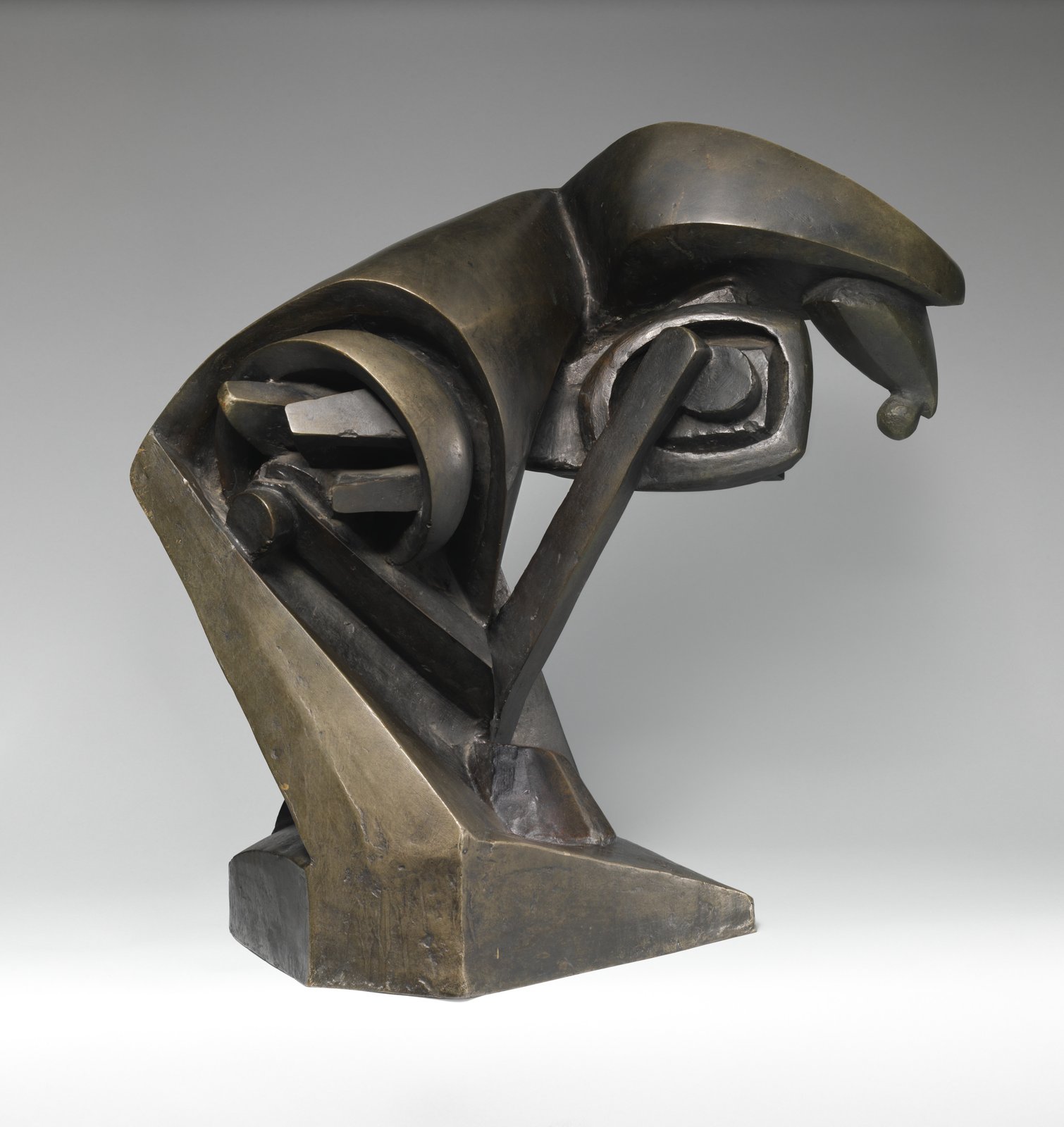
- The Horse, 1914. The Met’s bronze, shown above, is about 43 cm high and was probably cast in 1921. The Encyclopaedia Universalis says the final version was enlarged after his death under his brothers’ direction; Tate holds a Large Horse cast in 1961, and the Art Institute of Chicago a bronze about 99 cm high.
- Gallic Cock, 1916. A relief medallion, discussed below, with the painted plaster at the Phillips Collection and a painted bronze of 1919 at the Cleveland Museum of Art.
- Portrait of Professor Gosset, 1918. A late head recorded by The Art Story; the Art Institute of Chicago holds a 1957 bronze from the 1918 original.
What to look at in Raymond Duchamp-Villon’s work
Animal plus machine. The Guggenheim describes The Horse as a composite image of animal and machine, and the Universalis says the fusion creates dynamism through multiple viewpoints. In the Met’s cast, the horse’s neck becomes a curved hood, the legs become rods and the body a set of coiled plates, as if a piston were about to fire. The Nasher reads it as a hybrid of horse and train.
Compression. The whole figure, about 43 cm high in the Met’s cast, is gathered into a compact block. The energy is held inside the silhouette, so it reads as a spring under tension.
Faceted planes and hard edges. As he took up Cubism, the Universalis notes, his forms became simpler and his structures more geometric. Light catches the flat planes and edges of the bronze, so the sculpture draws itself in highlights.
Colour on sculpture. Several of his plasters are coloured, as the Art Institute of Chicago records for Torso of a Young Man and Baudelaire, and the Gallic Cock was painted. He treated surface colour as part of the design.
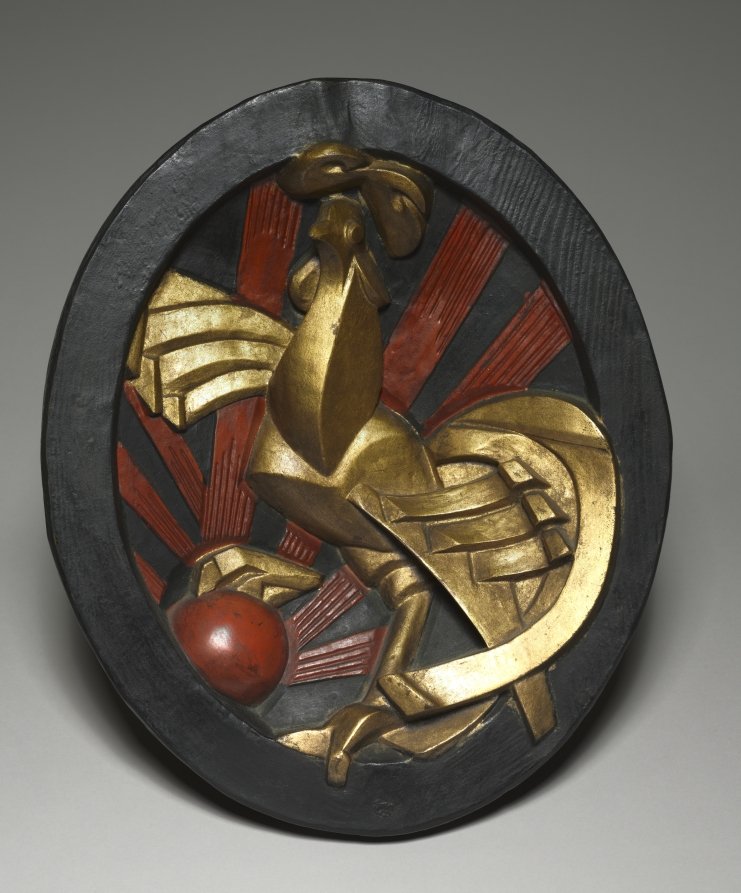
The Gallic Cock: an emblem in relief
The Phillips Collection says that Duchamp-Villon made the relief in 1916 while recovering from illness at Mourmelon, after he had been asked to design a portable theatre for entertaining the troops; the rooster was intended as an architectural medallion for it. The Cleveland Museum of Art similarly says it was meant for the entrance of a temporary theatre near the front. Both museums identify the rooster as a French symbol, shown with a rising sun. The Phillips records that the American collector John Quinn bought the original plaster in 1917 and commissioned bronze casts, painted to match, after the artist’s death.
For designers, it is close to a finished badge. An oval frame holds a single motif; the bird is cut into stepped, folded planes; a sphere sits at lower left and rays radiate behind. The palette in the Cleveland cast is limited to three families: measured from the museum’s scan of this impression, a near-black ground around #24211D, an oxide red around #653021, and gold from about #907749 in shadow to #EADCA9 in highlight. To a modern eye the stepped facets and sunburst recall later Art Deco emblems, although this was a wartime ornament.
Technique: plaster first, bronze later
Duchamp-Villon modelled most of his work in plaster. The Art Story notes that he also carved wood and stone, as the elm Song shows, and that many of his plasters were cast in bronze only after his death by friends, family and heirs. The museum dates confirm the pattern: the Met’s Horse was probably cast in 1921, Cleveland’s Gallic Cock in 1919, Tate’s Large Horse in 1961 and the Art Institute’s Gosset in 1957. Always check the cast date as well as the design date.
The war shaped his last years. The Guggenheim records that he served in the army as a medic, continued working on The Horse, contracted typhoid fever while stationed in Champagne in late 1916 and died in the military hospital at Cannes on 9 October 1918. The Art Story and the Phillips Collection also link his death to his service.
How designers can borrow from Raymond Duchamp-Villon
- Hybridise a subject. Cross an animal or figure with a machine part to suggest speed or power. Keep the recognisable gesture, as the coiled, leaping pose survives in The Horse, and replace the anatomy with mechanical forms.
- Design inside a tight silhouette. For logos and icons, pack the action into a compact block; tension reads better than sprawl at small sizes.
- Build emblems from planes. The Gallic Cock suggests a method for crests and badges: one motif, an oval or circle, rays behind and stepped facets catching light. Test it in flat colour and in foil.
- Use a three-family palette. Dark ground, one warm accent and metallic gold is enough. Sample your own references with our image colour picker and build the set with the colour palette generator.
- Apply art to architecture. The Maison Cubiste treated sculpture and decoration as one façade; let signage and ornament share one geometric system.
For more public-domain sculpture, prints and posters, browse the MGD museum inspiration collection.
Frequently asked questions
Who was Raymond Duchamp-Villon?
Raymond Duchamp-Villon (1876–1918) was a French sculptor, born in Damville near Rouen, and the brother of Jacques Villon and Marcel Duchamp. He worked with the Puteaux circle of Cubists, designed the façade of the 1912 Maison Cubiste and died in 1918 after serving in the French army.
What is Raymond Duchamp-Villon’s most important work?
The Encyclopaedia Universalis calls The Horse (1914) his main work. It fuses a horse with mechanical forms, and casts are held by the Met, the Art Institute of Chicago and Tate.
What was the Maison Cubiste?
It was a model house shown at the 1912 Salon d’Automne in Paris, organised under the direction of André Mare. Duchamp-Villon designed its Cubist façade, and the Centre Pompidou holds 36 of his studies for it, dated 1912.
Can I use Raymond Duchamp-Villon’s sculpture in my designs?
The Met flags its cast of Horse as public domain and the Cleveland Museum of Art releases its Gallic Cock under CC0, so those museum images can be reused under each museum’s open-access terms. Other works, including the Art Institute of Chicago’s casts, are not flagged public domain there, so check each collection’s terms first.