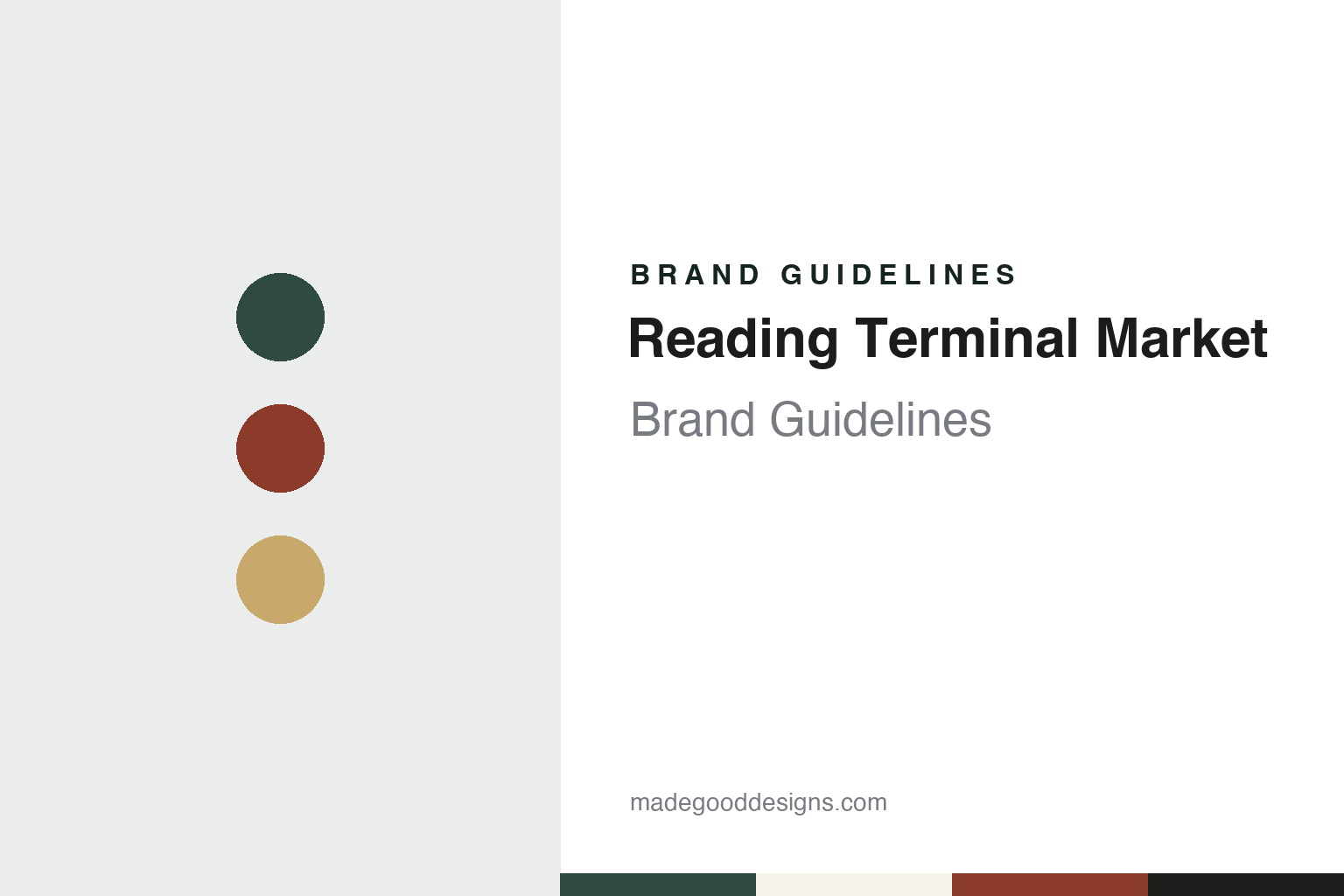
Reading Terminal Market Brand Guidelines
A city market under a railroad train shed, laid out like the streets outside.
Aa
Two constants: an iron green, brick red and ochre palette and a Sturdy slab serif register. Abstract homage — not a Reading Terminal Market asset or mark; no logo, sign or photograph is reproduced.
From Market Street to the train shed
Street markets, a railroad and an agreement of 1891.
Reading Terminal Market is an enclosed public market at 12th and Arch Streets in Center City, Philadelphia, on the ground floor of the former train shed of the Reading Railroad. Its roots lie in the open-air markets that once ran down the middle of High Street, which a city ordinance renamed Market Street in 1858, according to the market’s own timeline. By the middle of the nineteenth century, the market says, the line of market sheds stretched six blocks from the Delaware River.
The street markets did not last. The Encyclopedia of Greater Philadelphia, in a 2019 essay published by Rutgers University, says the city ordered the old sheds on High Street to close in October 1859, and that private market houses with ventilation and refrigeration were built to replace them. Two of these stood on the 1100 block of Market Street. The market’s timeline names them the Butchers’ and Farmers’ Market, which opened in 1860, and the Franklin Market, which moved alongside it by 1885; the encyclopedia names them the Farmers’ Market and the Twelfth Street Market.
In 1890 the Philadelphia and Reading Railroad bought the block for a single large downtown terminal, the market says. The merchants declined to move, and after lobbying through the summer of 1891 they reached an agreement with the railroad: a new market at street level, tucked beneath the elevated tracks and the train shed, with access to a cold-storage basement. The encyclopedia says the railroad hired George McKay, who had built Center Market in Washington, D.C., to oversee construction, and consulted the New York architect Francis H. Kimball on the ornament of its terminal. English Wikipedia credits Kimball with the eight-storey headhouse on Market Street, in an Italian Renaissance style, and Wilson Brothers & Company with the train shed.
The opening date is given two ways. The market’s history page says Reading Terminal Market opened for business on 22 February 1893, and its timeline places the opening in 1892. The encyclopedia says the market officially opened on 22 February 1892 while building work went on, and was complete by January 1893. The station above it opened on 29 January 1893, according to English Wikipedia. In 2018 the market marked its 125th anniversary on 22 February, its timeline says.
Colour
Twelve aisles, four avenues and a basement of cold rooms.
The market was planned as a grid. Its history page describes a hall of about 78,000 square feet with nearly 800 spaces for merchants in six-foot stalls, laid out like the streets of Philadelphia, with twelve aisles running east to west and four wider avenues running north to south. Sawdust was spread on the floor, and the trains could be heard overhead. The encyclopedia gives the train shed as 559 feet long and 88 feet high, sheltering thirteen tracks. Below the hall, the market says, a cold-storage basement held 52 rooms with half a million cubic feet of space, each kept at its own temperature.
The railroad link shaped the trade. The market describes a free market-basket service on suburban trains, in which an order filled at the market was held at the customer’s home station, and, after the First World War, refrigerated trucks serving some 60 suburban towns and resorts on the New Jersey shore. Its timeline says the market advertised itself in 1913 with 250 dealers and 100 farmers, that merchants formed the Reading Terminal Market Merchants’ Association in 1930, and that in 1933 the Reading Company added new doorways and six refrigerated show windows along Twelfth Street. In 1944, the market and the encyclopedia both say, 97 percent of its stalls were occupied.
The decades after the war were harder. The market says the cold-storage basement was shut down and dismantled in the 1960s, and that in 1976 the Reading Company ceased to be a railroad and carried on as a real-estate business, with the terminal and the market among its holdings. By the market’s account, the company bought back a lease on the market in 1980 and began to reinvest, recruiting new merchants including Amish farmers and Asian produce sellers. The last train left Reading Terminal on 6 November 1984, English Wikipedia says, citing The Philadelphia Inquirer; the market’s timeline says the new Market East station opened beneath it in 1985.
The building changed hands in 1990, when the Pennsylvania Convention Center Authority bought the market, according to the market’s timeline and the encyclopedia. The adjoining convention centre opened in 1993. English Wikipedia says renovations completed in 1997, designed by BLT Architects in a joint venture with CLA, made the headhouse the convention centre’s main entrance and the train shed its Grand Hall and ballroom. The market itself is run by the Reading Terminal Market Corporation, a non-profit set up in 1994 according to the market’s timeline and English Wikipedia; the market’s history page gives 1995.
Typography
Markets, halls and the cities around them.
Public markets and food halls in North America and Australia usually introduce themselves through who stands behind the name and when the market began. Some are run by a city council or a public development authority set up by a city charter, some by a non-profit corporation and some by a private property company. A founding date tends to sit close to the name, and a market’s documented origins and its present building often carry different dates.
The buildings do much of the work of an identity. Several markets occupy structures built for something else: space under a former railway train shed, a ferry terminal on a waterfront, or the brick and timber blocks of a former biscuit factory. Others grew as rows of covered arcades and open-sided sheds added stall by stall over decades, with halls for meat and fish and long tables for farmers who rent space by the day.
Lettering is often attached to the architecture rather than drawn for a page. A rooftop sign, a clock above an entrance, painted lettering on a wall or old company monograms set into an entryway can become the image that a market protects as a trademark, and in a historic district a commission may need to approve any change to that signage.
Inside, most of these markets describe their mix in general terms: fresh produce, fish, butchers, bakers and delis alongside food counters with seating, craft stalls and shops. Some are not buildings at all but weekly open-air markets that set up in a park or on a waterfront lot. Each guide in this series describes one market from dated sources and pairs it with a palette and typeface of our own.
Aa
A sturdy slab serif — our choice for a railroad-era market, not a documented typeface. (Specimen set in Zilla Slab, a slab-serif STAND-IN; NOT the Reading Terminal Market logo or any of its signs.)
Reading Terminal Market
A landmark shed, a central court and a bronze pig.
The building carries national recognition. English Wikipedia says the Reading Terminal and Trainshed was added to the National Register of Historic Places on 30 June 1972 and designated a National Historic Landmark on 8 December 1976, and that a Pennsylvania state historical marker followed in 2003. It describes the train shed as the only one of its kind left in the United States. The market’s own pages call its home a National Historic Landmark building.
Inside, the stalls still follow a grid, with an open area at the centre set with tables and seating, and entrances on Filbert Street to the south, Twelfth Street to the west and Arch Street to the north, according to English Wikipedia. The market is open every day; English Wikipedia notes that its Pennsylvania Dutch merchants generally trade from Monday to Saturday. The market groups its merchants under headings such as produce, meat and poultry, seafood, bakery, confections, Pennsylvania Dutch, flowers and plants, and eateries, and its history page speaks of more than 80 merchants, two of them descended from original standholders.
Its look has been updated in stages rather than through a single redesign. English Wikipedia says the Merchants’ Association helped fund a 1934 renovation of the facade that added new electric lights and window decorations. Outside, the market’s timeline says, the 1100 block of Filbert Street was rebuilt in 2022 as a curbless “festival street.” The market’s mascot is Philbert, a bronze pig sculpture by Eric Berg that also serves as a collection box, English Wikipedia says. The market’s name has stayed the same since 1893, keeping the railroad in the title four decades after the last train left.
For a design guide, Reading Terminal Market shows how a market can keep its railway name, its grid and its stalls while the building around it is reused. Compare Pike Place Market, another long-running city market, and Philadelphia Orchestra, a Philadelphia institution of its own. For this guide we use an iron green, a brick red and an ochre with a slab serif, an unofficial interpretation; no product or logo is reproduced.
Explore & save
Keep Reading Terminal Market’s identity on hand — save it to a board in the Made Good inspiration library.
Reading Terminal Market identity set
Pin the Reading Terminal Market iron green, brick red and ochre palette and the Sturdy slab serif register to your own board.
Source & notes
Frequently Asked Questions
What font can I use to match the Reading Terminal Market look?
This guide describes Reading Terminal Market’s type as “A sturdy slab serif — our choice for a railroad-era market, not a documented typeface”. Its type specimen is set in Zilla Slab from Google Fonts as a stand-in; Zilla Slab is not Reading Terminal Market’s own lettering.
What colours are in the Reading Terminal Market palette?
This guide’s Reading Terminal Market palette is Shed Iron Green #2F4A3E, Market Brick #8C3B2A, Sawdust Ochre #C9A86B, Ink #1E1E1C and Paper #F6F3EC. The tones are the guide’s own unofficial interpretation, not official Reading Terminal Market hex codes.