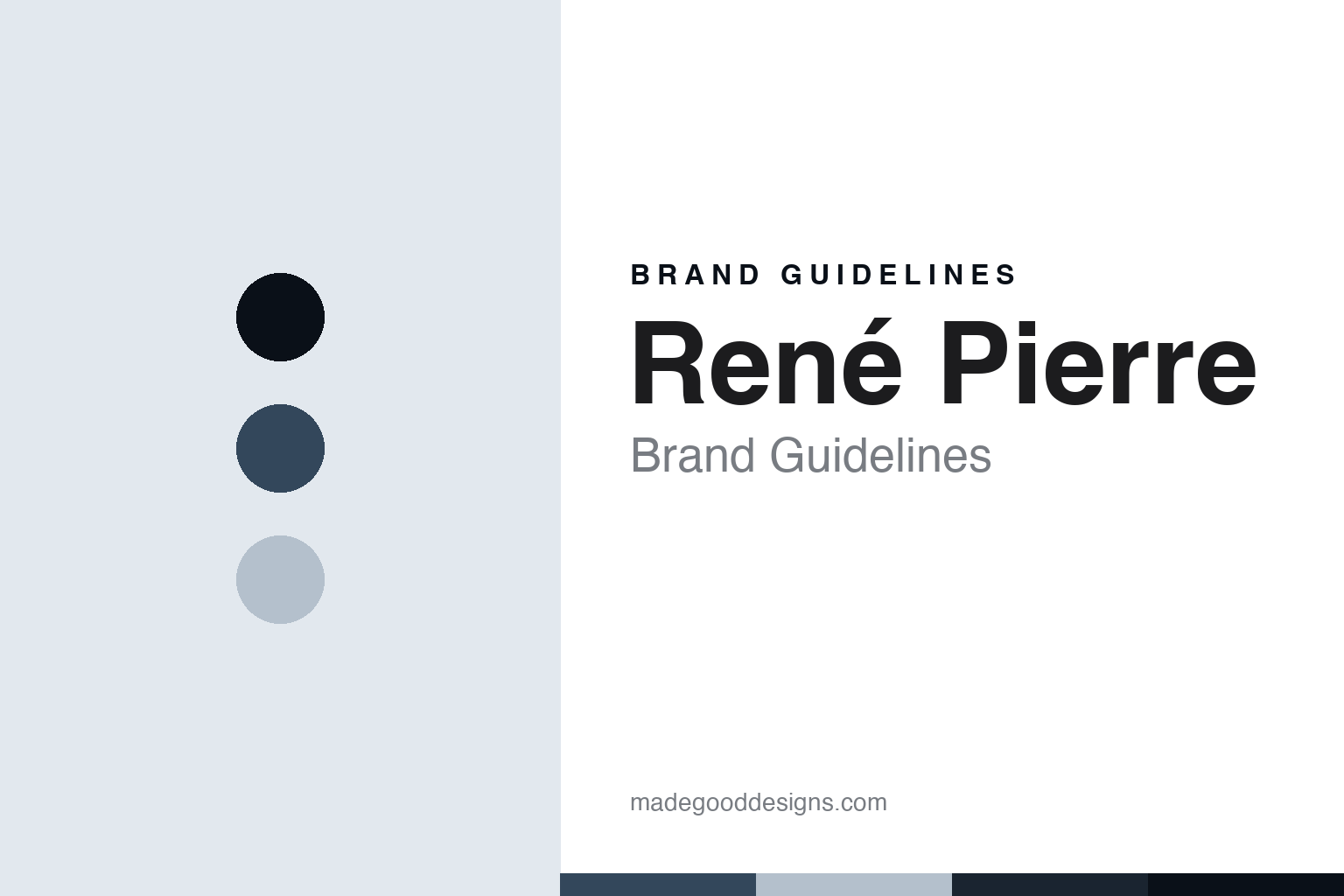
René Pierre Brand Guidelines
The Jura family that makes baby-foot and billiards.
Aa
Two constants: a René-Pierre-graphite palette and a maker-sans register. Abstract homage — not a René Pierre product or mark; no table, handle or logo is reproduced.
The Jura family that makes baby-foot and billiards
René Pierre is the 1952 French maker (from Ranchot in the Jura, now Chalon-sur-Saône), 100% family-owned, that builds both football tables and billiard tables in France.
René Pierre follows Garlando as the round’s French-maker node — the family firm that, unlike the café-only Bonzini, makes both baby-foot and billiards, still in France. Its answer to a round about who owns the foosball table is the family-and-craft one: the Jura family that makes baby-foot and billiards.
Its identity is the Jura family that makes baby-foot and billiards. The 1952 founding, the family ownership and the two crafts are the story here. Baby-foot and billiards. The Jura family that makes baby-foot and billiards.
(Honest notes, so the founding, the ownership, the crafts and a geography correction are framed accurately. René Pierre sells baby-foot and billiard tables as its heroes; we report its language as the brand’s own. On founding: René Pierre was founded in 1952 by René Pierre in Ranchot, a village in the Jura, not Moirans-en-Montagne. On ownership: it is still independent and 100% family-owned, led by Laurent Pierre as president with Claude Pierre, with about 46 employees, and it is not part of an outside group. On the crafts: it is a French maker of both baby-foot and billiard tables, with a master-billiard-maker heritage, and it also makes arcade cabinets, jukeboxes and pinball, its baby-foot lines including Leader, Club, Color, Sixties, Onyx and Cuir. On a geography correction: it is made in France at Chalon-sur-Saône, in Crissey, in Saône-et-Loire, not the Jura, with the original Jura site at Ranchot kept for wood storage and cutting, so we do not conflate the two départements. Its designs and the René Pierre name are IP we describe but do not reproduce; there is no official brand hex; these tones are an unofficial interpretation.)
Colour
René Pierre lives in a René-Pierre graphite. Click a swatch to copy the hex.
René Pierre’s identity is French, family and two-craft — a René-Pierre graphite, an ink, a pale steel, a deep slate, and a paper. The palette leans René-Pierre graphite and deep slate: a clean, workmanlike register that stands in for a French maker of tables rather than a loud logo colour. It signals the Jura family that makes baby-foot and billiards — French, family and two-craft. The honest caveat: with no official brand hex, these values are a workmanlike, unofficial interpretation, not first-party colours.
The lesson is a René-Pierre graphite signals a French, family identity. René Pierre’s world is the baby-foot and the billiard table, both from France. For designers, it is a reminder that a clean graphite and a pale steel can carry a French, family brand — a workmanlike tone held as an accent, not a product shot. Because a dark hue can flatten small text, keep type dark and even and let the colour live in the accents, palette and band. The takeaways: date the founding to 1952 and place it in Ranchot, Jura; keep it 100% family-owned; note the two crafts; and place current making in Chalon-sur-Saône, not the Jura.
Typography
The register is a maker sans — French, family, two-craft.
René Pierre’s identity carries a French, family spirit — a maker of two table crafts. A maker sans captures the mood: clean, workmanlike and grounded, the register of a family firm. Set in a René-Pierre-graphite palette, the maker sans feels dependable and rooted — exactly the personality René Pierre carries. It behaves like a made, tooled thing rather than a loud logo, mirroring a handle-ring and a player-dot. (René Pierre’s real products and the name are things we describe but do not reproduce, and the exact typeface is not ours to use.) Because it is not ours to use, the honest description is “a maker-sans brand,” shown here in a stand-in. The type behaves like the brand: French, family and two-craft.
Aa
A maker-sans brand — dependable and rooted. (Specimen set in Sora, a maker-sans STAND-IN; NOT the René Pierre logo or products.)
The foosball node
René Pierre stands for the Jura family that makes baby-foot and billiards.
René Pierre sits fourth in the round as its French-maker node. A René-Pierre-graphite palette, a maker sans and a 1952 founding make one thing — the Jura family that makes baby-foot and billiards — the whole identity: French, family and two-craft. The 1952 founding is the pitch, the family ownership is the frame, and the two crafts are the substance. The point is a family firm making both tables in France, in a round about who owns the foosball table.
Put to work, the identity is the brand told straight, the geography corrected and the crafts named. A brand in this spirit would date the founding to 1952 and place it in Ranchot, Jura, keep it 100% family-owned, note the two crafts, and place current making in Chalon-sur-Saône, not the Jura. A reader in this spirit would keep the facts right: René Pierre makes baby-foot and billiards; it dates to 1952; it is 100% family-owned; and it is made in France. René Pierre sits after Garlando and before Shelti. The honest editorial moves are to date the founding, to correct the geography, to keep it family-owned, and to name the crafts.
For designers and brand-builders, René Pierre carries the foosball node: a family maker can hold two crafts and get its own geography right. The lessons: a French firm can make both baby-foot and billiards, here René Pierre; a founding is dated to 1952 by René Pierre in Ranchot, a village in the Jura, not Moirans-en-Montagne; an ownership is kept, still independent and 100% family-owned under Laurent and Claude Pierre, about 46 employees, not part of an outside group; the crafts are named, both baby-foot and billiard tables plus arcade, jukeboxes and pinball, with baby-foot lines from Leader to Cuir; and a geography is corrected, made in France at Chalon-sur-Saône, in Crissey, Saône-et-Loire, not the Jura, the Ranchot site kept for wood. It is also a reminder to stay precise: René Pierre is the family-owned French maker of both tables in the foosball aisle — with the palette here an unofficial interpretation, and the two départements kept distinct. The hook is that craft: René Pierre is the Jura family that makes baby-foot and billiards, the 1952 French maker from Ranchot in the Jura, now Chalon-sur-Saône, 100% family-owned, building both football tables and billiard tables in France. Read that way, René Pierre is less a single table than the Jura family that makes baby-foot and billiards: French, family, two-craft. The lesson for a brand is that a family maker can hold two crafts and get its own geography right, and dating the founding keeps it earned. René Pierre made the-Jura-family-that-makes-baby-foot-and-billiards the identity — proof that a two-craft family maker can anchor a node.
Explore & save
Keep René Pierre’s identity on hand — save it to a board in the Made Good inspiration library.
René Pierre identity set
Pin the René-Pierre-graphite palette and the maker-sans register to your own board.