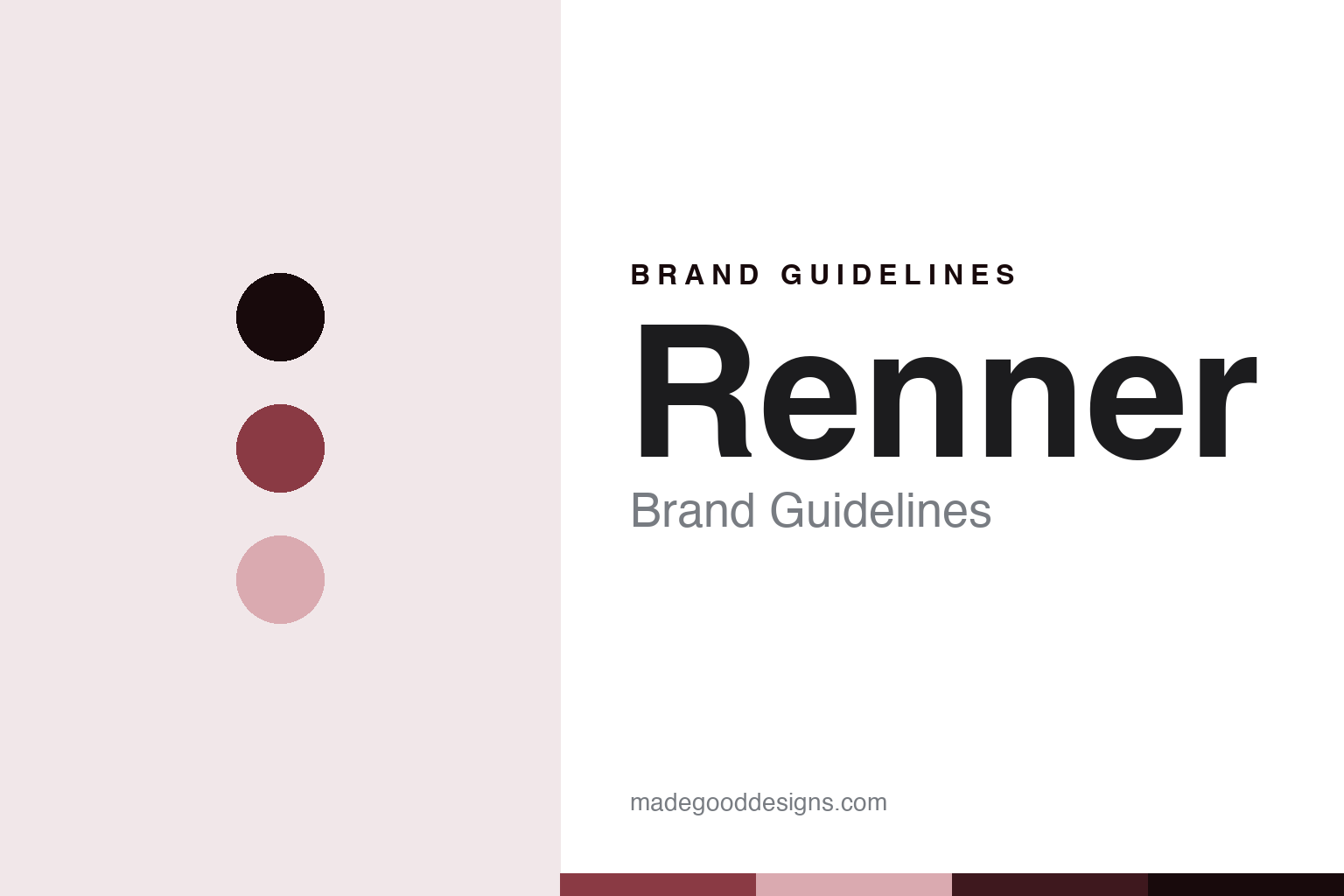
Renner Brand Guidelines
The heart of the piano.
Aa
Two constants: a hammer-felt palette and an action-sans register. Abstract homage — not a Renner action, hammer or mark.
The heart of the piano
Renner is the German maker of piano actions and hammers founded in Stuttgart in 1882, the hidden component inside many pianos, now owned by Steinway & Sons.
Renner is the round’s most hidden maker — the one whose work you never see. From Germany, Renner makes piano actions, the intricate mechanism of wood, felt and metal that turns a key-press into a hammer-strike, and the hammer heads that actually hit the strings. Its answer to how a maker becomes a name is precision, out of sight: build the mechanism at the heart of the piano so well that the world’s piano makers build around it. A German component that beats inside many pianos.
Its identity is the heart of the piano. Renner’s piano actions, its hammer heads and its role as the hidden component are the work it is known for. An action, made in Germany. The mechanism you play but never see.
(Honest notes, so the story stays precise. Renner — Louis Renner GmbH — was founded in 1882 by Louis Renner in Stuttgart, Germany; a German-language source lists a different founding town, but we follow the company’s own detailed Stuttgart account. On what it makes, it makes grand and upright piano actions (mechanisms of thousands of parts — the company cites roughly 8,800 per action, using woods such as white hornbeam and, it states, no plastic) and hammer heads, supplying piano manufacturers as well as an aftermarket for technicians and rebuilders. On where it is made — the crux of this round — Renner left Stuttgart in 2001 and today makes in Germany at two sites, Gärtringen and Meuselwitz, so we say made in Germany and do not say “made in Stuttgart.” On ownership — an important, honest point — Renner is owned by Steinway & Sons, which acquired it in July 2019; it is not Bechstein-owned, and we do not repeat an insolvency we could not verify. On its reputation, it describes itself as the world’s leading independent action maker; we attribute “gold standard” as the industry’s and company’s characterisation, and we do not claim any specific piano brand uses Renner actions. Its name and marks, and Steinway’s, are IP, described but never reproduced, and there is no official brand hex; these tones are an unofficial interpretation. This is design commentary and does not promote any product.)
Colour
Renner lives in a hammer-felt palette. Click a swatch to copy the hex.
Renner’s identity is precise, hidden and German — a hammer felt, an ink, a wool, a deep felt, and a paper. The palette leans hammer felt and wool: the register of the wool felt on a piano hammer and the wood of an action. It signals precision at the heart of the instrument. The honest caveat: with no published brand hex, these values are an original, unofficial interpretation, not first-party colours.
The lesson is a hammer-felt palette signals a precise, hidden-component identity. Renner’s world is a precise, wood-and-felt, German object. For designers, it is a reminder that a felt red and a soft wool can carry a maker built on a hidden mechanism — the colour of hammer felt and the pale of pressed wool. Because these tones can fail as small text, keep type dark and let the colour live in the accents, palette and band. The takeaways: build the hidden part best; make it in-country; be honest about the owner; and treat any single hex as unofficial.
Typography
The register is an action sans — precise, plain, engineered.
Renner’s identity carries a precise, plain, engineered spirit — a component maker, not a fashion label. An action sans captures the mood: even, exact and modern, the register of a mechanism of thousands of parts. Set in a hammer-felt palette, the action sans feels precise and engineered — exactly the personality Renner carries. It is a hidden mechanism rather than a marketing wall, mirroring a piano action. (Renner’s real logo and the Steinway mark are things we describe but do not reproduce, and the exact typeface is not ours to use.) Because it is not ours to use, the honest description is “an action-sans spirit,” shown here in a stand-in. The type behaves like the maker: precise, plain and engineered.
Aa
An action-sans spirit — precise and engineered. (Specimen set in Space Grotesk, an action-sans STAND-IN; NOT the Renner logo or any mark.)
How an instrument is made
Renner stands for the hidden mechanism at the heart of the piano.
Renner is a lesson in how a hidden component can be an identity. A hammer-felt palette, an action sans and a piano action make one thing — the heart of the piano — the whole identity: precise, hidden and German. The action mechanism is the differentiator, and its role inside other makers’ pianos is the meaning. The point is a maker whose work is never seen — the mechanism of thousands of parts between the key and the string — built so precisely that the piano industry builds around it.
Put to work, the identity is a hidden component, honestly told, as design. A maker in this spirit would perfect the unseen part, make it in-country, and be candid about the owner — piano actions and hammers, made in Germany, owned by Steinway since 2019. A brand learning from it would see that a hidden component can be a durable identity — that the maker of the mechanism at the heart of the piano holds a place the visible brand cannot always claim — and that being precise, founded 1882 in Stuttgart, made today in Gärtringen and Meuselwitz, owned by Steinway, keeps the story honest. Renner is the round’s purest “invisible maker,” alongside the tuning-hardware house that closes it: you play a piano and feel Renner’s action without ever seeing its name, exactly as this round argues — that how an instrument is made is often a story about parts the player never notices. It also carries the consolidation thread to its furthest point: the great independent action maker is now owned by one of the piano brands it long supplied. The discipline is in the restraint: following the company’s own founding city over a conflicting source, leaving out an unverified insolvency, and not naming which pianos use Renner, is what keeps a hidden-component story honest. The lesson Renner teaches is that the unseen can hold an identity: the action gives it substance, and the honesty about the Steinway ownership keeps it credible. The mechanism is the personality, and the piano action is the proof.
For designers and brand-builders, Renner holds the hidden-component pole in how an instrument is made, from Germany: perfect the unseen part, and be honest about the owner. The lessons: build the part no one sees best; make it in-country; name your parent plainly; don’t claim customers you can’t verify; and never reproduce a logo. It is also a reminder to stay precise: Renner is the German maker of piano actions and hammers founded in Stuttgart in 1882, the hidden component inside many pianos, now owned by Steinway & Sons — with the palette here an unofficial interpretation. Renner made the hidden mechanism the identity — proof that the part you never see, honestly told, can be the difference.
Explore & save
Keep Renner’s identity on hand — save it to a board in the Made Good inspiration library.
Renner identity set
Pin the hammer-felt palette and the action-sans register to your own board.