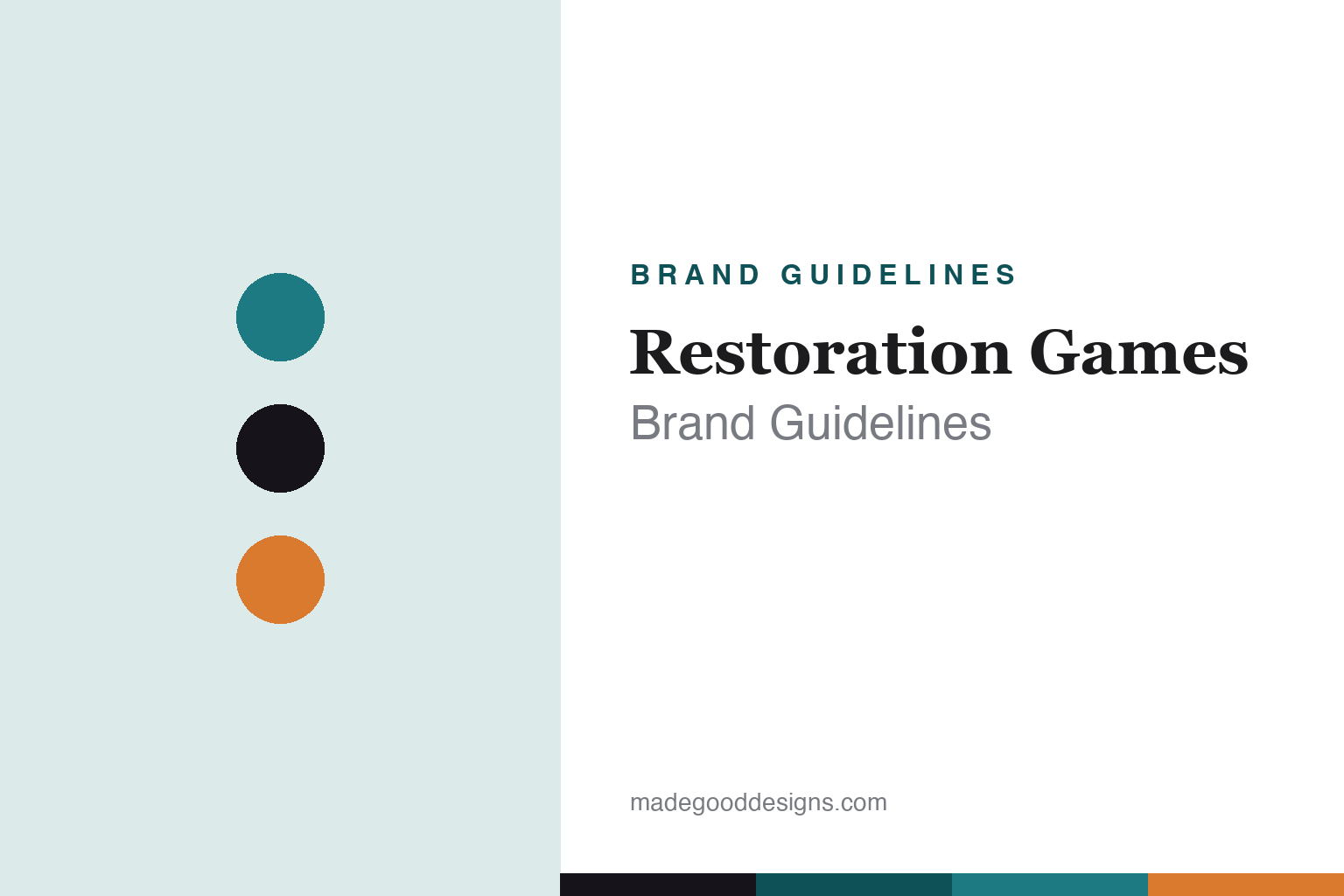
Restoration Games Brand Guidelines
Bringing forgotten games back to life — and building new classics from old ones.
Aa
Two constants: a retro-teal and vintage-orange palette and a vintage slab. Abstract homage — not the Restoration wordmark or logo.
Bringing games back to life
Restoration Games revives forgotten classics.
Restoration Games is a lesson in a mission as a brand. It’s a US studio (a Florida company) founded around 2016–2017 (we hedge the year) by publisher Justin D. Jacobson and famed designer Rob Daviau — who literally holds the title “Chief Restoration Officer.” Its whole reason for existing is in the name: it “restores” out-of-print and forgotten games, updating old designs with modern components, rules and production for today’s players.
The cross-link is delicious: Rob Daviau is the designer who invented the “legacy” game format (Risk Legacy) and co-designed Pandemic Legacy — so the industry’s great innovator of the new spends his days reviving the old. The restorations are real hits: ⭐ Fireball Island: The Curse of Vul-Kar (2018) reborn the beloved 1980s marble-run adventure (a $2.8M Kickstarter); Downforce restored a classic racing-bet game; and ⭐⭐ Return to Dark Tower (2020) reimagined the legendary 1981 electronic Dark Tower as an app-driven cooperative game (over $4M on Kickstarter).
Restoration also builds new classics from old bones: ⭐⭐ Unmatched, its acclaimed asymmetric miniatures dueling line, grew from the lineage of 2002’s Star Wars: Epic Duels and now pits licensed heroes (Marvel, Bruce Lee and more) against each other. It’s an independent studio with a genuinely distinctive purpose: nostalgia, done with modern craft. (Honest notes: the founding year is hedged; Jacobson owns/runs the company while Daviau leads design; restorations involve reacquired IP or new licenses — specifics hedged; Unmatched is a reimagining, not a reprint; and no official brand hex is published.)
Colour
Restoration lives in a retro-teal-and-orange palette. Click a swatch to copy the hex.
Restoration’s identity is nostalgic, warm and playful — a retro teal, ink black, and a vintage orange. The palette reads as an old game box brought back: the teal and warm orange of mid-century packaging, refreshed. It’s a nostalgic, joyful world that signals memory, revival and craft. It’s a retro-teal-and-orange palette that signals a restoration studio. The honest caveat: Restoration publishes no official brand hex, so the teal, ink and orange here are an original, unofficial interpretation, not first-party values.
The lesson is a retro-teal-and-orange palette signals nostalgia and revival. Restoration’s world reads as warm and playful. For designers, it’s a reminder that mid-century-tinged colours (retro teal, vintage orange) evoke memory and revival — perfect for a studio that brings old games back. The takeaways: use retro-tinged tones for nostalgia and revival; keep them warm and playful; and treat any single hex as unofficial when there’s no published spec.
Typography
The wordmark spirit is a vintage slab — sturdy and nostalgic.
Restoration’s identity carries a sturdy, nostalgic, playful spirit — a “Restoration Games” wordmark whose solid slab forms recall an old game-box logo, refreshed. A vintage slab captures the mood: it’s sturdy and nostalgic, matching a studio that revives mid-century classics with modern craft. Set against a retro palette, the vintage slab feels warm and familiar — exactly the Fireball-Island, Return-to-Dark-Tower personality Restoration carries. It’s nostalgic rather than sleek, mirroring a beloved game reborn. (Restoration’s real wordmark is a trademark we describe but don’t reproduce.) Because the exact mark isn’t ours to use, the honest description is “a vintage slab spirit,” not the Restoration logo. The type behaves like the brand: sturdy, nostalgic and playful.
Aa
A vintage slab spirit — sturdy and nostalgic. (Specimen set in Zilla Slab, a sturdy slab serif; NOT the Restoration logo, which is a trademark.)
A unique mission as the difference
Restoration owns nostalgia.
Restoration Games is a lesson in carving out a category no one else owns. Nearly every publisher chases new designs; Restoration went the opposite way and made reviving old games its entire identity — a genuinely distinctive mission that gives it a clear lane, a built-in supply of beloved IP to draw from, and a ready emotional hook (nostalgia). It’s reinforced by a perfect figurehead: Rob Daviau, the inventor of legacy games, applying cutting-edge design to forgotten classics. And the model has range — from faithful revivals (Fireball Island) to bold reinventions (Return to Dark Tower’s app) to brand-new lines grown from old roots (Unmatched). Owning “the restoration studio” means Restoration competes with almost no one for its exact position, while tapping a deep well of affection for games people already love.
For designers and brand-builders, Restoration offers a clear takeaway: a distinctive mission can hand you a category with little competition and built-in emotional pull. The lessons: find an underserved angle (reviving the old, not just making the new) and own it completely; use a credible figurehead to make the mission believable (Daviau); and keep the facts precise — Restoration is Justin Jacobson and Rob Daviau’s studio for restoring classics, behind Return to Dark Tower and Unmatched. It’s also a reminder to keep it honest: the founding year is hedged; Jacobson runs the company while Daviau leads design; restorations involve reacquired IP or licenses (Unmatched is a reimagining, not a reprint); and no official brand hex is published, so the palette here is an interpretation. Restoration owns nostalgia — proof that a unique mission can be the difference.
Explore & save
Keep Restoration Games’s identity on hand — save it to a board in the Made Good inspiration library.
Restoration Games identity set
Pin the retro-teal-and-orange palette and the vintage-slab spirit to your own board.


