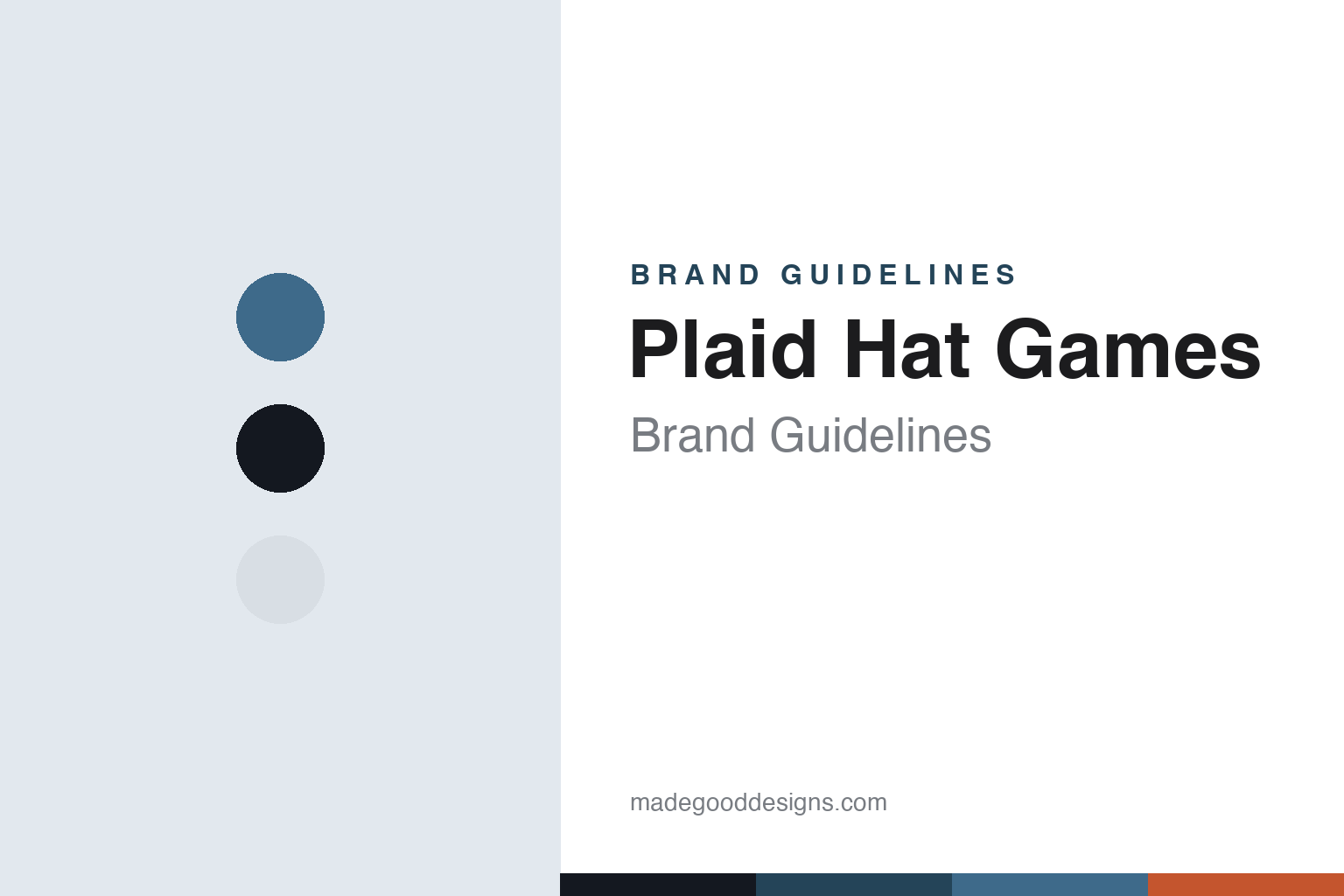
Plaid Hat Games Brand Guidelines
Narrative games — and a rare story of a studio that bought itself back.
Aa
Two constants: a slate-blue and winter-white palette and a bold narrative sans. Abstract homage — not the Plaid Hat wordmark or logo.
Narrative games, and a rare comeback
Plaid Hat tells stories — and told its own.
Plaid Hat Games is a lesson in narrative games and an unusually human corporate story. It’s a US publisher founded in 2009 by Colby Dauch, who created the two-player battle game Summoner Wars, couldn’t get it published, and started Plaid Hat to release it himself. From there it built an identity around story-driven games.
Its hits are narrative at heart. Mice and Mystics (2012) is a storybook cooperative adventure (heroes turned into mice); ⭐⭐ Dead of Winter: A Crossroads Game (2014) is its landmark — a semi-cooperative zombie-survival game with a possible hidden traitor and, crucially, “Crossroads” cards that inject moral-dilemma story beats mid-game (designed by Isaac Vega and Jonathan Gilmour). Add Ashes: Rise of the Phoenixborn (a dueling card game) and the “AdventureBook” game Stuffed Fables, and Plaid Hat’s through-line is clear: games that tell a story.
⭐ Its most remarkable story, though, is its own ownership arc. Plaid Hat was independent, then acquired by F2Z Entertainment in 2015 (F2Z was absorbed into Asmodee). Then, in a rare reversal of the industry’s consolidation, founder Colby Dauch bought the company back from Asmodee in early 2020, making it independent again. ⚠️ The catch: Asmodee kept the rights to several key titles (including Dead of Winter and Mice and Mystics), so Plaid Hat regained its name and freedom but not its full back-catalogue. (Honest notes: Dead of Winter was designed by Vega & Gilmour — Plaid Hat published it; the buyback was early 2020, not 2019; independent since then; and no official brand hex is published.)
Colour
Plaid Hat lives in a slate-blue-and-winter palette. Click a swatch to copy the hex.
Plaid Hat’s identity is atmospheric, narrative and cool — a slate blue, ink black, and a winter white (with an ember accent). The palette reads as Dead of Winter: the cold slate-blue and white of a snowbound survival story, warmed by a single ember of story-tension. It’s a moody, story-driven world that signals narrative, atmosphere and drama. It’s a slate-blue-and-winter palette that signals a narrative games studio. The honest caveat: Plaid Hat publishes no official brand hex, so the slate, white and ember here are an original, unofficial interpretation, not first-party values.
The lesson is a slate-blue-and-winter palette signals narrative atmosphere. Plaid Hat’s world reads as moody and story-driven. For designers, it’s a reminder that cool, atmospheric tones (slate blue, winter white) with a single warm accent evoke tension and story — right for narrative survival games. The takeaways: use cool atmospheric tones with a warm accent for narrative tension; let the flagship set the mood; and treat any single hex as unofficial when there’s no published spec.
Typography
The wordmark spirit is a bold narrative sans — atmospheric and strong.
Plaid Hat’s identity carries a bold, atmospheric, narrative spirit — a “Plaid Hat” wordmark whose strong forms match tense, story-driven games. A bold narrative sans captures the mood: it’s confident and dramatic, matching a studio whose signature is moral-dilemma storytelling in a survival setting. Set against a slate palette, the bold sans feels atmospheric and serious — exactly the Dead-of-Winter, Crossroads personality Plaid Hat carries. It’s strong rather than delicate, mirroring a tense survival night. (Plaid Hat’s real wordmark is a trademark we describe but don’t reproduce.) Because the exact mark isn’t ours to use, the honest description is “a bold narrative sans spirit,” not the Plaid Hat logo. The type behaves like the brand: bold, atmospheric and narrative.
Aa
A bold narrative sans spirit — atmospheric and strong. (Specimen set in Archivo, a bold grotesque; NOT the Plaid Hat logo, which is a trademark.)
Buying back independence as the difference
Plaid Hat reversed the trend.
Plaid Hat Games is a lesson in what independence is worth. In an era when nearly every notable studio has been absorbed by a conglomerate — Fantasy Flight, Days of Wonder, Z-Man, Repos, Libellud all sit under Asmodee — Plaid Hat did the opposite and bought itself back. Its founder sold to F2Z/Asmodee in 2015, then, in 2020, reacquired the company to run it on his own terms, even though the price was giving up rights to some of his best-known games. That choice is the brand’s most telling statement: for Plaid Hat, creative independence was worth more than the security and back-catalogue that came with the giant. In a consolidating industry, being the studio that went back to independent is a rare and meaningful identity.
For designers and brand-builders, Plaid Hat offers a clear takeaway: independence can be a deliberate, values-driven choice worth real sacrifice. The lessons: weigh creative control against scale honestly (Plaid Hat traded titles for freedom); let a genuine decision like that become part of the brand’s meaning; and keep the facts precise — Plaid Hat is Colby Dauch’s 2009 narrative studio, sold to Asmodee in 2015 and bought back in 2020. It’s also a reminder to keep it honest: Dead of Winter was designed by Vega & Gilmour (Plaid Hat published it); the buyback was early 2020, and Asmodee kept several titles’ rights; it’s independent again; and no official brand hex is published, so the palette here is an interpretation. Plaid Hat reversed the trend — proof that choosing independence can be the difference.
Explore & save
Keep Plaid Hat Games’s identity on hand — save it to a board in the Made Good inspiration library.
Plaid Hat identity set
Pin the slate-blue-and-winter palette and the narrative-sans spirit to your own board.