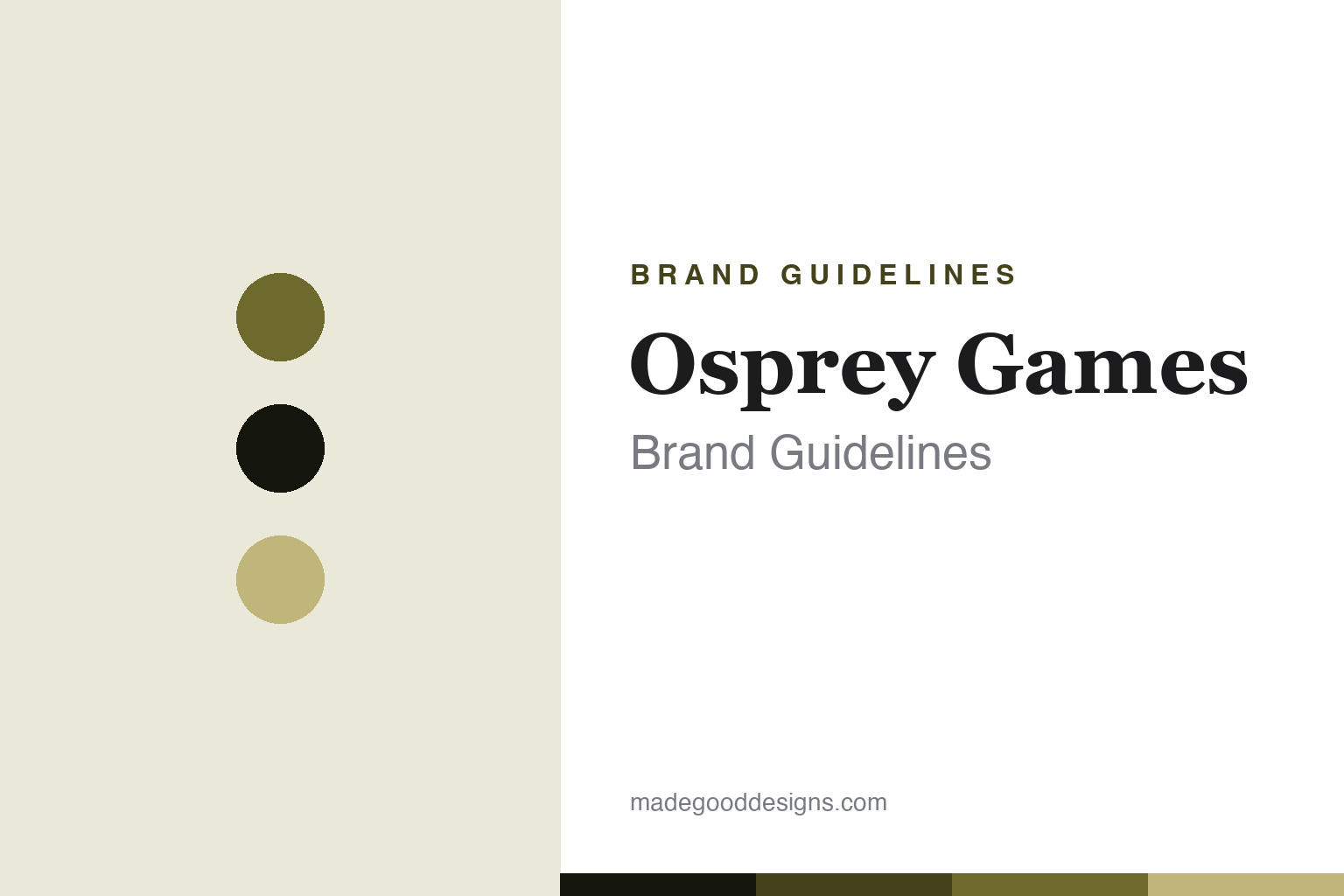
Osprey Games Brand Guidelines
A military-history book publisher’s games arm — curated, and quietly excellent.
Aa
Two constants: an olive-and-khaki palette and a heritage serif. Abstract homage — not the Osprey wordmark or logo.
A book house makes games
Osprey Games comes from a publisher of history books.
Osprey Games is a lesson in a heritage publisher extending into a new medium. It’s the tabletop-games imprint of Osprey Publishing — the British house famous worldwide for its illustrated military-history books (the unit-and-uniform reference guides beloved by historians and modellers). Osprey Publishing became part of Bloomsbury in December 2014, and Osprey Games launched in 2015 (building on the earlier Osprey Wargames rulebooks). So its games come with a genuine pedigree in history and craft.
Its catalogue is curated and quietly excellent rather than sprawling. The flagship is ⭐ Undaunted — a WWII deck-building/tactics series (Undaunted: Normandy, North Africa and more) by David Thompson and Trevor Benjamin, widely praised for marrying deck-building with battlefield tactics. Its peak is ⭐⭐ Paleo (2020), a cooperative Stone-Age survival game (designed by Peter Rustemeyer) that won the Kennerspiel des Jahres 2021 — though note Paleo’s original German publisher is Hans im Glück and Osprey is its English-language publisher. Add the fantasy miniatures wargame Frostgrave (Joseph A. McCullough), Wildlands (Martin Wallace), The Lost Expedition, and modern reprints of Reiner Knizia classics (High Society, Ra), and the picture is clear: a small, high-quality list spanning board games, miniatures wargames and RPGs.
⚠️ A current caveat: in 2026, Bloomsbury put Osprey’s board- and card-game division up for sale (reportedly retaining the wargames and roleplaying lines) — so the games arm’s future ownership is in flux as of this writing. (Honest notes: the games are by named external designers, not “in-house”; Paleo won its award as the German edition; the launch year is 2015; Osprey Games is a modern imprint distinct from the century-plus book legacy; and no official brand hex is published.)
Colour
Osprey lives in an olive-and-khaki palette. Click a swatch to copy the hex.
Osprey’s identity is heritage, considered and history-rooted — a military olive, ink black, and a khaki. The palette reads as its parent’s world: the olive and khaki of military history, the ink of a reference book, considered and authoritative. It’s a curated, scholarly world that signals history, quality and restraint. It’s an olive-and-khaki palette that signals a history-publisher’s games arm. The honest caveat: Osprey publishes no official brand hex, so the olive, ink and khaki here are an original, unofficial interpretation, not first-party values.
The lesson is an olive-and-khaki palette signals history and considered quality. Osprey’s world reads as scholarly and curated. For designers, it’s a reminder that muted military tones (olive, khaki) evoke history and seriousness — fitting for the games arm of a military-history book house. The takeaways: use muted heritage-military tones for history and gravitas; keep the list curated; and treat any single hex as unofficial when there’s no published spec.
Typography
The wordmark spirit is a heritage serif — scholarly and considered.
Osprey’s identity carries a scholarly, considered, heritage spirit — an “Osprey Games” wordmark whose classic forms match the games arm of a respected history-book publisher. A heritage serif captures the mood: it’s bookish and authoritative, matching a curated list rooted in history and craft. Set against an olive palette, the heritage serif feels scholarly and considered — exactly the Undaunted, Paleo personality Osprey carries. It’s considered rather than flashy, mirroring a well-made reference book. (Osprey’s real wordmark is a trademark we describe but don’t reproduce.) Because the exact mark isn’t ours to use, the honest description is “a heritage serif spirit,” not the Osprey Games logo. The type behaves like the brand: scholarly, considered and heritage.
Aa
A heritage serif spirit — scholarly and considered. (Specimen set in Cardo, a classic text serif; NOT the Osprey Games logo, which is a trademark.)
Curated pedigree as the difference
Osprey brings a book house’s eye to games.
Osprey Games is a lesson in bringing a publisher’s curatorial pedigree into a new medium. Osprey Publishing spent decades earning trust for quality and authority in military-history books; its games arm inherited that instinct, choosing a curated, quality-over-quantity list rather than flooding the market. The result is a catalogue where nearly every title is well-regarded — the acclaimed Undaunted series, the Kennerspiel-winning Paleo, the enduring Frostgrave, thoughtful Knizia reprints — with history and craft running through it. That editorial discipline is the difference: a book house knows how to curate, and applying that eye to games produced a small list punching well above its weight. (The 2026 sale of the board/card division is a reminder that even a well-curated arm sits within a larger corporate strategy.)
For designers and brand-builders, Osprey offers a clear takeaway: a curatorial pedigree can transfer into a new medium and become the differentiator. The lessons: let editorial discipline (curate, don’t flood) carry quality across formats; lean on a parent brand’s existing authority (history, craft) where it genuinely applies; and keep the facts precise — Osprey Games is the tabletop arm of the military-history book publisher Osprey (part of Bloomsbury), known for Undaunted and Paleo. It’s also a reminder to keep it honest: the games are by named external designers; Paleo won its award as the German (Hans im Glück) edition; the imprint launched in 2015; the board/card division was put up for sale in 2026; and no official brand hex is published, so the palette here is an interpretation. Osprey brings a book house’s eye to games — proof that curated pedigree can be the difference.
Explore & save
Keep Osprey Games’s identity on hand — save it to a board in the Made Good inspiration library.
Osprey Games identity set
Pin the olive-and-khaki palette and the heritage-serif spirit to your own board.