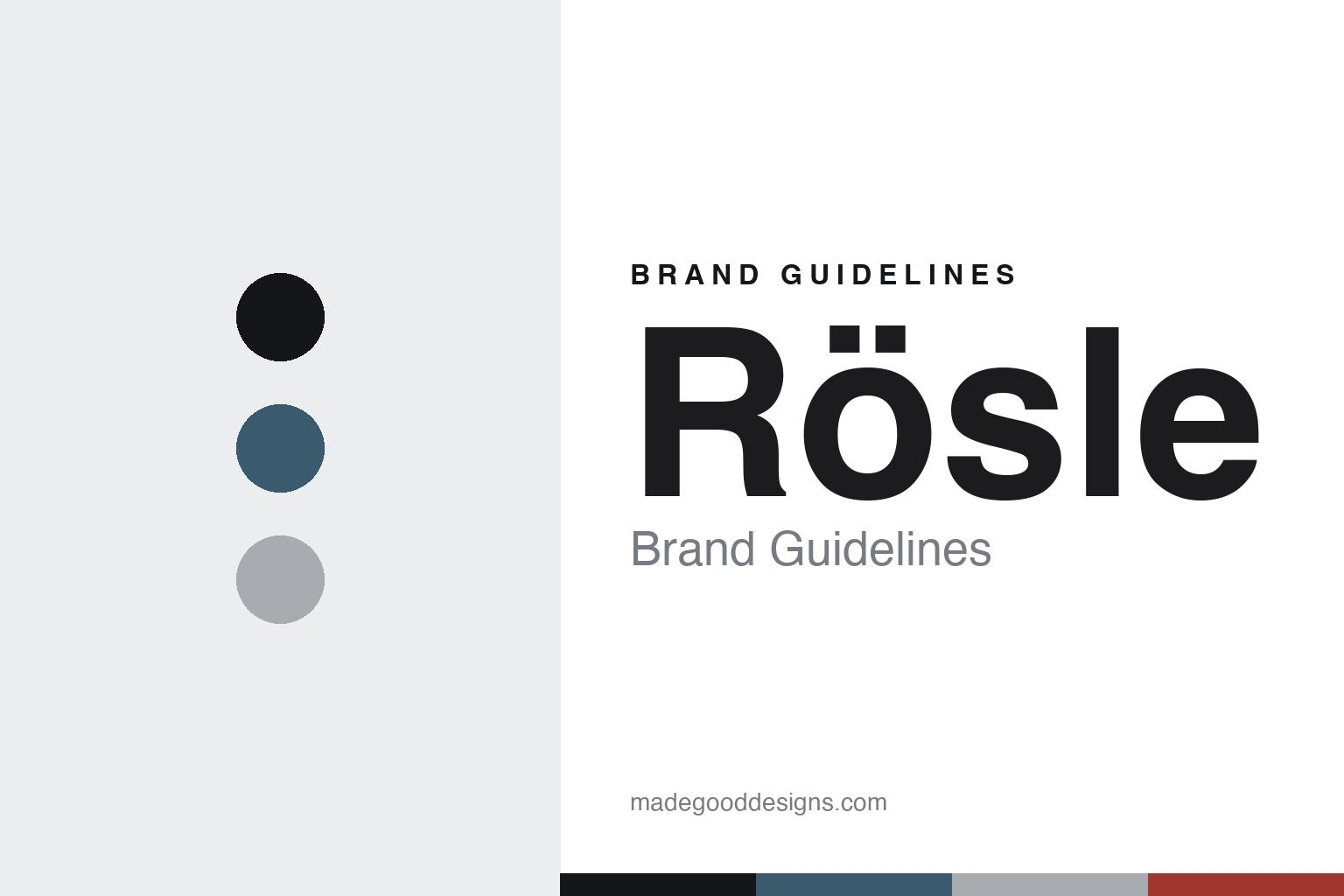
Rösle Brand Guidelines
The hanging ring.
Aa
Two constants: a steel-and-stainless palette and a functional sans register. Abstract homage — not the Rösle product or packaging.
The hanging ring
Rösle designs stainless tools around a hanging ring.
Rösle is a lesson in functional design as identity. Founded in 1888 by Karl Theodor Rösle — a master tinsmith — as a metalworking and roofing workshop in Marktoberdorf, Bavaria, it moved into kitchen utensils before the war and became kitchen-only in 1993.
Its identity is functional stainless-steel tools. The signature is the “Open Kitchen” concept — a hanging-rail system where each stainless tool is known for a round hanging ring at the end of its handle, so tools hang neatly on a rail — clean, functional German design that has won well over a hundred design prizes, including Red Dot and iF awards.
(Honest notes: 1888 is a tinsmith/roofing founding — Rösle only became a kitchen-tool brand in 1993; the roofing lineage lives on in a sister firm. And “Made in Germany” is largely no longer accurate for the tools — the German factory closed in 2009 and production moved abroad, so Rösle is best described as German-designed and headquartered rather than German-made. The round-ring detail is widely reported. There’s no official brand hex, so these tones are an unofficial interpretation. This is design commentary and does not promote any product.)
Colour
Rösle lives in a steel-and-stainless palette. Click a swatch to copy the hex.
Rösle’s identity is functional, stainless and German — a steel blue, an ink, a stainless, a Red-Dot red, and a paper. The palette pairs a steel blue with a stainless — the register of hanging stainless tools. It signals function and precision rather than colour. The honest caveat: with no published brand hex, these tones are an original, unofficial interpretation, not first-party values.
The lesson is a steel blue with a stainless signals a functional-tools brand. Rösle’s world is a rail of gleaming, ring-ended tools. For designers, it is a reminder that a cool, metallic palette reads as functional and precise — right for a design-award tool-maker. The takeaways: design a system (hanging rail + ring); keep the tools stainless and functional; earn the design pedigree; and treat any single hex as unofficial.
Typography
The register is a functional sans — precise, clean, systematic.
Rösle’s identity carries a precise, clean, systematic spirit — a hanging rail and a ring-ended tool. A functional grotesque sans captures the mood: it is rational and clean, the register of a systematic design. Set in a steel-and-stainless palette, the functional sans feels precise and clean — exactly the personality Rösle carries. It is systematic rather than decorative, mirroring a rail of tools. (Rösle’s real products and wordmark are works we describe but do not reproduce, and the exact typeface is not ours to use.) Because it is not ours to use, the honest description is “a functional sans spirit,” shown here in a stand-in. The type behaves like the brand: precise, clean and systematic.
Aa
A functional sans spirit — precise and clean. (Specimen set in Archivo, an austere grotesque STAND-IN; NOT the Rösle packaging.)
Functional design as identity
Rösle stands for the ring-ended stainless tool.
Rösle is a lesson in making functional design the identity. A steel-and-stainless palette, a functional sans and the Open Kitchen hanging system make functional design the whole brand — precise, clean, systematic. The system is the differentiator. The differentiator is a functional, hanging-ring identity.
For designers and brand-builders, Rösle offers a clear takeaway: design a coherent system, not just a tool. The lessons: unify the range (hanging rail + ring); keep it stainless and functional; earn design credibility (Red Dot, iF); and be honest about the making. It is also a reminder to stay accurate: 1888 is a tinsmith founding (kitchen-only from 1993), the tools are now largely made abroad, and the palette here is an unofficial interpretation. Rösle made functional design the brand — proof that a system can be the difference.
Explore & save
Keep Rösle’s identity on hand — save it to a board in the Made Good inspiration library.
Rösle identity set
Pin the steel-and-stainless palette and the functional-sans register to your own board.