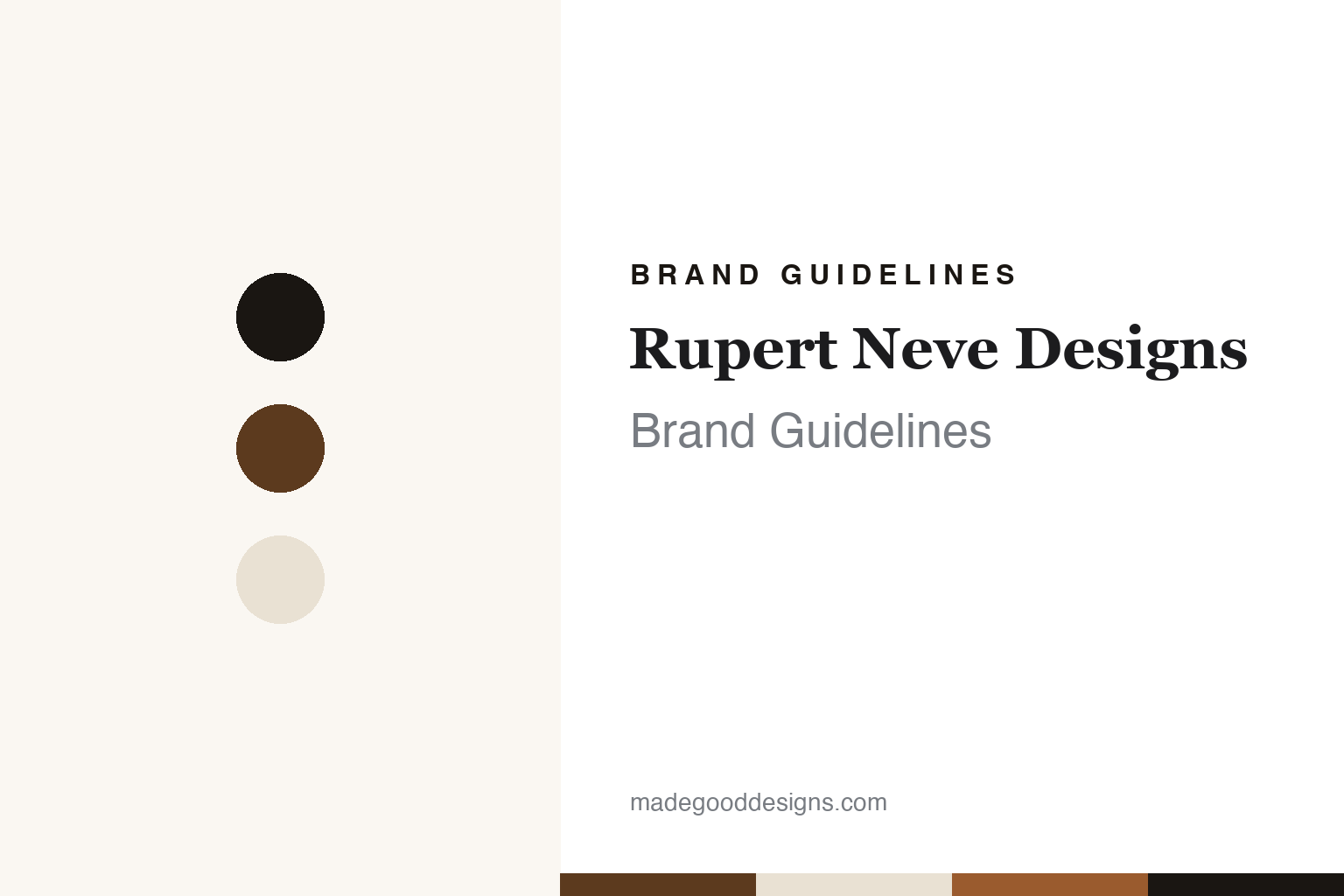
Rupert Neve Designs Brand Guidelines
The Texas company Rupert Neve founded in 2005.
Aa
Two constants: a Rupert Neve Designs limestone, oak and copper palette and a Classic serif register. Abstract homage — not a Rupert Neve Designs product or mark; no unit, logo or nameplate is reproduced.
A second company, a full name
Rupert Neve in the Texas Hill Country.
Rupert Neve Designs is the audio-equipment maker of Wimberley, a small town in the Texas Hill Country. It was founded in 2005 by the British-born engineer Rupert Neve, his wife Evelyn Neve and Josh Thomas, the company says; Sound On Sound and Pitchfork, in their reports of February 2021, also date the company to 2005. The Neves had moved to Wimberley in 1994 and became US citizens in 2002, and in 2005 they “acquired premises near where they had settled” to start the business, the company says.
The name invites confusion, so it is worth being plain. Rupert Neve’s first company, Neve Electronics, was founded in England in 1961 and sold in the mid-1970s; through later owners it became part of AMS Neve, the Burnley company that sells under the Neve name today. Rupert Neve Designs says the two “are not the same company, and have no affiliation with one another,” and that Rupert Neve “did not design anything Neve-branded” after the sale. Its products carry the full name, Rupert Neve Designs, rather than the Neve name, which AMS Neve lists as its registered trademark.
Before Neve Electronics, the company says, Rupert Neve worked for Rediffusion and Ferguson Radio and made hi-fi amplifiers and loudspeakers under the name CQ Audio. Between his first company and his last came a long career as a consultant. Rupert and Evelyn Neve set up ARN Consultants in 1975; in 1985 they founded Focusrite, which went into liquidation in 1989, when Phil Dudderidge bought its assets for the company now known as Focusrite Audio Engineering; and from 1989 Rupert Neve designed consoles and outboard equipment for Amek of Manchester, including the 9098 range. He also designed a preamplifier and pickup system for Taylor Guitars and, from 2011, microphones with sE Electronics, according to Sound On Sound.
Colour
Portico, the 5088 and Shelford.
The company began with the Portico series in 2005: modular outboard units — microphone preamplifiers, equalisers and compressors — that took ideas from Rupert Neve’s work at Neve, Focusrite and Amek, the company says. The 5088 analogue mixing console followed; Rupert Neve Designs calls it the culmination of his console thinking and says it uses custom transformers on every input and output and discrete op-amps of its own design. Later lines include the Portico II channel and bus processors, 500-series modules, the Shelford series introduced in 2013, whose channel strips draw on classic Neve circuits such as the 1073 and the 2254 compressor, and the Newton Channel, Master Bus Transformer and OptoFET. Many of the units have a circuit feature the company calls Silk, which it says adds tonal flexibility; Sound On Sound reported the OptoFET’s launch in January 2026.
The company has moved beyond the studio. The RNDI direct boxes, the 5045 Primary Source Enhancer and the RMP-D8, a Dante-networked eight-channel microphone preamplifier released in 2018 and described by the company as Rupert Neve’s first digital design, are aimed at live sound. Yamaha launched Rupert Neve Designs plug-ins for its Steinberg platform in 2011, the company says, and in 2019 it launched Fidelice, a home-listening range launched with a headphone amplifier, a phono stage and a digital-to-analogue converter — a return, it says, to the hi-fi Rupert Neve made with CQ Audio in the 1950s. In 2026 it introduced its first AAX, AU and VST3 plug-ins.
Rupert Neve Designs says all of its products are “designed, manufactured, and tested in the USA,” and its website carries a “Made in the USA” line; it also says it designs its own audio transformers. We found no independent account of its factory to confirm the claim, so we give it as the company’s.
Typography
British consoles and the studio trade.
The seven makers in this guide build recording-studio equipment, from large mixing consoles to desktop interfaces.
Solid State Logic, founded by Colin Sanders in 1969, says its headquarters has been at Begbroke Manor, near Oxford, since 1986; it was bought in 2017 by Audiotonix, a British console group that says it agreed new investment from PAI Partners in 2024, with Ardian and Astorg keeping minority stakes. AMS Neve, formed by Siemens in 1992 from Neve Electronics and Advanced Music Systems, says it has been privately owned since 1996 and makes its products in Burnley, Lancashire.
In the United States, API, formed in 1969, is in Jessup, Maryland, and is owned by its president, Larry Droppa, according to English Wikipedia. Rupert Neve Designs, founded in 2005 by Rupert Neve, Evelyn Neve and Josh Thomas, is in Wimberley, Texas; MOTU says it is based in Cambridge, Massachusetts. Apogee Electronics was acquired in November 2025 by Rockforce Tech Holding Inc., the parent of Manley Labs, and says it will stay in Santa Monica.
Behringer, founded by Uli Behringer in 1989, is part of his Music Tribe group, and its own timeline marks 25 years of production in China; English Wikipedia places its Music Tribe City factory in Zhongshan, Guangdong.
Rupert Neve Designs says its products are designed, manufactured and tested in the USA. Solid State Logic, API, MOTU and Apogee do not say, on the pages we checked, where their current products are made, and we have not guessed.
This guide sets out what can be checked about each brand — who founded it, who owns it, and what it says about where its products are made — and marks clearly what rests only on the company’s own word.
Aa
A classic serif for a company built on a founder’s full name. (Specimen set in Libre Baskerville, a serif STAND-IN; NOT the Rupert Neve Designs logo.)
Rupert Neve Designs
A team trained to carry on.
Rupert Neve died in Wimberley in February 2021, aged 94, Sound On Sound reported on 13 February that year. The company presents Josh Thomas as its co-founder and general manager — he said he had worked with Rupert Neve “for nearly 30 years” — and says its founder spent years training a team to carry on his design methods. We found no independent dated report of a sale or change of ownership since his death, and the company does not publish who owns it; its website names the business as Rupert Neve Designs, LLC.
Rupert Neve’s own reputation is documented independently. He received a Technical Grammy for lifetime achievement in 1997, and in December 1999 Studio Sound magazine named him first in its list of the audio personalities of the 20th century, according to English Wikipedia. The company says Rupert Neve Designs products have won 16 TEC Awards. Its mission statement, attributed to Evelyn Neve, speaks of “harnessing hidden powers of human creativity in electronics, magnetism and sound.”
For a design guide, Rupert Neve Designs shows how a founder’s full name can become a brand when his surname alone belongs to someone else. Compare AMS Neve, the Burnley company that sells under the Neve name, and API, another American console maker. For this guide we use limestone, oak brown and a copper with a serif, an unofficial interpretation; no product or logo is reproduced.
Explore & save
Keep Rupert Neve Designs’s identity on hand — save it to a board in the Made Good inspiration library.
Rupert Neve Designs identity set
Pin the Rupert Neve Designs limestone, oak and copper palette and the Classic serif register to your own board.