Antelope Audio Brand Guidelines
The master-clock maker with a San Francisco past and a Sofia base.
Aa
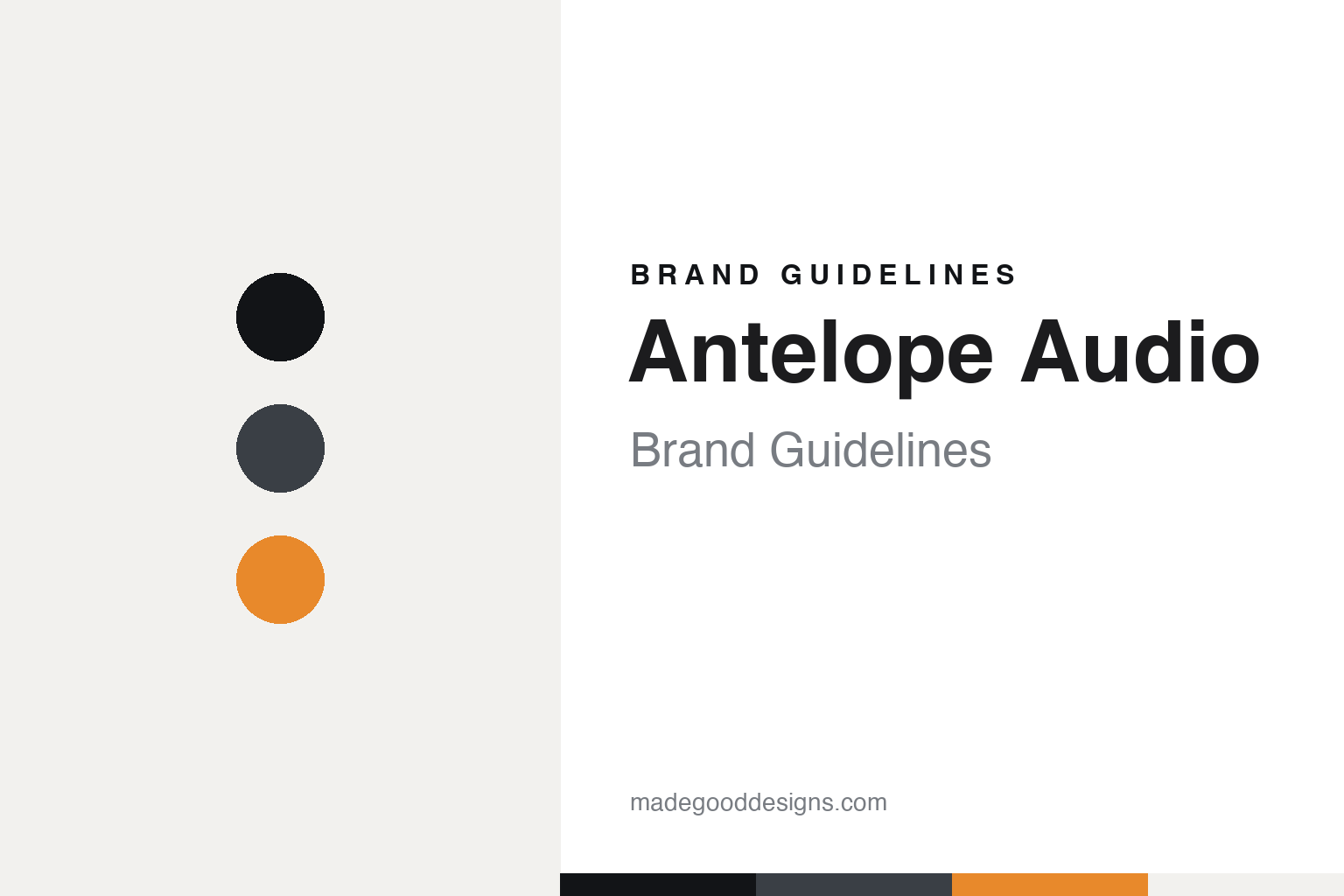
Two constants: an Antelope black, graphite and amber palette and a Geometric sans register. Abstract homage — not an Antelope Audio product or mark; no device, logo or nameplate is reproduced.
After Aardvark
A clock designer starts again.
Antelope Audio is the second company of the designer Igor Levin. Stereophile, in a review by Jon Iverson posted in August 2014, set out the sequence: Levin’s Aardvark Audio “began offering digital clocks and converters for recording studios in 1990, and quickly became known for its AardSync external clock. Aardvark eventually closed, and Levin opened Antelope Audio in 2005.” The company’s own about page, archived in 2016, put it more briefly: Antelope “is the brainchild of Igor Levin, best known for creating the legendary AardSync.” A 2020 post on the company blog calls him Antelope’s “founder and owner”; we give that as the company’s description.
The earliest captures of the website, from March 2005, fit that date. The first “company” page said Antelope had been “founded by industry veterans with a shared belief that digital audio hardware can be done better,” and listed a phone number in San Francisco’s area code. A German-language page archived in 2007 named the business as Antelope Audio Inc. of San Francisco, and as late as 2014 Stereophile’s specification box still gave the manufacturer as “Antelope Audio, San Francisco, CA.” Where the company is based today is a different answer, which we come to below.
The idea Antelope built its name on was the studio master clock: a box that sends one timing reference to every digital device in a room, so that converters and recorders sample in step. Clock accuracy, and the timing error called jitter, is the problem Levin had worked on at Aardvark, and it runs through almost everything the company has sold since.
Colour
Clocks, converters and then everything else.
Antelope’s first reputation came from the Isochrone clocks. Stereophile wrote that Levin made “his mark in recording studios with the Isochrone digital clock and, later, a line of premium A/D and D/A converters.” The engineering idea behind them was heat. Antelope’s Marcel James told the magazine that Levin felt that “if he could keep the word clock’s quartz crystal oscillator at a constant temperature, he could significantly improve its performance,” so he sealed the oscillator in its own enclosure — what the company calls oven-controlled clocking.
The company then went further, to atomic clocks. Its 10M uses a rubidium reference that Stereophile, reporting from a show in June 2012, said was claimed to be “100,000 times more stable than a traditional crystal oscillator,” and the about page says Antelope “pioneered the adoption of Atomic clock generators in Audio Master Clocks”; both are the company’s claims. The same year it moved into home audio with the Rubicon Atomic, a converter and preamplifier with a built-in atomic clock, which Stereophile put at $40,000 and described as looking like something out of a classic science-fiction film. The smaller Zodiac converters followed; in 2014 the magazine reviewed a Zodiac Platinum bundle with its Voltikus power supply at $5,500.
The studio interfaces came next. Reviewing the Orion 32 in June 2013, Sound On Sound wrote that it was “apparently” the world’s first 32-channel, 1U USB interface. In February 2014 the same magazine measured the Eclipse 384 converter at about 121dB of dynamic range — excellent, it said, but short of the 123dB and 129dB claimed. By 2016, an archived copy of its website shows, Antelope was promoting effects modelled on vintage hardware and run on FPGA chips inside its interfaces — now sold as Synergy Core — and it later added modelling microphones, monitor speakers and monitor controllers. Its range in 2026 runs from the Zen and Orion interfaces to the Galaxy 64, the Pure 2 mastering converter and the Isochrone Trinity, OCXHD and 10MX clocks.
Typography
Design and documentation.
The makers in this guide build the equipment that turns sound into numbers and back again — analog-to-digital and digital-to-analog converters, clocks, and the audio interfaces that connect microphones to computers. Their reputations were made in recording and mastering studios, and several now also sell to home musicians.
They are spread across Europe and the United States. Weiss Engineering is in Uster, near Zurich, according to its website. Prism Sound says it has been based since 2008 in the former SADiE building at Stretham, Cambridgeshire, after buying that company. Antelope Audio is the trading name of Elektrosfera Ltd. of Sofia, Bulgaria, according to its privacy policy.
In the United States, Benchmark Media Systems ships its orders from what it calls its factory in Syracuse, New York; Lynx Studio Technology gives its address as Costa Mesa, California; and Universal Audio is based in Scotts Valley, California, according to the companies’ websites.
Ownership varies more than location. Focusrite, of High Wycombe in Buckinghamshire, is the only listed company here: shares in its parent, Focusrite plc, trade on the London Stock Exchange’s AIM market, and the group also owns brands including Novation and ADAM Audio, according to Wikipedia. Universal Audio is privately held, Wikipedia says. Prism Sound’s studio business has operated since 2019 under Audio Squadron, alongside Tracktion and SADiE, while the original 1987 company is controlled by its founders’ firm, Companies House shows. For Weiss, Benchmark, Lynx and Antelope we found no parent company in the sources we checked.
This guide sets out what can be checked about each brand — who founded it, who owns it, and what it says about where its products are made — and marks clearly what rests only on the company’s own word.
Aa
A geometric sans for a company of clocks and converters. (Specimen set in Sora, a sans STAND-IN; NOT the Antelope Audio logo.)
Antelope Audio
An American address, a Bulgarian company.
Is Antelope American or Bulgarian? On the evidence, it has been both. The early website and Stereophile placed it in San Francisco. Its current terms of use say that “Antelope Audio is the trade name” under which Elektrosfera Ltd, a company registered in Bulgaria, does business; that Antelope “is doing business from its office in Bulgaria”; and that disputes go to the arbitration court of the Bulgarian Chamber of Commerce and Industry. Its management address is in Sofia. The English-language shop, the same page adds, is run by a separate distribution company, Earbyte Inc. We did not find a dated source for when the business moved its centre to Bulgaria, so we do not give one.
Where the hardware is built is less clear. The company’s terms of sale say European orders are shipped “directly from the manufacturer’s warehouse in the Republic of Bulgaria,” naming Elektrosfera as the manufacturer; we found no statement on whether circuit boards and chassis are made in-house or by suppliers, so we say only what the company says. None of the sources we checked describes a factory.
The product names follow a pattern: many are taken from stars and constellations — Orion, Galaxy, Zodiac — alongside clocks named for time itself, such as Isochrone. Antelope does not publish colour values or name its typeface, so the palette here is ours.
For a design guide, Antelope Audio shows how a narrow technical idea — a better clock — can carry a whole product family and a visual language with it. Compare RME, the German interface maker, and Mytek, a converter maker that also splits its story between two countries. For this guide we use black, graphite and an amber with a sans, an unofficial interpretation; no product or logo is reproduced.
Explore & save
Keep Antelope Audio’s identity on hand — save it to a board in the Made Good inspiration library.
Antelope Audio identity set
Pin the Antelope black, graphite and amber palette and the Geometric sans register to your own board.