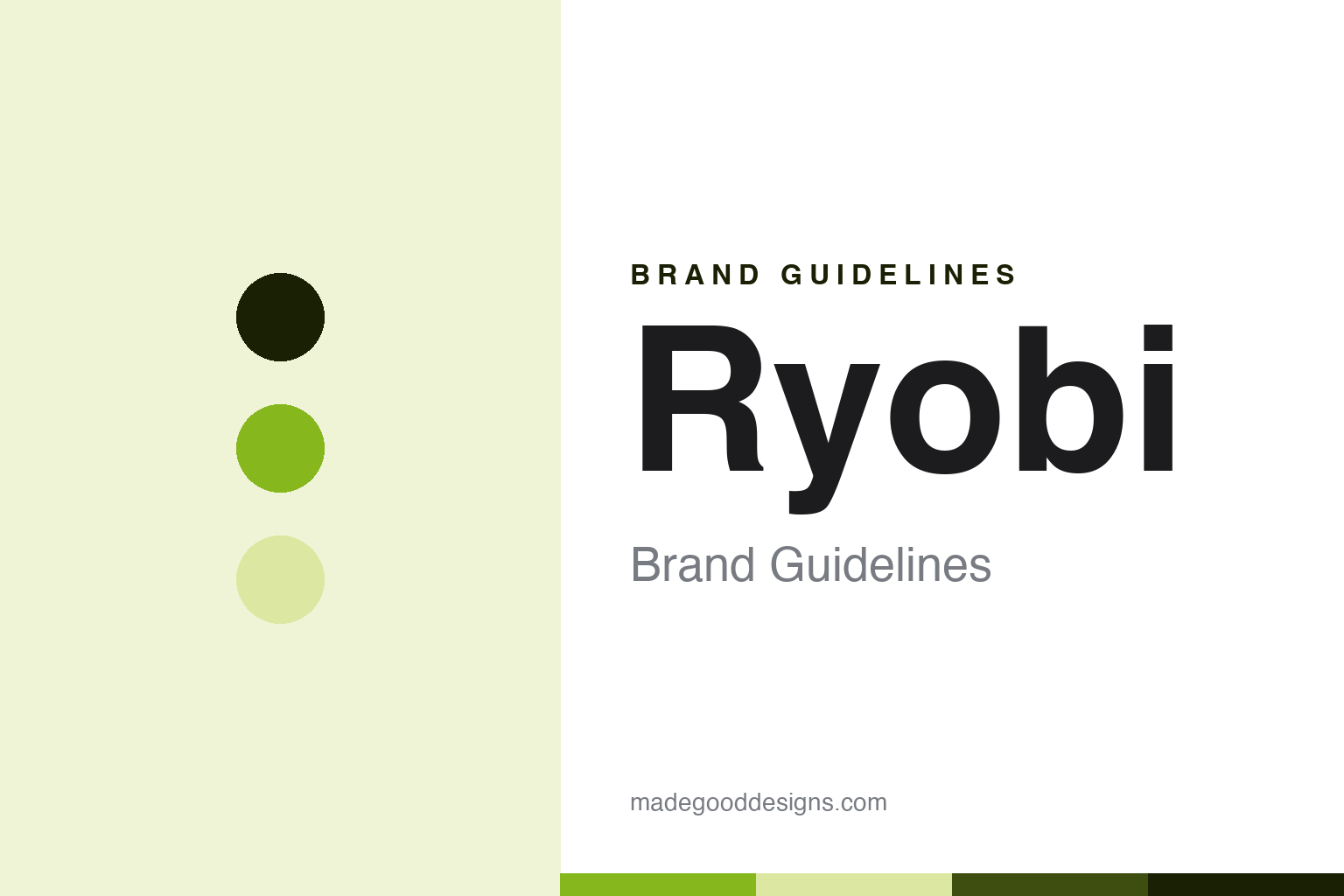
Ryobi Brand Guidelines
The licensed lime-green tool.
Aa
Two constants: a Ryobi-lime palette and a licensed-sans register. Abstract homage — not a Ryobi product or mark; no washer, tool or logo is reproduced.
The licensed lime-green tool
Ryobi is the Home Depot value brand made by Hong Kong’s Techtronic Industries under a trademark license from Japan’s Ryobi Limited — whose pressure washers drew a major 2025 recall.
Ryobi closes the pressure-washer round as its licensed-name node — the lime-green value tools sold at Home Depot, made by a Hong Kong conglomerate under a trademark license from a Japanese company, spanning power tools and pressure washers. Its answer to a round about who owns the washers is the licensed one: a famous name whose maker and its licensor are different companies.
Its identity is the licensed lime-green tool. The TTI manufacture, the Ryobi Limited license and the lime-green line are the story here. Licensed name, other maker. The licensed lime-green tool.
(Honest notes, so the licensing, the making and a recall are framed accurately, with the key structure and one big dated item. Ryobi sells value tools and outdoor power as its heroes — the lime-green ONE+ line and its electric and gas pressure washers; we report its language as the brand’s own. On the licensing, the key point: Ryobi is a trademark of Ryobi Limited of Japan, used by Techtronic Industries under license, and Ryobi Limited has no ownership stake in TTI, so the lime-green tools sold at Home Depot are a TTI product under a Japanese-owned trademark license, not made by Ryobi Limited Japan. On the regional nuance: the license is regional, and in 2018 Ryobi Limited moved its remaining power-tool business to the Kyocera Group, so Ryobi power tools outside TTI’s territories are now Kyocera. On the parent: TTI is a Hong Kong company listed there, which also owns Milwaukee, the one power-tool trademark it actually owns. On the making: TTI manufactures largely in China, so for Ryobi we keep it high-level. On a documented recall, major and dated: in 2025 TTI recalled about 764,000 US and 16,000 Canadian Ryobi electric pressure washers over a capacitor that can overheat and burst, with a related class action alleging the remedy was insufficient, which we attribute as a plaintiff claim. Its designs and the Ryobi name are IP we describe but do not reproduce; there is no official brand hex; these tones are an unofficial interpretation.)
Colour
Ryobi lives in a Ryobi lime. Click a swatch to copy the hex.
Ryobi’s identity is licensed, TTI-made and value-DIY — a Ryobi lime, an ink, a pale lime, a deep olive, and a paper. The palette leans Ryobi lime and deep olive: a bright, unmistakable register that nods to the iconic lime-green tools rather than a loud logo colour. It signals the licensed lime-green tool — licensed, TTI-made and value-DIY. The honest caveat: with the lime-green iconic but no official hex verified, these values are a bright, unofficial interpretation, not first-party colours.
The lesson is a Ryobi lime signals a value, DIY identity. Ryobi’s world is the Home Depot aisle. For designers, it is a reminder that a bright lime and a deep olive can carry a value, DIY brand — a bright tone held as an accent, not a product shot. Because a bright hue fails as small text, keep type dark and let the colour live in the accents, palette and band. The takeaways: explain the TTI-under-Ryobi-Limited license and the 2018 Kyocera move; name TTI as the Hong Kong maker; keep the making high-level as China; and date the 2025 electric-pressure-washer recall.
Typography
The register is a licensed sans — licensed, TTI-made, value-DIY.
Ryobi’s identity carries a licensed, TTI-made spirit — a famous name on a maker’s value tools. A licensed sans captures the mood: clean, bright and accessible, the register of a DIY tool line. Set in a Ryobi-lime palette, the licensed sans feels energetic and approachable — exactly the personality Ryobi carries. It behaves like a made, shelved thing rather than a loud logo, mirroring a jet-arc and a stream-line. (Ryobi’s real products and the name are things we describe but do not reproduce, and the exact typeface is not ours to use.) Because it is not ours to use, the honest description is “a licensed-sans brand,” shown here in a stand-in. The type behaves like the brand: licensed, TTI-made and value-DIY.
Aa
A licensed-sans brand — energetic and approachable. (Specimen set in Space Grotesk, a licensed-sans STAND-IN; NOT the Ryobi logo or products.)
The pressure-washer node
Ryobi stands for the licensed lime-green tool.
Ryobi closes the round as its licensed-name node. A Ryobi-lime palette, a licensed sans and a TTI manufacture make one thing — the licensed lime-green tool — the whole identity: licensed, TTI-made and value-DIY. The TTI manufacture is the reality, the Ryobi Limited license is the frame, and the lime-green line is the icon. The point is a famous name whose maker and its licensor are different companies, in a round about who owns the washers.
Put to work, the identity is the brand told straight, the license explained and the recall dated. A brand in this spirit would explain the TTI-under-Ryobi-Limited license and the 2018 Kyocera move, name TTI as the Hong Kong maker, keep the making high-level as China, and date the 2025 recall. A reader in this spirit would keep the facts right: Ryobi sells lime-green ONE+ tools and pressure washers at Home Depot; the Ryobi name is a Ryobi Limited trademark used by TTI under license; TTI is a Hong Kong company that also owns Milwaukee; and TTI recalled about 780,000 Ryobi electric pressure washers in 2025 over a capacitor hazard. Ryobi closes the round, after Greenworks. The honest editorial moves are to explain the license, to name the maker, to keep the making high-level, and to date the recall.
For designers and brand-builders, Ryobi closes the pressure-washer node: explain a trademark license — and date a major recall precisely. The lessons: a brand can be a licensed name made by someone other than its trademark owner, here Ryobi; a license is explained, the Ryobi trademark owned by Ryobi Limited of Japan and used by Techtronic Industries under a regional license, with Ryobi Limited holding no stake in TTI and its other-region power-tool business moved to Kyocera in 2018; a maker is named, TTI, a Hong Kong company that also owns Milwaukee, the one power-tool trademark it actually owns; a making is kept high-level as largely China; and a recall is dated precisely, the 2025 recall of about 764,000 US and 16,000 Canadian Ryobi electric pressure washers over a capacitor overheat-and-burst hazard, with a related class action attributed as a plaintiff claim rather than a finding. It is also a reminder to stay precise: Ryobi is the TTI-made, Ryobi-Limited-licensed lime-green value brand of the pressure-washer aisle — with the palette here an unofficial interpretation. The hook is that structure: Ryobi is the licensed lime-green tool, the Home Depot value brand made by Hong Kong’s Techtronic Industries under a trademark license from Japan’s Ryobi Limited, whose pressure washers drew a major 2025 recall. Read that way, Ryobi is less a single washer than the licensed lime-green tool: licensed, TTI-made, value-DIY. The lesson for a brand is that explaining a trademark license and dating a major recall precisely reinforce the honesty, and naming the maker keeps it earned. Ryobi made the-licensed-lime-green-tool the identity — proof that an honestly-explained licensed name can close a round.
Explore & save
Keep Ryobi’s identity on hand — save it to a board in the Made Good inspiration library.
Ryobi identity set
Pin the Ryobi-lime palette and the licensed-sans register to your own board.