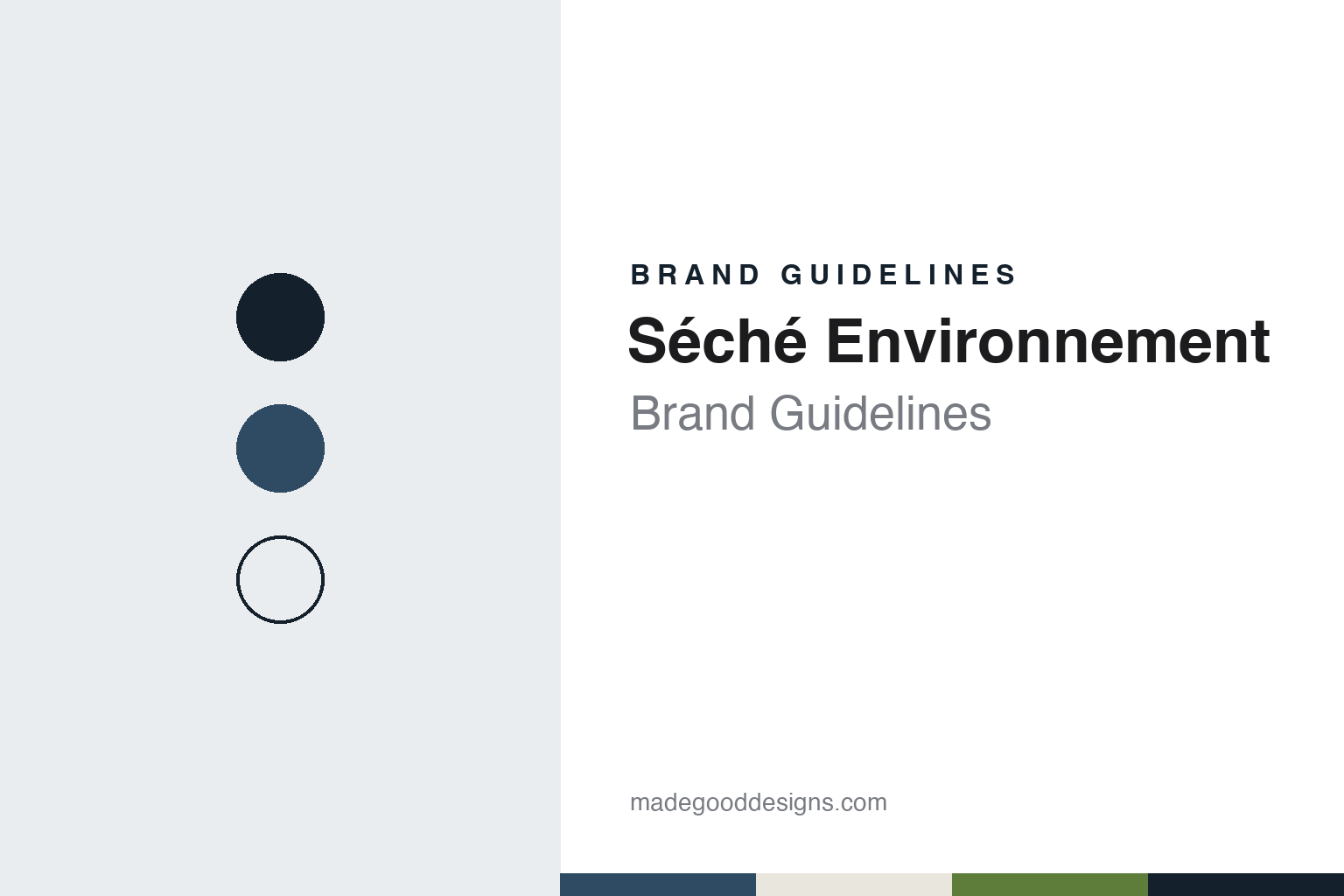
Séché Environnement Brand Guidelines
A Mayenne landfill, a family name and a group built on hazardous waste.
Aa
Two constants: a slate blue, moss and limestone palette and a geometric sans register. Abstract homage — not a Séché Environnement asset or mark; no logo, vehicle or site is reproduced.
Laval Services
A family public-works firm turns to waste.
Séché Environnement grew out of a small family public-works business in the Mayenne département of western France. French Wikipedia dates the turning point to 1984, when Joël Séché took over the family firm and began moving it towards environmental work; the company’s own history puts the start in 1985. It says he set up Laval Services, the first entity of the future group, and, at the request of the mayor of Laval, looked for a better answer to the town’s rubbish tip. The result was a storage site for non-hazardous waste at Changé, just outside Laval, which the company says was the first in France built to modern standards.
Changé became the group’s home ground. In 1993 an ecologist carried out a biodiversity impact study on the site, the company says, and in 1994 it opened what it calls a “waste activity park” there, adding a storage centre for hazardous waste. A sorting centre followed in 1997. The company also says that in 1996 it became the first company in the waste sector anywhere to gain ISO 14001 environmental-management certification; that is its own claim.
In 1997 the group joined the Second Marché of the Paris Bourse. The company describes itself as the first French waste specialist to be listed, and French Wikipedia records the same 1997 listing. Séché Environnement is still listed in Paris. French Wikipedia says that at the end of 2023 Joël Séché and his family were its majority shareholders, and the company calls itself a family group; its chief executive today is Maxime Séché.
Colour
Hazardous waste, solvents and energy.
The listing was followed by a run of acquisitions. In 2001 Séché bought Alcor, the waste arm of the Caisse des Dépôts, and took full control of DRIMM, a multi-stream waste centre in the Montauban area of the south-west. In 2002 it bought Tredi, a specialist in incineration and physico-chemical treatment of hazardous waste, and added Speichim Processing and Valls Quimica, two distillation specialists that regenerate solvents and purify chemical intermediates. French Wikipedia says the Tredi deal roughly doubled the size of the group. Between 2007 and 2013 Séché also held a third of the water company Saur, a stake it gave up to Saur’s creditor banks in 2013, French Wikipedia says.
Energy became a second product. From 2008, the company says, its storage sites captured biogas and its thermal-treatment plants recovered heat, with the electricity fed into the public grid. It won public-service contracts to run the energy-from-waste plants of the Strasbourg metropolitan area, Sénerval, in 2010 and of Nantes Métropole, Alcéa, in 2011. In 2017 it started up what the company and French Wikipedia both describe as France’s first boiler fired with solid recovered fuel; French Wikipedia places it at Changé, the company at Laval.
The company lists the collection, sorting, recovery and treatment of hazardous and non-hazardous waste; clean-up of polluted sites and soils; solvent and bromine recycling; sanitation services; industrial water treatment; and low-carbon energy. A bromine regeneration unit opened at Saint-Vulbas in 2015, and the group set up its research centre there in 2018. Other subsidiaries carry their own names, among them Séché Healthcare, for healthcare waste, and Séché Urgences Interventions, an environmental emergency service launched in 2015.
Typography
How waste groups present themselves.
Waste and recycling companies rarely sell a product people choose off a shelf. Their identity is carried instead by the things the public sees every week: collection vehicles, bins, depots and, increasingly, large plants on the edge of town. Some of those marks have long histories. English Wikipedia records that the London firm Cory gave its colliers a black funnel with a white band and a black diamond, flew a red house flag with a cream diamond, and later painted its road haulage vehicles white with the same black lozenge.
On their own websites, the companies in this guide arrange themselves around services rather than products: collection, recycling and energy recovery, each with its own page. Viridor’s site leads with energy from waste, decarbonisation and what it calls Circular Solutions; Cory’s explains, step by step, how a black bag travels from a riverside transfer station by barge to its Riverside plant at Belvedere, and how ash from the process becomes aggregate. Those pages describe the work as the companies describe it, and this guide treats them that way.
Photography does much of the branding. Plants, barges, tugs, sorting halls and depots appear far more often than logos, and new facilities are announced with architects’ impressions long before they open; the trade weekly letsrecycle.com illustrated its 2022 report on Cory’s second Belvedere plant with one.
The other constant is the dated report. Viridor published its ESG report for the 2026 financial year in October 2026, and Cory published its 2025 annual and sustainability reports in June 2026, each with tonnages, electricity generated and progress on new plants. This guide uses such figures only as the companies or a dated source give them, and sets out what can be checked about each firm: who founded it, who owns it and how it presents its work.
Aa
A geometric sans for a group that signs with a family name. (Specimen set in Outfit, a sans STAND-IN; NOT the Séché Environnement logo.)
Séché Environnement
From Changé to Singapore.
International growth began in 2015. That year the company opened Kanay in Peru; in 2017 it added the hazardous-waste firms San in Chile and Taris in Peru, the environment arm of the Charier group, and the Spanish industrial chemical-cleaning company Solarca. In 2019 it bought Interwaste, which it calls one of the major integrated waste operators in South Africa and southern Africa, and the Italian hazardous-waste specialist Mecomer. French Wikipedia lists later purchases including Spill Tech in South Africa in 2021 and, in 2023, Furia in Italy, Rent-a-Drum in Namibia and Essac in Peru.
In Asia, Séché bought all of ECO, a Singapore specialist in hazardous industrial waste, on 18 July 2024, Le Figaro reported in November 2024, when it also reported an agreement for the infrastructure investor CVC DIF to take 49.9% of ECO through a reserved capital increase, with ECO staying fully consolidated in Séché’s accounts. A further purchase in France, the hazardous-waste group Flamme from the Nord, was announced in June 2025; the business news service API of Ouest-France reported on 29 October 2026 that the deal had been notified to the competition authority eleven months after the announcement and was still not confirmed, so it remains pending at the time of writing.
Today the company says it employs more than 7,400 people, about 3,000 of them in France, at more than 120 sites, with operations listed in countries from Germany and Italy to South Africa, Peru and Singapore. In July 2026 it inaugurated Le Chêne, a new head office in Laval built on a former railway site in the station district, which brings together about 280 support staff. The company says the group was born in Changé more than forty years ago, and its storage site there now runs as Séché Eco Industries.
For a design guide, Séché Environnement shows how a family name can sign an industrial group that runs from one Mayenne storage site to plants in Europe, Africa, South America and Asia, while subsidiaries such as Tredi keep their own names beneath it. Compare it with Paprec and Derichebourg, two other French groups in waste and recycling. For this guide we use slate blue, moss green and limestone with a geometric sans, an unofficial interpretation; no product or logo is reproduced.
Explore & save
Keep Séché Environnement’s identity on hand — save it to a board in the Made Good inspiration library.
Séché Environnement identity set
Pin the slate blue, moss and limestone palette and the geometric sans register to your own board.