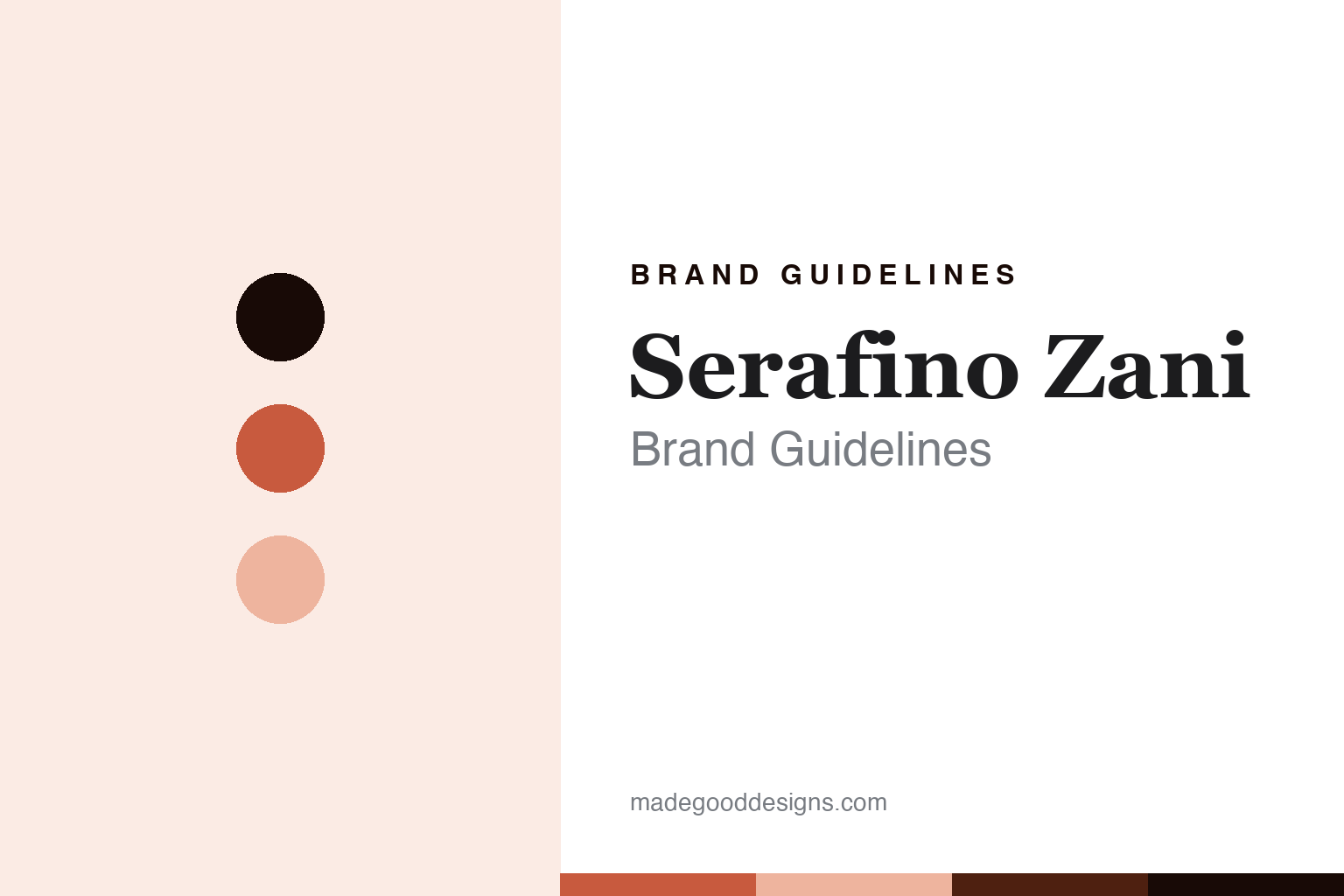
Serafino Zani Brand Guidelines
The Italian design-author flatware.
Aa
Two constants: a Sottsass-coral palette and a design-author-serif register. Abstract homage — not a Serafino Zani product or mark; no cutlery silhouette, no designer pattern, and no logo is reproduced.
The Italian design-author flatware
Serafino Zani is the Lumezzane flatware maker with Sottsass and Grcic collaborations, made in Italy.
Serafino Zani brings the round its design-author — the Italian flatware maker from Lumezzane, since 1963, whose ranges carry collaborations with named designers, from Ettore Sottsass to Konstantin Grcic, made in Italy’s Lombardy metalworking district. Serafino Zani makes flatware, and its answer to a round about the cutlery drawer is authorship — an Italian-made cutlery signed by design names rather than sold anonymously. A brand, authored.
Its identity is the Italian design-author flatware. The Lumezzane making, the named-designer collaborations and the Italian production are the story here. A brand, authored. The Italian design-author flatware.
(Honest notes, so the story stays precise, and the designers stay credited. Serafino Zani, since 1963, makes flatware — with lines such as its five-star, accent and slim ranges — in Lumezzane, in the province of Brescia, and we report its performance language as the brand’s own marketing. On its design, the authorship theme of this round, it has confirmed collaborations with the designers Ettore Sottsass and Konstantin Grcic, whom we credit by name rather than reproduce; a sometimes-suggested link to another design name we could not confirm, so we do not assert it. On where it is made, the star theme of this round, it makes in Italy, in the Lombardy metalworking district. On who owns it, a theme of this round, it is likely an Italian family firm, though the ownership type we could not verify, so we describe it carefully. Its designs are IP we describe but do not reproduce; there is no official brand hex; these tones are an unofficial interpretation.)
Colour
Serafino Zani lives in a Sottsass coral. Click a swatch to copy the hex.
Serafino Zani’s identity is authored, Italian and designed — a Sottsass coral, an ink, a pale apricot, a deep terracotta, and a paper. The palette leans Sottsass coral and pale apricot: a warm, design-forward register that nods to a signed Italian cutlery rather than a loud logo colour. It signals a design-author maker. The honest caveat: with no published brand hex, these values are an original, unofficial interpretation, not first-party colours, and a general design-era tone rather than any specific designer’s work.
The lesson is a Sottsass coral signals an authored, Italian identity. Serafino Zani’s world is a forged, finished object. For designers, it is a reminder that a warm coral and a soft pale apricot can carry a cutlery brand — the tone of design-led Italy. Because these tones can fail as small text, keep type dark and let the colour live in the accents, palette and band. The takeaways: make it in Lombardy; credit the designers; describe the ownership carefully; and treat any single hex as unofficial.
Typography
The register is a design-author serif — authored, editorial, designed.
Serafino Zani’s identity carries an authored, editorial, designed spirit — a design-led maker, not a graphics label. A design-author serif captures the mood: refined, expressive and confident, the register of a signed Italian cutlery. Set in a Sottsass-coral palette, the design-author serif feels authored and designed — exactly the personality Serafino Zani carries. It is a forged object rather than a logo, mirroring brushed stainless. (Serafino Zani’s real flatware and its designers’ patterns are things we describe but do not reproduce, and the exact typeface is not ours to use.) Because it is not ours to use, the honest description is “a design-author-serif maker,” shown here in a stand-in. The type behaves like the brand: authored, editorial and designed.
Aa
A design-author-serif maker — authored and designed. (Specimen set in Playfair Display, a design-author-serif STAND-IN; NOT the Serafino Zani logo, a designer pattern or any cutlery.)
The flatware
Serafino Zani stands for the Italian design-author flatware.
Serafino Zani brings the round its design-author. A Sottsass-coral palette, a design-author serif and a Lumezzane base make one thing — the Italian design-author flatware — the whole identity: authored, Italian and designed. The Lumezzane making is the pitch, and the named-designer collaborations are the edge. The point is an Italian-made cutlery signed by design names rather than sold anonymously, in a round that maps who really makes the cutlery drawer.
Put to work, the identity is authorship told straight, as making — with the designers credited and the ownership described carefully. A maker in this spirit would make it in Lombardy, credit the designers, and describe the ownership carefully. A reader in this spirit would keep the facts right: Serafino Zani, since 1963, makes flatware — five-star, accent and slim ranges among them — in Lumezzane, in Brescia; it has confirmed collaborations with Ettore Sottsass and Konstantin Grcic, credited by name, with a further suggested designer link left unasserted; it makes in Italy, in the Lombardy metalworking district; and it is likely an Italian family firm, its ownership type described carefully rather than asserted. Serafino Zani joins the round’s genuine-own-making end and brings its clearest design-authorship, a different Italian voice from the first round’s Italian entry. The honest editorial moves are to date it to 1963, to credit Sottsass and Grcic, to decline the unconfirmed designer link, and to describe the ownership carefully.
For designers and brand-builders, Serafino Zani continues the cutlery drawer: make it in Lombardy — and credit the designers. The lessons: let named-designer authorship be the brand; credit designers by name rather than reproduce their patterns; decline a design attribution you cannot confirm; describe an unverified ownership type carefully; and never reproduce a piece of cutlery. It is also a reminder to stay precise: Serafino Zani is the Lumezzane flatware maker with Sottsass and Grcic collaborations, made in Italy — with the palette here an unofficial interpretation. Read that way, Serafino Zani is less a fork than an authorship: forged, Italian, signed. The lesson for a brand is that design authorship and Italian making reinforce each other, and crediting the designers keeps the story earned. Serafino Zani made the-Italian-design-author-flatware the identity — proof that authorship can carry a brand, the round’s clearest design signature.
Explore & save
Keep Serafino Zani’s identity on hand — save it to a board in the Made Good inspiration library.
Serafino Zani identity set
Pin the Sottsass-coral palette and the design-author-serif register to your own board.