Simons Brand Guidelines
A Quebec City dry-goods shop that became a national fashion house.
Aa
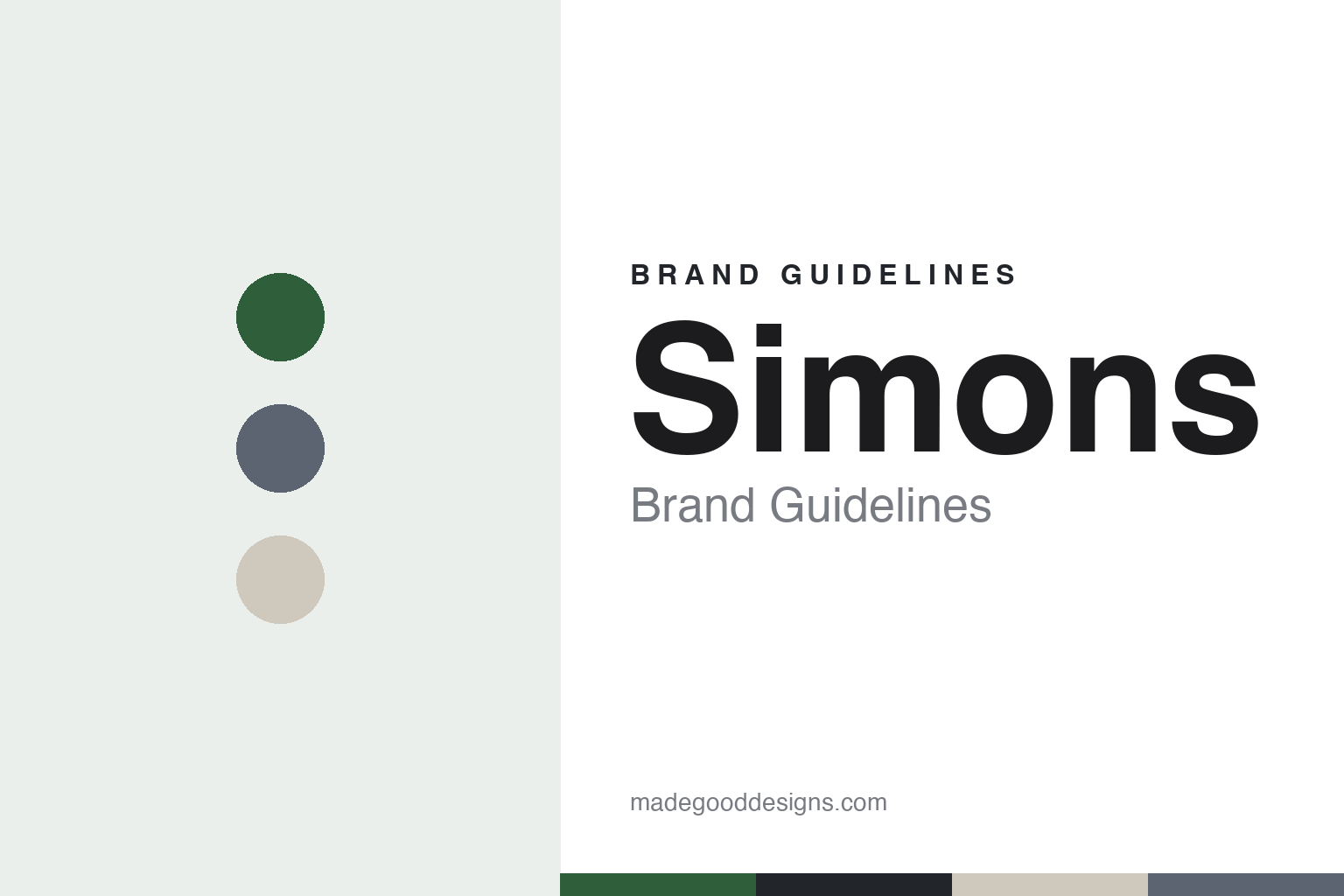
Two constants: a leaf green, charcoal and limestone palette and a clean geometric sans register. Abstract homage — not a Simons product or mark; no leaf symbol, wordmark or label is reproduced.
La Maison Simons
A dry-goods shop in Old Quebec.
Simons started as a small shop in Quebec City in 1840. English Wikipedia says its founder, John Simons, opened a dry-goods store at the age of 17; his father, Peter Simons, had come from Scotland and settled at Beauport, near Quebec City, in 1812. French Wikipedia places the first shop near the Porte Saint-Jean, one of the gates of the walled city. The business imported goods from Britain, and English Wikipedia says John Simons crossed the Atlantic many times to buy English and Scottish stock for it.
In 1870 the shop moved to Côte de la Fabrique in Old Quebec, where the store still trades and where, French Wikipedia says, the company’s head office also sits. The business ran under partnership names including Simons & Foulds and Simons & Minguy before the family became its sole owner in 1934, when it began to move from dry goods toward ready-to-wear clothing, according to English Wikipedia. The company calls itself La Maison Simons, and shoppers in both languages shorten that to Simons.
The change into a department store came in the 1950s. English Wikipedia says Gordon Donald Simons joined the company in 1952 and led its transformation into a department store, adding youth-focused fashion labels. Among them was Twik, named after the model Twiggy; French Wikipedia says the 1960s also brought the house labels Le 31 and La Contemporaine. The company stayed with the family, and English Wikipedia describes it as privately owned by the Simons family.
Colour
Slow growth, one store at a time.
For more than a century Simons was a single store. Its second location opened in 1961 at Place Sainte-Foy in Quebec City, where it introduced home decor and new men’s and women’s labels, and a third followed at Galeries de la Capitale in 1981, English Wikipedia says. Expansion across Quebec came from 1999, with stores in Sherbrooke and Montreal, then Saint-Bruno in 2001 and Laval in 2002.
The move beyond Quebec began in 2012 at West Edmonton Mall, the company’s seventh store and its first outside the province, according to English Wikipedia. Gatineau and Park Royal in West Vancouver followed in 2015, Square One in Mississauga and the Rideau Centre in Ottawa in 2016, and two Alberta stores, in downtown Calgary and at Londonderry Mall in Edmonton, in 2017. English Wikipedia says each store is designed individually with art installations and its own architecture; it quotes Peter Simons telling Canadian Business in 2015 that the company was working with the artist Douglas Coupland on a piece for its Vancouver store.
The pace stayed deliberate. In June 2024 CBC News described a chain with 10 stores in Quebec and a handful elsewhere, in Vancouver, Edmonton, Calgary, Halifax, Mississauga and Ottawa, and quoted a Toronto Metropolitan University retail professor saying the company had grown “relatively organically” across the country. Halifax, its first store in Atlantic Canada, opened in March 2024. Toronto came next: English Wikipedia says the chain opened at Yorkdale Shopping Centre on 14 August 2025, in a two-storey space formerly held by Nordstrom, and at the Eaton Centre on 18 September 2025. CBC reported in 2024 that the two Toronto stores would bring the total to 19.
Typography
Banners, own labels and flyers.
Canadian retail identities are often built in layers: a parent group, a set of store banners, and the own-label ranges that sit on their shelves. Loblaw Companies is a clear example. English Wikipedia describes it as running corporate and franchise supermarkets under 22 regional and market-segment banners, from the full-service Loblaws to the discount No Frills and Maxi, each with its own sign, store format and tone of voice.
Own labels carry much of the visual identity. Loblaw’s No Name range arrived in 1978 in plain yellow packaging, and its President’s Choice line followed in the mid-1980s with photography-led packs, according to the International Directory of Company Histories. Loblaw’s apparel label, Joe Fresh, began in 2006, English Wikipedia says. Loyalty schemes and flyers do similar work: Loblaw’s PC Optimum points programme runs across its grocery and pharmacy banners, and when No Frills built a 2020 campaign around shopper types, Canadian Grocer reported, one of them was a deal hunter who searches the weekly digital flyer before she shops.
Quebec adds a language layer. Some national chains trade under French names there: Shoppers Drug Mart has used the Pharmaprix banner in the province since its first Quebec store in 1972, Loblaw’s own history says, and Loblaw entered the Quebec grocery market in 1998 by buying the Quebec-based chain Provigo, whose name it kept.
Corporate pages tell the rest of the story. Groups such as Loblaw publish timelines of founders and acquisitions, investor pages and lists of banners, and these are useful for dates and ownership; this guide presents them as the company’s own account, alongside encyclopaedias, trade press and regulators. The brands that follow range from century-old grocers to fashion chains, and each is described by what the sources show about its names, formats and labels.
Aa
A clean geometric sans for a store that sells its own labels next to designer names. (Specimen set in Jost, a sans STAND-IN; NOT the Simons logo or wordmark.)
Simons
A green leaf, house labels and a first outside chief executive.
The Simons identity is a name and a leaf. French Wikipedia says the green leaf beside the Simons name stands for the cycle of the seasons and constant renewal, and that it was created by the Quebec artist Claude A. Simard. Inside the stores, much of what is sold carries the company’s own names. French Wikipedia lists ten house labels and spaces, among them Twik for teenagers and young women, La Contemporaine for women, Le 31 for men and Simons Maison for linens and homeware, alongside Édito, the space for international designers and emerging labels. English Wikipedia says the company runs buying offices in London, Paris, Florence and Hong Kong.
The business has also changed behind the stores. English Wikipedia says Simons took outside investment for the first time in May 2018, to help fund a new distribution centre in Quebec City; French Wikipedia says the centre was fully working by spring 2021, and that in autumn 2018 the company launched Fabrique 1840, an online marketplace for goods by Canadian artisans.
Leadership left the family in 2022. Hardlines reported on 16 March 2022 that Peter Simons was stepping down as chief executive after more than two decades and that Bernard Leblanc, executive vice-president and head of corporate operations, succeeded him, the first chief executive from outside the Simons family in the company’s 182-year history; Peter Simons stayed on as chief merchant and on the family council and advisory board. In the June 2024 CBC News interview, Leblanc said stores in Toronto, Montreal, Quebec City and Vancouver would carry the same inventory, adjusted to local buying, and described a customer base running from younger teenagers to mature adults.
For a design guide, Simons shows how a single green leaf and a set of house labels can carry a family store from Old Quebec to malls across the country. Compare Hudson’s Bay, the older department-store name that closed its stores in 2025, and Canada Goose, another Canadian fashion label. For this guide we use leaf green, charcoal and limestone with a sans, an unofficial interpretation; no product or logo is reproduced.
Explore & save
Keep Simons’s identity on hand — save it to a board in the Made Good inspiration library.
Simons identity set
Pin the leaf green, charcoal and limestone palette and the clean geometric sans register to your own board.