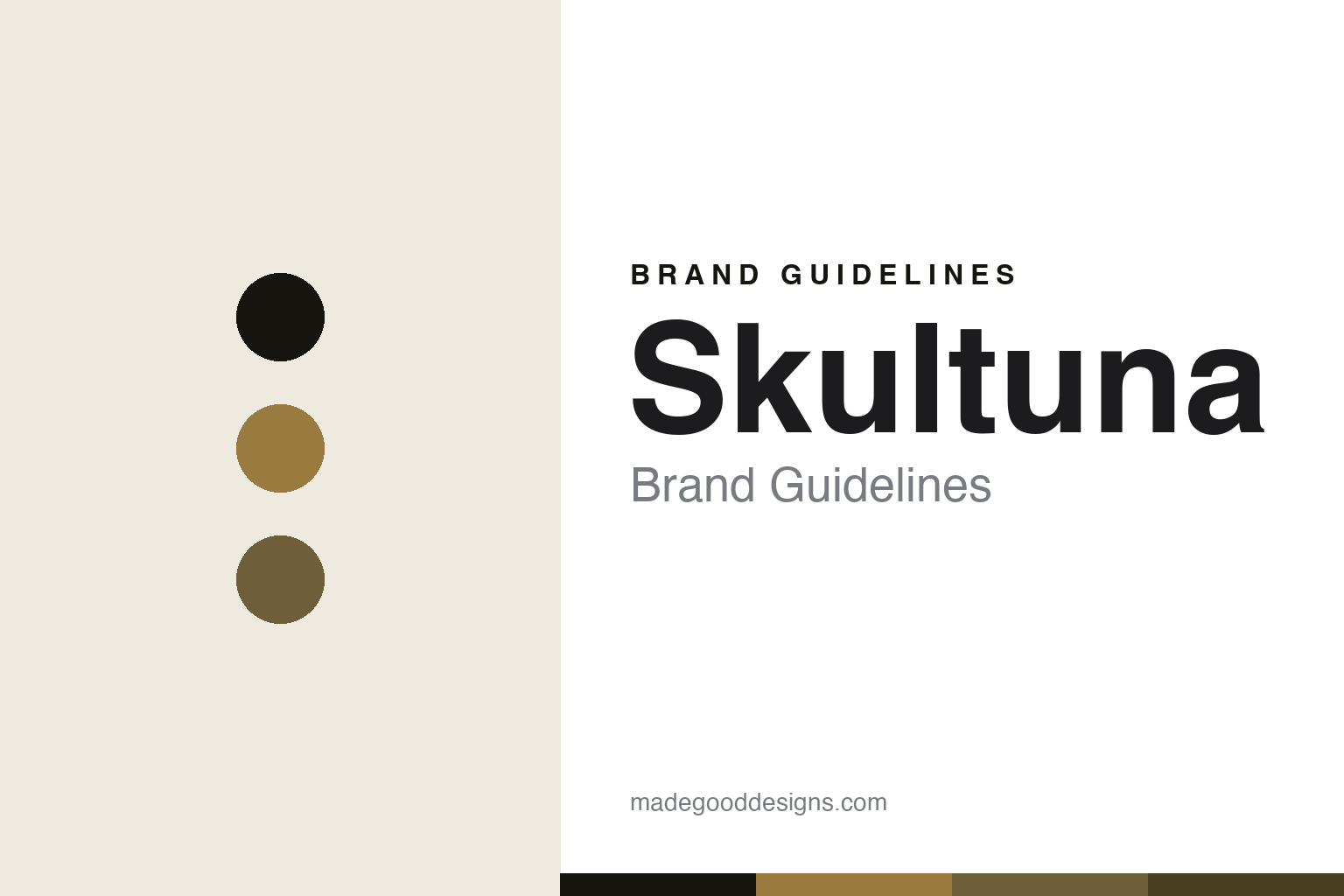
Skultuna Brand Guidelines
The brass tray.
Aa
Two constants: a brass palette and a heritage sans register. Abstract homage — not the Skultuna tray or wordmark.
The brass tray
Skultuna has cast brass since 1607.
Skultuna is a lesson in brass heritage as the identity. A Swedish foundry founded in 1607, it has worked brass for four centuries — its brass trays and catch-alls the desk signature.
Its identity is the brass tray. Skultuna’s Oval Tray, Karui trays and small catch-all bowls are the desk objects it is known for, holding pens, keys and paper clips. Four hundred years of brass, on the desktop. Heritage, spun and cast.
(Honest notes: Skultuna is a Swedish brass foundry whose works still sit in the town of Skultuna, in Västmanland, on the Svartån river (company Skultuna Messingbruk AB); it was founded in 1607 by King Karl IX of Sweden and is one of the world’s oldest continuously operating companies. For the desk, its genuine objects include the Oval Tray (“Ovalt Fat”) — for pens, jewellery and catch-all use — the Karui trays and small brass bowls (Ballerina, Kolte, Kylix) for paper clips and cards, plus boxes; we drop the unverified name “Boll” and use these. On production, the brass is genuinely spun and cast at the original Skultuna works, on the same site since 1607, using traditional metal-spinning — a strong made-in-Sweden story. On ownership, it operates as Skultuna Messingbruk AB and appears independent, though we couldn’t verify the exact current owner, so we soft-pedal that. Its brass objects are often designer collaborations (Monica Förster, Claesson Koivisto Rune and others). There’s no official brand hex — these tones are an unofficial interpretation. This is design commentary and does not promote any product.)
Colour
Skultuna lives in a brass palette. Click a swatch to copy the hex.
Skultuna’s identity is warm, heritage and metallic — a brass, an ink, an antique brass, a bronze, and a cream. The palette leans brass — the register of spun, polished and antiqued brass. It signals heritage and craft rather than novelty. The honest caveat: with no published brand hex, these tones are an original, unofficial interpretation, not first-party values.
The lesson is a brass palette signals four centuries of craft. Skultuna’s world is a warm, heritage, metallic object. For designers, it is a reminder that a single material and a long lineage can carry a whole brand — brass, worked since 1607 — and that a warm, brass palette signals that heritage. Because a brass can fail as small text, keep type dark and let the colour live in the accents, palette and band. The takeaways: commit to the material; honour the lineage; work the brass; and treat any single hex as unofficial.
Typography
The register is a heritage sans — clean, warm, enduring.
Skultuna’s identity carries a clean, warm, enduring spirit — a brass, heritage object. A humanist sans captures the mood: it is modern yet warm, the register of a heritage brand made current. Set in a brass palette, the heritage sans feels clean and warm — exactly the personality Skultuna carries. It is enduring rather than trendy, mirroring worked brass. (Skultuna’s real tray and wordmark are works we describe but do not reproduce, and the exact typeface is not ours to use.) Because it is not ours to use, the honest description is “a heritage sans spirit,” shown here in a stand-in. The type behaves like the brand: clean, warm and enduring.
Aa
A heritage sans spirit — clean and warm. (Specimen set in Manrope, a humanist sans STAND-IN; NOT the Skultuna wordmark.)
Brass heritage as identity
Skultuna stands for the brass tray.
Skultuna is a lesson in carrying a four-century craft forward. A brass palette, a heritage sans and a spun tray make brass heritage the whole brand — warm, enduring, metallic. The lineage is the differentiator. The differentiator is a brass foundry that has worked the same material, on the same site, since 1607 — and still makes desk objects from it.
Put to work, the identity is heritage made useful. A designer building in this spirit would keep a long craft lineage at the centre and apply it to contemporary objects, so a brass tray carries four centuries of making rather than a season’s styling. The lesson Skultuna teaches is that a deep heritage is a rare asset: being one of the world’s oldest companies, still spinning brass at the original works, gives the brand unmatched authenticity, and a warm, heritage design language — refreshed through designer collaborations — keeps that lineage current.
For designers and brand-builders, Skultuna offers a clear takeaway: let a long lineage do the talking. The lessons: commit to the material; honour the lineage; work the brass; and be honest about the story. It is also a reminder to stay accurate: it was founded in 1607 by King Karl IX, and its desk objects are the Oval Tray and catch-all bowls, not a “Boll” — the palette here is an unofficial interpretation. And it is a reminder that made-where honesty can be the whole point: the brass is genuinely spun and cast at the Skultuna works in Sweden, and that is worth stating plainly. It is a reminder, too, that ownership should be handled carefully: because the exact current owner isn’t verified, we describe it as an independent Swedish company rather than name one. Skultuna made the brass tray the desk signature — proof that heritage can be the difference.
Explore & save
Keep Skultuna’s identity on hand — save it to a board in the Made Good inspiration library.
Skultuna identity set
Pin the brass palette and the heritage-sans register to your own board.


