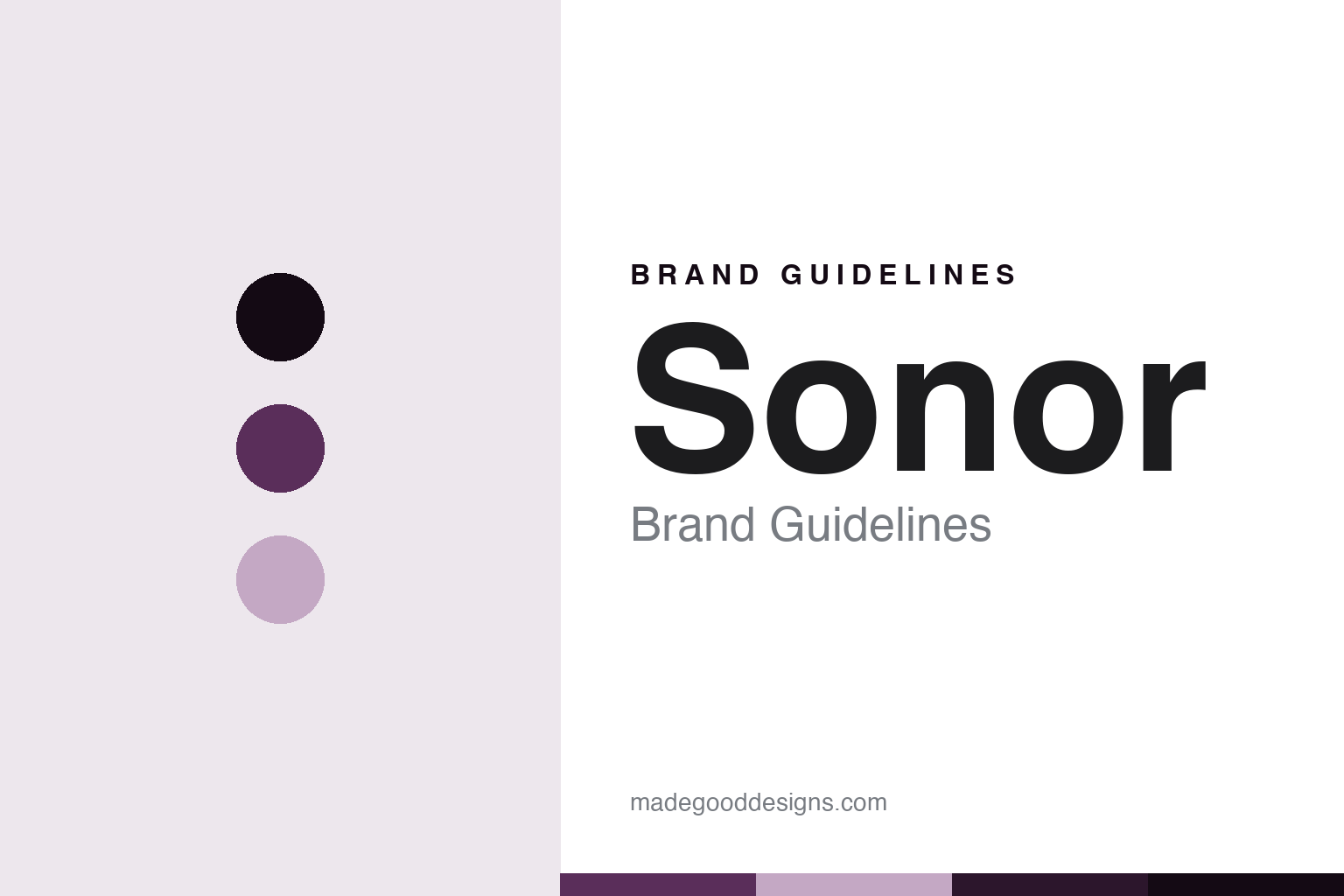
Sonor Brand Guidelines
The German drum house.
Aa
Two constants: a lacquer-plum palette and an engineering-sans register. Abstract homage — not a Sonor drum, lug or mark.
The German drum house
Sonor is the German drum maker founded in 1875, one of the world’s oldest, whose flagship drums are made in Germany while its budget lines are made in China, now owned by Taiwan’s KHS group.
Sonor is the round’s drum house, and its where-made story is a two-part one. Founded in 1875, it is one of the oldest drum makers in the world — and today its story turns the round toward its second question: not just where a maker started, but who owns it and where the work has moved. Its answer to how a house becomes a name is engineering and age: build precise German drums for well over a century, and become a byword for the craft. A German drum, with a flagship at home and a budget line abroad.
Its identity is the German drum house. Sonor’s 1875 founding, its German-made flagship drums and its two-tier making are the work it is known for. A drum, engineered in Germany. An old house with a modern supply chain.
(Honest notes, so the story stays precise. Sonor was founded in 1875 by Johannes Link, a turner, in Weißenfels an der Saale, Germany, first making natural drumheads and military drums; after the war it moved west, and today it is based in Bad Berleburg — the “Aue” in its address is the Bad Berleburg-Aue district, not the town of Aue in Saxony, so we do not imply two cities. On where it is made — the crux of this round’s second theme — the picture is honestly two-tier: its flagship and professional drums, such as the made-to-order SQ2, are made in Germany at Bad Berleburg, while its lower-priced kits and components are made in Tianjin, China — so we do not say “made in Germany” across the board, and we treat specific per-line labels as reported. On ownership, Sonor was independent and family-run for most of its history, then linked with the Taiwanese KHS Musical Instruments group from 1997; it is now a KHS-owned brand, a sister to Mapex — the exact year KHS took full ownership we do not pin down. Its drummers are attributed as reported. Its name and marks are IP, described but never reproduced, and there is no official brand hex; these tones are an unofficial interpretation. This is design commentary and does not promote any product.)
Colour
Sonor lives in a lacquer-plum palette. Click a swatch to copy the hex.
Sonor’s identity is engineered, German and layered — a lacquer plum, an ink, an orchid, a deep plum, and a paper. The palette leans lacquer plum and orchid: the register of a deep drum lacquer and a precise workshop. It signals engineering over ornament. The honest caveat: with no published brand hex, these values are an original, unofficial interpretation, not first-party colours.
The lesson is a lacquer-plum palette signals an engineered, two-tier-made identity. Sonor’s world is an engineered, lacquered, German object. For designers, it is a reminder that a deep plum and a soft orchid can carry a house built on precision — the sheen of a lacquered shell and the neutral of a workshop bench. Because these tones can fail as small text, keep type dark and let the colour live in the accents, palette and band. The takeaways: engineer the flagship at home; be honest that the budget line is abroad; name the owner plainly; and treat any single hex as unofficial.
Typography
The register is an engineering sans — precise, plain, modern.
Sonor’s identity carries a precise, plain, modern spirit — an engineering-led drum house, not a fashion label. An engineering sans captures the mood: even, exact and contemporary, the register of a German workshop. Set in a lacquer-plum palette, the engineering sans feels precise and modern — exactly the personality Sonor carries. It is a precision craft with a global supply chain rather than a marketing wall, mirroring a lacquered drum. (Sonor’s real logo, badge and lug hardware are things we describe but do not reproduce, and the exact typeface is not ours to use.) Because it is not ours to use, the honest description is “an engineering-sans spirit,” shown here in a stand-in. The type behaves like the house: precise, plain and modern.
Aa
An engineering-sans spirit — precise and modern. (Specimen set in Mulish, an engineering-sans STAND-IN; NOT the Sonor logo, badge or lug.)
The instrument makers
Sonor stands for the old German house with a two-tier make.
Sonor is a lesson in how age and honesty about a modern supply chain can be an identity. A lacquer-plum palette, an engineering sans and a German-made flagship drum make one thing — the German drum house — the whole identity: engineered, German and layered. The 1875 founding is the differentiator, and the two-tier making is the meaning. The point is one of the oldest drum makers in the world, whose story is no longer a simple “made in Germany” — its flagship is, but its budget line is Chinese-made, and its owner is Taiwanese.
Put to work, the identity is age plus candour, honestly told, as design. A house in this spirit would engineer the flagship at home, be plain that the budget line is abroad, and name the owner — a German-made SQ2, a China-made entry line, a Taiwanese parent in KHS. A brand learning from it would see that honesty about a split supply chain is a durable identity — that an old house that says exactly what is made where earns a trust a blanket “made in Germany” cannot — and that being precise, founded 1875 in Weißenfels, flagship made in Bad Berleburg, budget lines in Tianjin, owned by KHS, keeps the story honest. Sonor is the round’s hinge: it opens the second half, where the maker’s national name no longer tells you who owns it or where it is built. Against Petrof, Ramírez, Istanbul Agop and Pigini — all still family, all still fully at home — Sonor is the heritage name whose ownership crossed a border and whose budget making crossed an ocean, and the honest move is to say so rather than trade only on the 1875 date. There is discipline in the geography, too: not confusing the Bad Berleburg-Aue district with Saxony’s Aue, and treating per-line “made where” labels as reported, is what keeps the account precise. The lesson Sonor teaches is that candour can hold an identity: the age gives it substance, and the honesty about owner and supply chain keeps it credible. The engineering is the personality, and the honestly-labelled drum is the proof.
For designers and brand-builders, Sonor holds the Germany pole in the instrument makers: keep the flagship at home, and be honest about the rest. The lessons: build the flagship in-country; state plainly where the budget line is made; name the owner; keep the geography precise; and never reproduce a logo or badge. It is also a reminder to stay precise: Sonor is the German drum maker founded in 1875, one of the world’s oldest, whose flagship drums are made in Germany while its budget lines are made in China, now owned by Taiwan’s KHS group — with the palette here an unofficial interpretation. Sonor made candour the identity — proof that an old house honest about its supply chain can be the difference.
Explore & save
Keep Sonor’s identity on hand — save it to a board in the Made Good inspiration library.
Sonor identity set
Pin the lacquer-plum palette and the engineering-sans register to your own board.