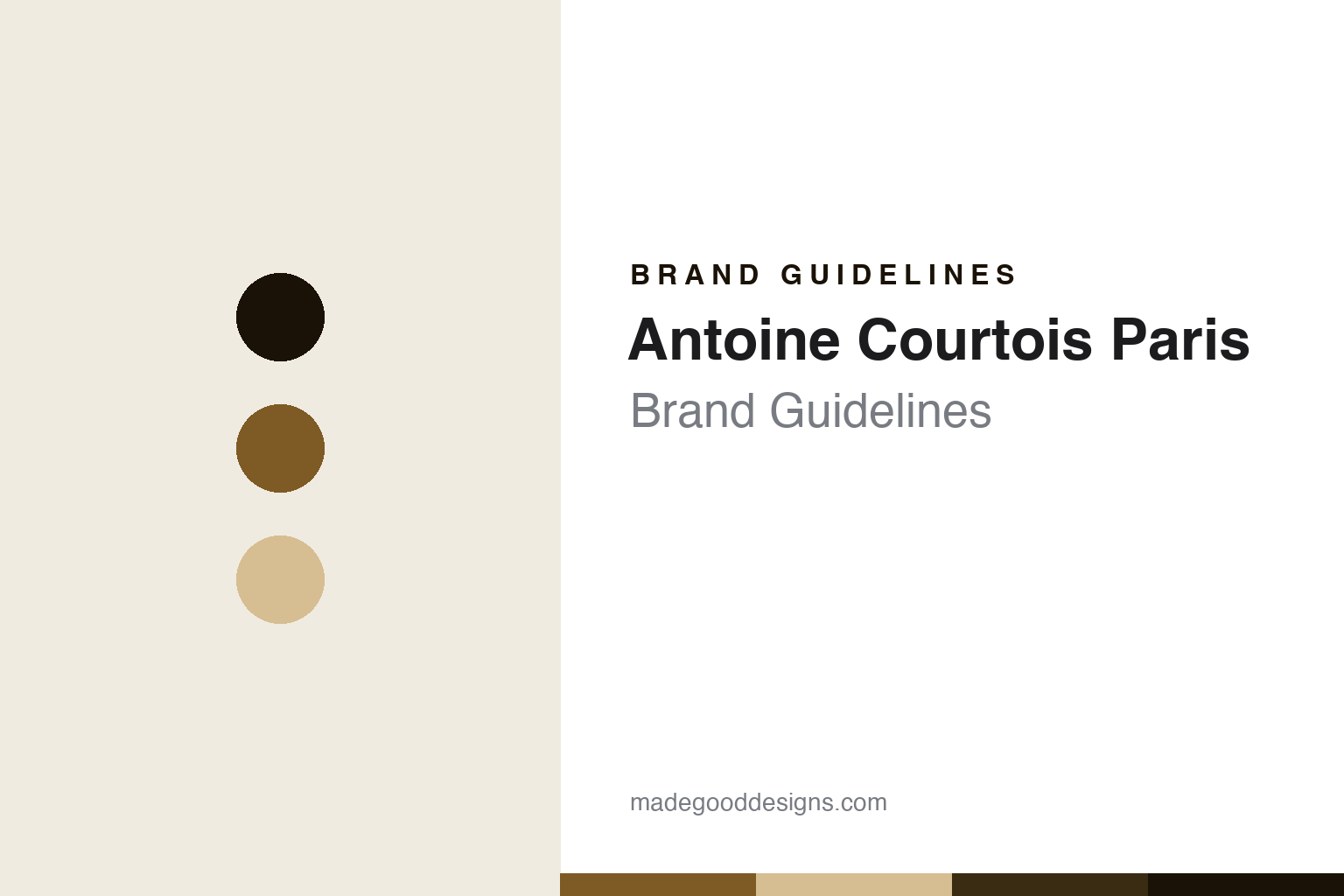
Antoine Courtois Paris Brand Guidelines
The Paris brass house.
Aa
Two constants: a brass-gold palette and a brass-sans register. Abstract homage — not an Antoine Courtois instrument or mark.
The Paris brass house
Antoine Courtois Paris is the historic French brass house whose lineage is claimed from 1789, now a Buffet Crampon brand whose instruments are made in Markneukirchen, Germany.
Antoine Courtois Paris is the round’s brass house, and it carries its most instructive where-made twist. One of the oldest surviving brass makers, Parisian in origin, it makes professional brass — trumpets, cornets, flugelhorns, saxhorns and, above all, trombones. Its answer to how a house becomes a name is heritage and reputation: carry a Paris brass name more than two centuries old, and be known especially for trombones. A French brass name — whose instruments, today, are made in Germany.
Its identity is the Paris brass house. Antoine Courtois’s brass heritage, its trombone reputation and its place inside a larger group are the work it is known for. A brass instrument, Paris by name. A heritage house whose factory has moved.
(Honest notes, so the story stays precise. Antoine Courtois’s founding is genuinely ambiguous: the house markets a lineage from 1789, while the Courtois brand name is usually dated to around 1803 — so we present it as a range, a Parisian brass workshop whose lineage is claimed from 1789 with the Courtois name established around 1803, not a single settled year. On what it makes, it is professional brass, best known today for its trombones. On where it is made — the sharpest example of this round’s theme — despite the “Paris” in the name and a French corporate address, Antoine Courtois is a brass brand of the Buffet Crampon group, and the group states that its brass instruments are manufactured at its works in Markneukirchen, Germany; so the honest answer is that Courtois brass is made in Germany, not France, and we flag any model-specific French-made claim as unverified. On ownership, it was acquired by the Buffet Crampon group (reported around 2006), which also owns Besson, B&S, Hans Hoyer, Keilwerth and Melton Meinl Weston. Its named model lines and player endorsements we keep generic unless separately verified. Its name and marks are IP, described but never reproduced, and there is no official brand hex; these tones are an unofficial interpretation. This is design commentary and does not promote any product.)
Colour
Antoine Courtois lives in a brass-gold palette. Click a swatch to copy the hex.
Antoine Courtois’s identity is heritage, brass and layered — a brass gold, an ink, a lacquer, a deep brass, and a paper. The palette leans brass gold and lacquer: the register of a lacquered brass bell and a two-century name. It signals heritage over transparency about the factory. The honest caveat: with no published brand hex, these values are an original, unofficial interpretation, not first-party colours.
The lesson is a brass-gold palette signals a heritage brass identity — read the label carefully. Antoine Courtois’s world is a heritage, brass, French-named object. For designers, it is a reminder that a warm brass gold and a pale lacquer can carry a house built on a Paris name — the gold of a brass instrument and the sheen of its lacquer — while the making sits elsewhere. Because these tones can fail as small text, keep type dark and let the colour live in the accents, palette and band. The takeaways: a heritage name is real equity; but say where the making actually is; date an ambiguous founding as a range; and treat any single hex as unofficial.
Typography
The register is a brass sans — warm, plain, heritage.
Antoine Courtois’s identity carries a warm, plain, heritage spirit — a two-century brass name, not a fashion label. A brass sans captures the mood: even, warm and classic, the register of a professional brass house. Set in a brass-gold palette, the brass sans feels warm and heritage — exactly the personality Antoine Courtois carries. It is a Paris name within a larger group rather than a single independent workshop, mirroring a lacquered brass instrument. (Antoine Courtois’s real logo, its “AC” monogram and its tagline lockup are things we describe but do not reproduce, and the exact typeface is not ours to use.) Because it is not ours to use, the honest description is “a brass-sans spirit,” shown here in a stand-in. The type behaves like the house: warm, plain and heritage.
Aa
A brass-sans spirit — warm and heritage. (Specimen set in Work Sans, a brass-sans STAND-IN; NOT the Antoine Courtois logo or monogram.)
The instrument makers
Antoine Courtois stands for the Paris brass name made in Germany.
Antoine Courtois is a lesson in how a heritage name and its real factory can diverge. A brass-gold palette, a brass sans and a professional trombone make one thing — the Paris brass house — the whole identity: heritage, brass and layered. The two-century Paris lineage is the differentiator, and the honest where-made is the meaning. The point is a French brass name, one of the oldest there is, whose instruments today are built not in Paris but in Germany, inside a larger group.
Put to work, the identity is a heritage name, honestly located, as design. A house in this spirit would carry its lineage, own its trombone reputation, and be candid about the making — a Paris name claimed from 1789, the Courtois name from around 1803, brass built in Markneukirchen, Germany, under the Buffet Crampon group. A brand learning from it would see that a heritage name is durable equity — but that trust depends on saying where the instrument is actually made, not letting the “Paris” on the bell imply a French factory. Antoine Courtois is the round’s sharpest divergence between name and making: it looks, from its name, like the French counterpart to the family houses earlier in this piece, but its instruments are German-made and its owner is a group — the clearest case of the vein’s lesson that the national name on an instrument is not always where or by whom it is made. There is discipline in the founding, too: dating it as a 1789-claimed lineage with a circa-1803 brand name, rather than printing one heroic year, is what keeps a two-century story honest. The lesson Antoine Courtois teaches is two-sided: a heritage name can hold an identity, and honesty about the factory behind it is what keeps that identity credible. The name is the personality, and the honestly-located instrument is the proof.
For designers and brand-builders, Antoine Courtois holds the France pole in the instrument makers: carry the heritage name, and say where it is really made. The lessons: a heritage name is equity; locate the making honestly (a “Paris” name can be a German-made instrument); date an ambiguous origin as a range; keep model names and endorsements verified; and never reproduce a logo or monogram. It is also a reminder to stay precise: Antoine Courtois Paris is the historic French brass house whose lineage is claimed from 1789, now a Buffet Crampon brand whose instruments are made in Markneukirchen, Germany — with the palette here an unofficial interpretation. Antoine Courtois made a heritage name the identity — and a reminder that saying where it is made is what earns trust.
Explore & save
Keep Antoine Courtois Paris’s identity on hand — save it to a board in the Made Good inspiration library.
Antoine Courtois identity set
Pin the brass-gold palette and the brass-sans register to your own board.