P. Mauriat Brand Guidelines
The Taiwan saxophone.
Aa
Two constants: a vintage-brass palette and a vintage-sans register. Abstract homage — not a P. Mauriat saxophone or mark.
The Taiwan saxophone
P. Mauriat is the Taiwanese saxophone maker founded in 2003, hand-finishing its horns in Taichung under a name that pays tribute to French orchestra leader Paul Mauriat.
P. Mauriat is the round’s saxophone maker, and its honesty is in its name. From Taichung, in Taiwan, P. Mauriat makes professional saxophones — vintage-voiced, hand-finished horns — under a French-sounding name that is a deliberate tribute, not a claim of French manufacture. Its answer to how a maker becomes a name is craft plus a story: build fine Taiwanese saxophones, and name the brand for a French musical legend. A Taiwanese saxophone, with a French name it wears openly.
Its identity is the Taiwan saxophone. P. Mauriat’s Taiwanese making, its vintage-voiced horns and its tribute name are the work it is known for. A saxophone, made in Taiwan. A French name on an honestly Taiwanese horn.
(Honest notes, so the story stays precise. P. Mauriat was founded in 2003 by Alex Mingmann Hsieh, a saxophone enthusiast; it is a Taiwanese brand, operated by Albest Musical Instruments, with its company in Taipei. On what it makes, it is professional saxophones above all, plus trumpets, clarinets and flutes. On where it is made — the crux of this round’s honesty — its saxophones are made in Taiwan, in Taichung; the “P. Mauriat” name is a licensed tribute to the French orchestra leader Paul Mauriat, a transparent brand choice the company states openly, and we make clear the maker is Taiwanese, not French. On its craft, the company describes traditional hand-crafted techniques with modern precision; we say “hand-finished” rather than assert hand-hammering or hand-engraving we could not confirm. Its models — System 76, Le Bravo 200, Master 97, Venus — and its endorsing players, such as Greg Osby and Kirk Whalum, we present as the company’s own. This article is not affiliated with the company or with Paul Mauriat’s estate. Its name and marks are IP, described but never reproduced, and there is no official brand hex; these tones are an unofficial interpretation. This is design commentary and does not promote any product.)
Colour
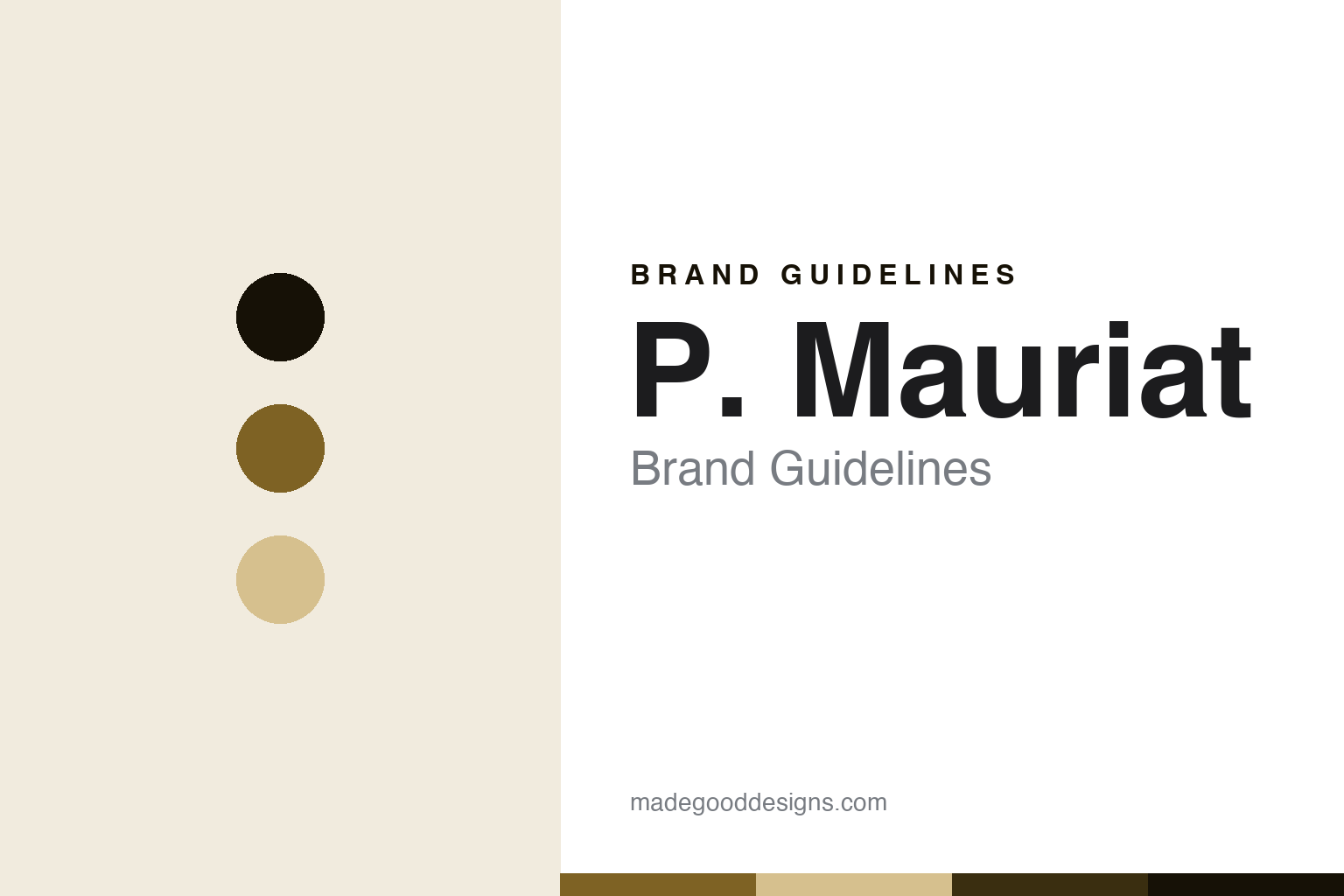
P. Mauriat lives in a vintage-brass palette. Click a swatch to copy the hex.
P. Mauriat’s identity is vintage, Taiwanese and honest — a vintage brass, an ink, a lacquer, a deep brass, and a paper. The palette leans vintage brass and lacquer: the register of a vintage-voiced saxophone and an aged lacquer. It signals a vintage voice and an honest origin. The honest caveat: with no published brand hex, these values are an original, unofficial interpretation, not first-party colours.
The lesson is a vintage-brass palette signals a vintage-voiced, made-in-Taiwan identity. P. Mauriat’s world is a vintage, brass, Taiwanese object. For designers, it is a reminder that a vintage brass and a soft lacquer can carry a maker built on a vintage sound — the warm gold of an aged horn and the sheen of its lacquer. Because these tones can fail as small text, keep type dark and let the colour live in the accents, palette and band. The takeaways: build a vintage voice; be honest about the origin behind the name; attribute the craft claims; and treat any single hex as unofficial.
Typography
The register is a vintage sans — warm, plain, honest.
P. Mauriat’s identity carries a warm, plain, honest spirit — a vintage-voiced saxophone maker, not a heritage French house. A vintage sans captures the mood: even, warm and straightforward, the register of a modern maker with a vintage sound. Set in a vintage-brass palette, the vintage sans feels warm and honest — exactly the personality P. Mauriat carries. It is a vintage voice with an honest origin rather than a borrowed pedigree, mirroring a hand-finished horn. (P. Mauriat’s real logo, its “PM” mark and any engraving are things we describe but do not reproduce, and the exact typeface is not ours to use.) Because it is not ours to use, the honest description is “a vintage-sans spirit,” shown here in a stand-in. The type behaves like the maker: warm, plain and honest.
Aa
A vintage-sans spirit — warm and honest. (Specimen set in Manrope, a vintage-sans STAND-IN; NOT the P. Mauriat logo or PM mark.)
The instrument around the world
P. Mauriat stands for the Taiwanese saxophone honest about its name.
P. Mauriat is a lesson in how honesty about a name can be an identity. A vintage-brass palette, a vintage sans and a hand-finished saxophone make one thing — the Taiwan saxophone — the whole identity: vintage, Taiwanese and honest. The vintage-voiced horns are the differentiator, and the openly-explained tribute name is the meaning. The point is a Taiwanese maker that chose a French-sounding name to honour a French musical figure — and is transparent that the maker is Taiwanese, so the name is a tribute, not a disguise.
Put to work, the identity is an honest origin, told as design. A maker in this spirit would build a distinctive voice, choose its name openly, and be clear about where it is made — vintage-voiced saxophones, made in Taiwan, a name that pays tribute to a French legend. A brand learning from it would see that transparency about a name is a durable identity — that a Taiwanese horn under a French tribute name earns trust precisely by explaining itself — and that being precise, founded 2003 by Alex Mingmann Hsieh, made in Taichung, a licensed tribute to Paul Mauriat, keeps the story honest. P. Mauriat holds the round’s name-isn’t-origin thread: in a world tour where most makers wear their country plainly, this one wears a French name over Taiwanese making — and the honest editorial move is to say exactly that, so the tribute reads as a choice rather than a claim. The discipline is in the caveats: calling it Taiwanese-made under a French tribute name, softening the craft claims to “hand-finished,” and keeping the piece unaffiliated with Paul Mauriat’s estate. The lesson P. Mauriat teaches is that honesty can hold an identity: the vintage voice gives it substance, and the transparency about the name keeps it credible. The honesty is the personality, and the Taiwanese saxophone is the proof.
For designers and brand-builders, P. Mauriat holds the Taiwan pole in the instrument around the world: choose a name openly, and say where it is made. The lessons: build a distinctive voice; explain a name that isn’t your origin; state the country of make; attribute the craft claims; and never reproduce a logo. It is also a reminder to stay precise: P. Mauriat is the Taiwanese saxophone maker founded in 2003, hand-finishing its horns in Taichung under a name that pays tribute to French orchestra leader Paul Mauriat — with the palette here an unofficial interpretation. P. Mauriat made an honest name the identity — proof that a Taiwanese saxophone under a French tribute name, honestly told, can be the difference.
Explore & save
Keep P. Mauriat’s identity on hand — save it to a board in the Made Good inspiration library.
P. Mauriat identity set
Pin the vintage-brass palette and the vintage-sans register to your own board.