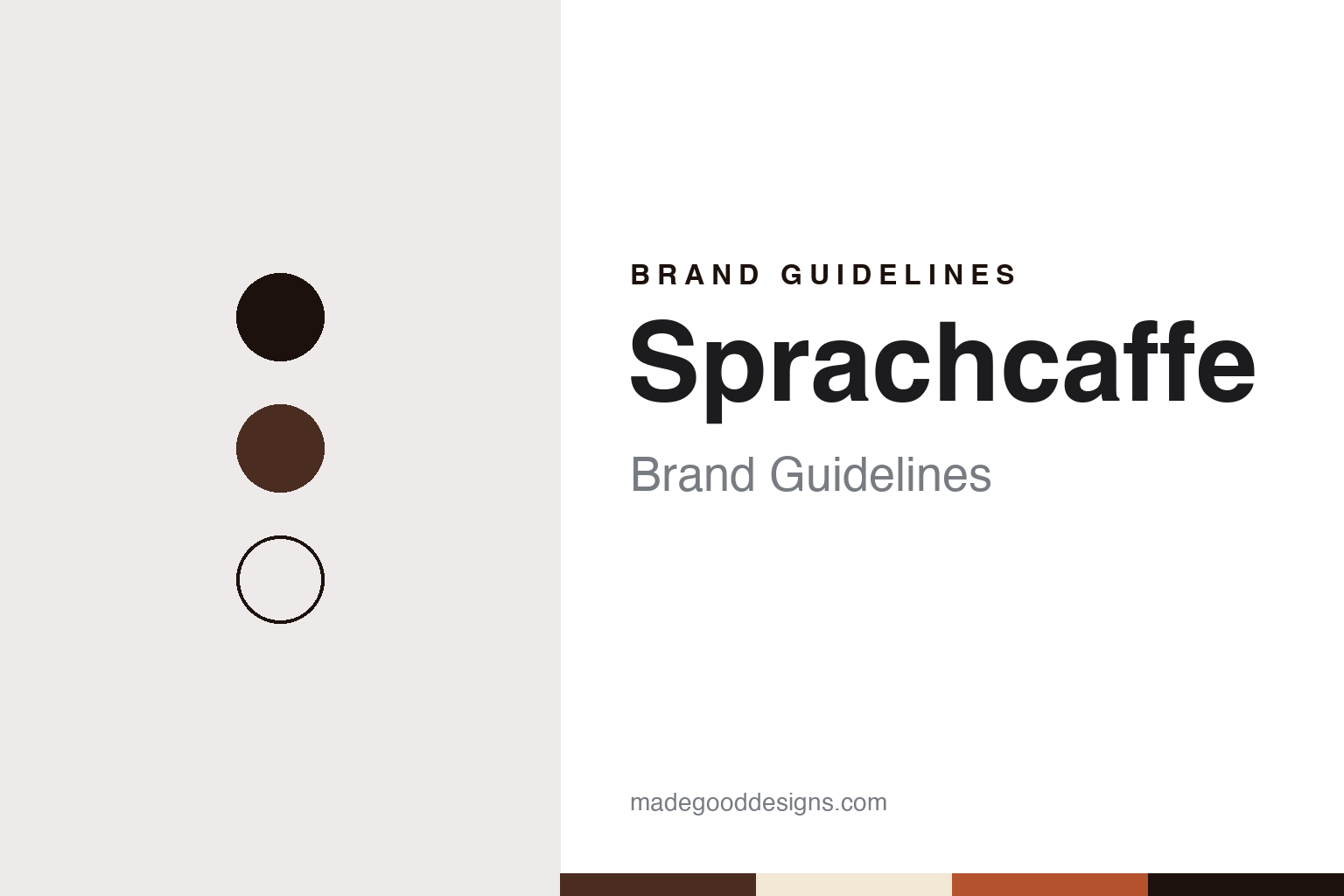
Sprachcaffe Brand Guidelines
Frankfurt since 1983, a café mood and an Italian heart.
Aa
Two constants: a Sprachcaffe espresso and terracotta palette and a Warm serif register. Abstract homage — not a Sprachcaffe product or mark; no logo, brochure or school photograph is reproduced.
Frankfurt, 1983
A German company with an Italian heart.
Sprachcaffe dates itself to 1983: its German website says the company has welcomed more than 65,000 students a year “since our founding in 1983” (our translation), and that it has been bringing people together through language for over four decades. It is run from Frankfurt am Main, where its travel business trades as Sprachcaffe Reisen GmbH. Its president and co-owner, Alberto Sarno, told The PIE News in October 2016 that the business “started in Germany and Italy,” and that it soon added more destinations because German and Italian courses alone could not take it further. In the same interview he summed up the company’s character in a line that works as a brand idea: “We always say we are a German company with an Italian heart.”
The chain grew through new schools and purchases. In September 2011 Sprachcaffe Languages Plus, as it was then styled, bought the GEOS North America school chain, The PIE News reported in October 2011, taking its network to 31 language centres, 12 of them in the United States and Canada, in cities including New York, San Francisco, Vancouver and Victoria. Speaking to the same publication in November 2011, Sarno said the plan was to keep the GEOS name, followed by “languages PLUS,” which he described as the company’s reason for being, and to add Sprachcaffe’s schools in London, Brighton, Exmouth and Malta to that portfolio. He also pointed to a school in Beijing and to schools in Mexico and Cuba, where he said Spanish enrolments had risen strongly over the previous ten years.
In February 2016 Sprachcaffe opened a German school in Munich, its second German branch after its flagship school in Frankfurt; The PIE News then counted 26 schools in 12 countries, with branches in Spain, France, Italy, the UK, the US, Canada, China, Morocco, Cuba, Mexico and Malta. The Munich school opened for adults only in its first year and offered a university pathway course preparing students for the entrance exam required for higher education in Germany, alongside standard, intensive and one-to-one courses.
The 2016 interview also set out how the company sees its product. When it began, Sarno said, students were often travelling to London or Paris for the first time; now many have been there before, so a course has to offer more than language. “Experience is the key word,” he told The PIE News. “You can learn a language at home, but you cannot get the abroad experience.” That idea runs through the brand’s current pages, which talk about learning languages “where they are really lived” (our translation).
Colour
Café lessons, with the screens put away.
Sprachcaffe’s own pages describe its teaching more than any visual system. The German site promises lessons in small international groups with native-speaker teachers, in an atmosphere that is “relaxed, friendly and dynamic, just like your favourite café” (our translation). Its method page says courses run in groups of usually 8 to 12 learners, follow the Common European Framework of Reference from A1 to C2, and deliberately use less technology in class so that learners look at one another rather than at a screen. For learners aged 12 to 17 it describes a task-based approach built on games, role plays and group projects.
The range is broad. The company says it runs 16 schools of its own and sells every trip under German travel law. Its booking menus are organised by audience (school students, adults, groups, gap year, high school exchange, au pair, study preparation, and job and study), and group trips are listed in Florence, Paris, Nice, Barcelona, Málaga, Brighton, London, St. Julian’s and Playa del Carmen. A business section offers language training in eight languages, among them English, German, Spanish and Chinese, as one-to-one coaching, group workshops or a blended mix of a course abroad and online follow-up. Students share photos under the hashtag #SPRACHCAFFEMoment, and the accreditation logos shown on the site name FELTOM, DIN, ALTO and WYSE.
Typography
How language schools present themselves.
Language schools sell something that is hard to photograph: progress in a language. Their websites tend to show the setting instead. ELS, for example, describes its centres as sitting on American college campuses and points to shared lounges, cafeterias and computer labs, while inlingua’s international site sorts its courses for adults, companies and children and names the local centre, such as inlingua Berlin or inlingua Utah, beside each student quote.
Course and level names do much of the identity work. The Common European Framework of Reference for Languages offers a shared scale of six levels, from A1 to C2, and inlingua organises its own course books by those codes. Others number their own ladders: ELS teaches in 12 class levels and says more than 600 colleges recognise its level 109 or 112.
Much of the booking and some of the teaching happen online. Schools such as inlingua and ELS carry placement tests, application pages and branded learning platforms on their sites: inlingua runs a family of “my.” products for e-learning and virtual classrooms, and ELS offers a free online English test and a WhatsApp chat with admissions staff.
Owners, networks and accreditations appear on the schools’ corporate pages. inlingua licenses its name to independently owned centres, a franchise model the Swiss newspaper 20 Minuten described in 2024. ELS names its accreditation by ACCET, and since 2022 has belonged with ILSC and Berlitz to Language Education Holdings, The PIE News reported. This guide sets out what can be checked about each brand, and marks clearly what rests on the company’s own word.
Aa
A warm serif, for a café mood. (Specimen set in Fraunces, a serif STAND-IN; NOT the Sprachcaffe logo.)
Sprachcaffe
A school chain that also owns an agency.
In October 2016 The PIE News reported that Sprachcaffe had bought iST, a study-abroad agency based in Heidelberg with offices in Germany, Austria and Switzerland, which held the address sprachreisen.de and had been trading for about 40 years. The agency kept its own name. Sprachcaffe then ran 30 language schools, in places including Cuba, Morocco, China and the United States, teaching English, Spanish, French, Italian, German, Chinese and Arabic. In March 2021 the same publication reported that the British group LAL Language Centres had partnered with Sprachcaffe to revive the lal.de portal for students and agents in Germany, Austria and Switzerland.
The school counts have moved over time: 31 in 2011, 26 in early 2016 and 30 later that year in The PIE News, and 16 schools of its own on the company’s website in 2026. Its menus for adults today list Malta, England, Canada, South Africa, Spain, Cuba, Germany, Italy, France, Morocco and China, plus online courses, and the method page names Malta, Barcelona, London and Vancouver among its course destinations.
For a design guide, Sprachcaffe shows how a language-travel brand can borrow the warmth of a café (small groups, real conversation, sunny coasts) and carry it across a long list of cities. Compare EF Education First, another language-travel brand, and Eurocentres. For this guide we use an espresso brown, a terracotta and a foam cream with a serif, an unofficial interpretation; no product or logo is reproduced.
Explore & save
Keep Sprachcaffe’s identity on hand — save it to a board in the Made Good inspiration library.
Sprachcaffe identity set
Pin the Sprachcaffe espresso and terracotta palette and the Warm serif register to your own board.