Burson Brand Guidelines
A 1953 founder’s name brought back to unite two agencies.
Aa
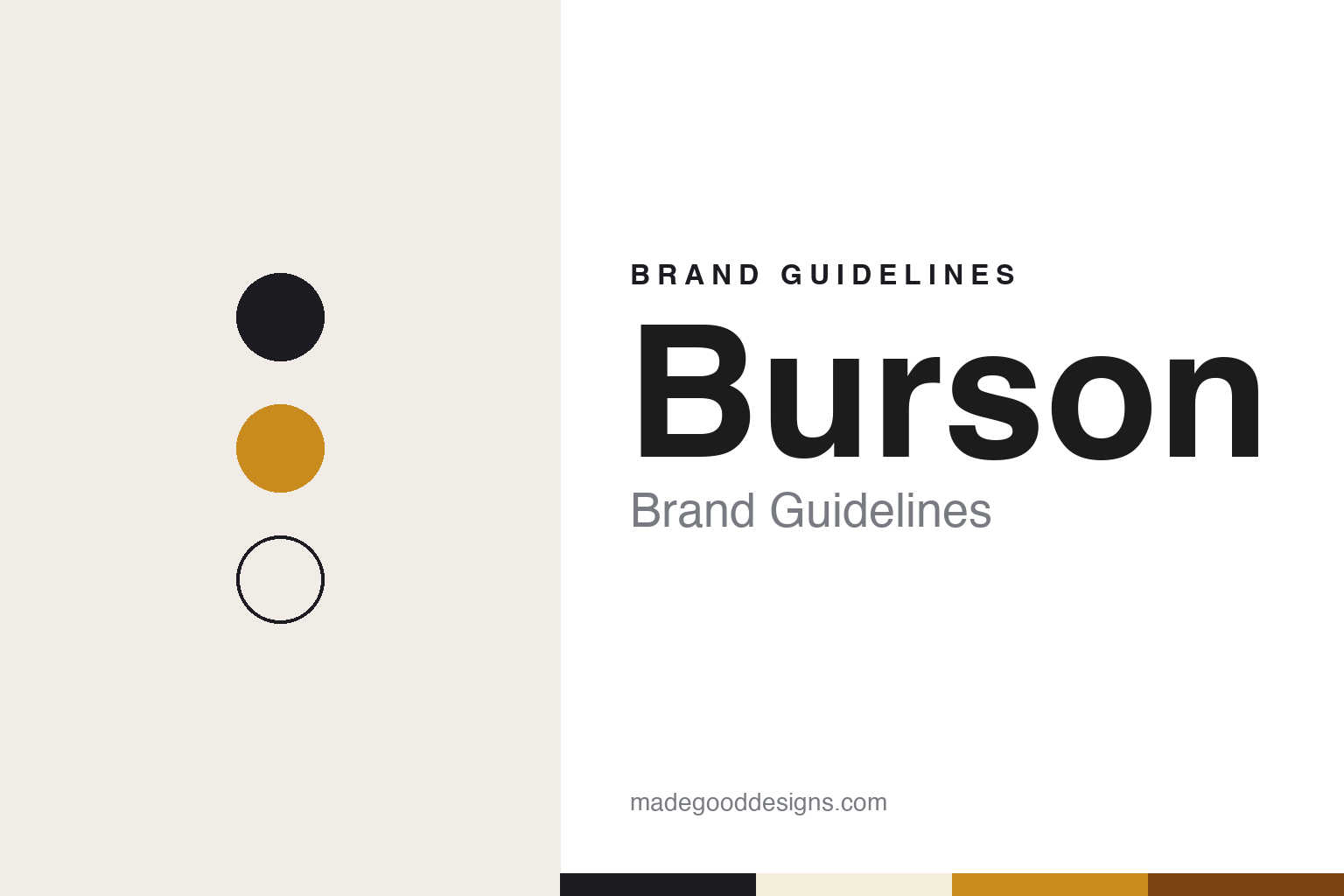
Two constants: a deep ink, amber and cream palette and a clean sans register. Abstract homage — not a Burson asset; no logo or wordmark is reproduced.
Burson-Marsteller
A PR man, an advertising man and a shared account.
Burson takes its name from Harold Burson, who with William Marsteller founded the public relations firm Burson-Marsteller in 1953, according to English Wikipedia. Each already ran his own business: Burson had set up Harold Burson Public Relations in New York in 1946, and Marsteller had founded a Chicago advertising agency, Marsteller Gebhardt and Reed, in 1951. English Wikipedia says the two met in 1952, when Marsteller needed a PR agency for an account with his client Rockwell Manufacturing, and that after sharing that and another industrial account they formed a new firm in 1953, owned jointly by Burson and by Marsteller’s advertising agency.
The firm started with a staff of four and two main clients, English Wikipedia says, and within a decade it was looking beyond the United States. It opened an office in Toronto in 1960, a European base in Geneva in 1961, Brussels in 1965 and London in 1967, and its offices in Asia, in Hong Kong, Singapore, Kuala Lumpur and Tokyo, in 1973. One of its early accounts, English Wikipedia says, was the Electro-Motive Division of General Motors, the diesel-locomotive maker, from 1956.
In 1979 Burson-Marsteller was sold to the advertising group Young & Rubicam. English Wikipedia says Burson gave two reasons in his memoirs: the firm needed capital to pay for its expansion, and Marsteller’s advertising agency had become less profitable. When Young & Rubicam became a subsidiary of WPP in 2000, Burson-Marsteller came with it, and it remained a WPP agency under its double-barrelled founders’ name for almost two more decades.
Colour
Cohn and Wolfe, then Hill and Knowlton.
The second strand of the modern firm began in Atlanta. English Wikipedia says Cohn & Wolfe was founded there by Bob Cohn and Norman Wolfe in 1970, was acquired by Burson-Marsteller in 1984 and operated as its subsidiary until 2000, later sitting alongside it inside Young & Rubicam and WPP.
The two were brought back together in February 2018. Marketing-Interactive reported on 28 February 2018 that WPP was merging Burson-Marsteller and Cohn & Wolfe to create Burson Cohn & Wolfe, known as BCW, a network of more than 4,000 employees across 42 countries. The report described the combination as joining Cohn & Wolfe’s digital, creative-content and integrated communications work in the consumer, healthcare and technology sectors with Burson-Marsteller’s strength in corporate and crisis management, technology and research. Donna Imperato, chief executive of Cohn & Wolfe, was named chief executive of the merged agency. English Wikipedia adds that BCW bought HZ, an integrated creative agency based in Rockville, Maryland, in August 2018, and that HZ’s leadership bought the firm back from BCW in April 2024, three months after WPP announced the next merger.
The BCW name lasted six years. On 25 January 2024, WPP announced that it would merge BCW with Hill & Knowlton, its two largest communications agencies, to form a single agency called Burson; Marketing-Interactive reported the announcement the same day. WPP said the new firm would have more than 6,000 employees in 43 markets, that its name honours Harold Burson, and that it would be operational from 1 July 2024. Corey duBrowa, global chief executive of BCW, was named global chief executive of Burson, and AnnaMaria DeSalva, chairman and chief executive of Hill & Knowlton, became global chairman. WPP’s chief executive Mark Read said at the time that he was delighted “to see the Burson brand brought back to unite them.”
Typography
How communications agencies present themselves.
Public relations and communications agencies sell advice, so their visual identity is mostly carried by what they publish about themselves. Case-study pages, award announcements and research reports do much of the work that a product range does for a manufacturer. FleishmanHillard, for example, announced in October 2026 that a campaign it made with Icelandair had been named the top entry in PRovoke Media’s Global SABRE Awards, and the guides in this set treat such pages as the agency’s own dated claims.
Names change more often than logos in this field, usually after a merger. Founders’ surnames are joined, shortened or dropped, and a hyphen can disappear: FleishmanHillard closed up its two founders’ names in 2013, English Wikipedia says. When holding groups rearrange their agencies, one firm may also keep another as a dedicated brand inside it, as FleishmanHillard did with Porter Novelli in February 2026.
Many firms present their offices and their people rather than objects. Partner profiles, office lists and pages on how the firm is owned and run take the place of a catalogue; Brunswick’s site, for instance, gives a page to each of its offices and describes the firm as a partnership. Some firms also publish magazines or research series under their own names, which become a second visible identity beside the logo.
Ownership and leadership are recorded on corporate pages, in company registers and in trade and business press, and they change with each acquisition, investment or appointment. The guides in this set give office, staff and partner counts only as a dated source states them, name the owner as of that source, and treat colours and typefaces as an unofficial interpretation unless the agency has published its own.
Aa
A clean sans for a modern agency register. (Specimen set in Manrope, a sans STAND-IN; NOT the Burson logo.)
Burson
A new identity inspired by light.
The new brand went public ahead of the merger date. Burson’s own newsroom dates its official launch to 13 June 2024, when it unveiled a new visual identity that, the company says, was “inspired by the power of light to illuminate insights and reveal opportunity.” English Wikipedia says the merger was finalised in July 2024. Alongside the identity, Burson introduced a “reputation capital” framework that it says looks at four areas, namely company actions, communications, social narratives and stakeholder beliefs, and a set of AI-assisted tools it calls the Burson Innovation Portfolio, with suites named Sonar, Decipher, Creators’, Specialists’ and Fount.
Burson describes itself as the flagship of the Burson Group, which at launch also included AxiCom for technology communications, GCI Health for healthcare, Burson Buchanan, renamed from Buchanan Communications, for financial communications, and Hill & Knowlton, which kept its own name for a select group of clients. The launch announcement calls the Burson Group a streamlined suite of agencies anchored by the flagship, full-service Burson brand, so several established agency names stay in use under one founder’s surname. Its website says “Burson is part of WPP,” and opens its about page with a line from Harold Burson: “Public relations is fundamentally a problem-solving discipline.” On 13 August 2026 Research News Online reported that the WPP-owned agency had acquired Limbik, the partner with which it had developed the Decipher predictive tool since 2024, bringing that technology and its engineering and research teams in-house.
For a design guide, Burson shows how a holding group can revive a founder’s surname to sit above several older agency names. Compare Hill & Knowlton, which now operates inside Burson, and WPP, its parent. For this guide we use deep ink, a warm amber and a soft cream with a sans, an unofficial interpretation; no product or logo is reproduced.
Explore & save
Keep Burson’s identity on hand — save it to a board in the Made Good inspiration library.
Burson identity set
Save the Burson deep ink, amber and cream palette and the clean sans register for your own reference.