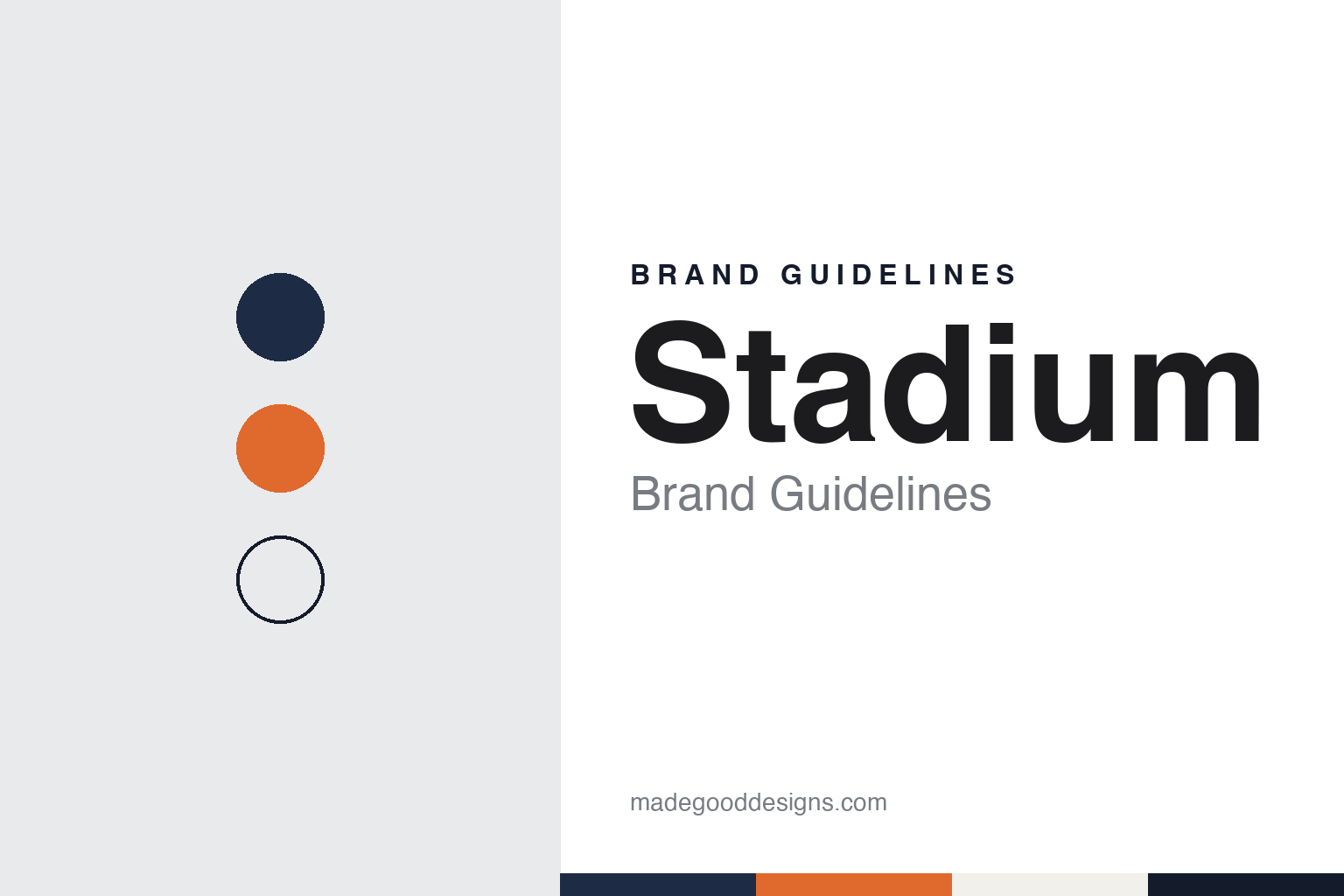
Stadium Brand Guidelines
The Eklöf brothers’ Norrköping start and a 1987 Stockholm store.
Aa
Two constants: an ink blue and running-track orange palette and a grotesque sans register. Abstract homage — not a Stadium product or mark; no logo, sign or store interior is reproduced.
Spiralen Sport
A Norrköping sports shop and two brothers.
Stadium is a Swedish sports retailer, and its story begins in Norrköping. In 1974, while he was still a business student, Ulf Eklöf bought a sports shop in his home town called Spiralen Sport, Dagens PS reported in March 2026; he had learned selling in his parents’ grocery shop, the same report said. His younger brother Bo Eklöf joined him a couple of years later, and over the following years the brothers ran several sports shops before planning a large one in the capital.
That store opened on 25 March 1987 on Sergelgatan in central Stockholm, the first to carry the Stadium name, according to Dagens PS. Ikano, the investment group of the Kamprad family, gave the same outline in 2018: the brothers laid the foundation in the 1970s, and the first Stadium store opened in Stockholm in 1987.
The chain grew fast. By the end of its financial year in August 2007 it had 113 stores and about 1,800 full-time staff, the Swedish business site Realtid reported in April 2008. It had already crossed into Denmark and Finland; Realtid noted the two markets in 2007, and The Copenhagen Post later dated the first Danish shop to 2000.
The family stayed in charge. The brothers once considered a stock-market listing, Realtid wrote in 2007, but instead brought in Ikano as a part-owner in 2005 with about a quarter of the shares. In 2014 TextilWirtschaft put the split at 55 per cent for Ulf Eklöf, 20 per cent for Bo Eklöf and the rest for Ikano. In September 2018 Ikano announced that it was selling its holding back to the founders; by December 2019 TextilWirtschaft described the Stadium Group as owned by the Eklöf family. Ulf Eklöf’s son Karl Eklöf has since led the company as chief executive.
Colour
Big boxes, own labels and an outlet chain.
Stadium built its name on large stores that mix sports equipment with sportswear and everyday sports fashion. When it opened in Hamburg in 2014, TextilWirtschaft described a store of 1,650 square metres that put women’s sportswear and children’s outdoor clothing at the front, with a 400-square-metre children’s department selling skateboards, bicycles and ski helmets as well as clothing. The Hamburg store opened next to competitors including SportScheck and Intersport.
Own labels have long sat beside the brands it stocks. In 2014 the same trade paper listed six of them, including Soc, Everest, 4D and Occano, alongside shop-in-shops for brands such as Adidas and Peak Performance. Stadium launched its web shop in 2007; Realtid reported that about 200 people had worked on the project over two years before it went live, and that the site drew visitors with exclusive auctions and with blogs and columns by well-known Swedish sports figures.
The group runs more than one store format. In December 2019 TextilWirtschaft counted about 180 stores across the concepts Stadium, Stadium Outlet and Sneakers Point, with close to 4,000 employees, and noted the group’s Stadium Sports Camp for children and young people.
In March 2026 Stadium said its store in Täby, north of Stockholm, was the first built entirely to a new concept of close to 2,000 square metres, with a new graphic identity and navigation system; its chief operating officer said colours that had been part of Stadium for many years were made stronger, with customers greeted by an orange running track laid into the floor.
Typography
How European sporting-goods chains present themselves.
European sporting-goods chains present themselves most visibly through the shop sign. A name, a logo and a set of colours have to work on a high-street fascia, a shopping-centre unit, a large out-of-town store and a website at once, and the companies show these marks on their own sites and in their store photographs. The colours and type in this guide are our own interpretation, not official specifications.
Store formats vary widely. SportScheck, the Munich chain, runs city-centre stores and an online shop, and in 2024 it opened a 2,000-square-metre Berlin store under a concept it calls “Future Retail,” FashionUnited reported. Sport 2000 separates a general multi-category shop from specialist running and team-sport formats that carry names of their own.
Ownership takes several forms, and it is worth stating plainly. Buying groups such as Sport 2000 and Intersport link independent shops that keep their own owners while sharing a name, buying terms and marketing; Germany’s competition authority named both groups as competitors when it reviewed SportScheck’s sale in 2020. Other chains belong to larger retail groups: SportScheck was owned by the Otto Group from 1991 and by Signa Retail from 2020, and since 2024 it has been part of Italy’s Cisalfa Sport. Own ranges sit beside outside brands, as with Witeblaze, the label Sport 2000 launched in 2023.
Corporate pages tell the founding story in each company’s own words, from Otto Scheck’s Munich clothing business of 1946 to the 36 French retailers who formed Sport 2000 in 1966. This guide sets out what can be checked about each chain — founders, owners, insolvencies and sales, with dates — and marks what rests only on the company’s own account.
Aa
A sturdy grotesque for wayfinding and department signs. (Specimen set in Archivo, a sans STAND-IN; NOT the Stadium logo.)
Stadium
Two exits abroad and a Nordic focus.
Not every move abroad lasted. In July 2016 Stadium’s board decided to leave Denmark after years of losses at its eight stores there, The Copenhagen Post reported in August 2016, citing Jyllands-Posten; the Jutland chain Sport24, which then ran 45 shops in Jutland, took over six of the store sites from 1 October 2016, among them those in Field’s, Lyngby Storcenter, Fisketorvet and Rødovre Centrum, giving it a foothold on Zealand. After the exit Stadium still had shops in Sweden, Finland and Germany, the paper noted.
Germany followed. In September 2014 Stadium opened its first store outside Scandinavia in Hamburg, which also served as its German head office, TextilWirtschaft reported; a German web shop followed in 2015. The planned expansion across the country never gathered pace: only two more stores opened, both in Hamburg. In December 2019 the same trade paper reported that the stores on Mönckebergstraße and in the Phoenix-Center were in closing-down sales and would shut before the end of the year, while the Altona store would stay open until its lease ran out, after which Stadium would leave Germany entirely. The company said market conditions and high rents meant it could not reach its profit targets.
Since then the group has concentrated on Sweden, Finland and Norway; Norway was then a recent addition, according to TextilWirtschaft. In September 2026 the company described itself as owned by the Eklöf family, with Stadium and Stadium Outlet stores in the same three countries.
For a design guide, Stadium shows how a family-run retailer can hold one name across large stores, an outlet chain and three countries, and how a single floor colour can carry an identity. Compare XXL, a Norwegian sports chain in the same Nordic markets, and Intersport. For this guide we use ink blue, night ink, a running-track orange and chalk white with a grotesque sans, an unofficial interpretation; no product or logo is reproduced.
Explore & save
Keep Stadium’s identity on hand — save it to a board in the Made Good inspiration library.
Stadium identity set
Pin the Stadium ink blue and running-track orange palette and the grotesque sans register to your own board.
Source & notes
Frequently Asked Questions
What font can I use to match the Stadium look?
This guide describes Stadium’s type as “A sturdy grotesque for wayfinding and department signs”. Its type specimen is set in Archivo from Google Fonts as a stand-in; Archivo is not Stadium’s own lettering.
What colours are in the Stadium palette?
This guide’s Stadium palette is Ink blue #1E2B45, Night ink #141B2B, Running-track orange #E0692D, Chalk line #F2F0EB and Fjord grey #AEB4BC. The tones are the guide’s own unofficial interpretation, not official Stadium hex codes.
When was Stadium founded?
Stadium was founded in 1974 (Spiralen Sport), in Norrköping, Sweden.
Who founded Stadium?
Stadium was founded by Ulf and Bo Eklöf in 1974 (Spiralen Sport).