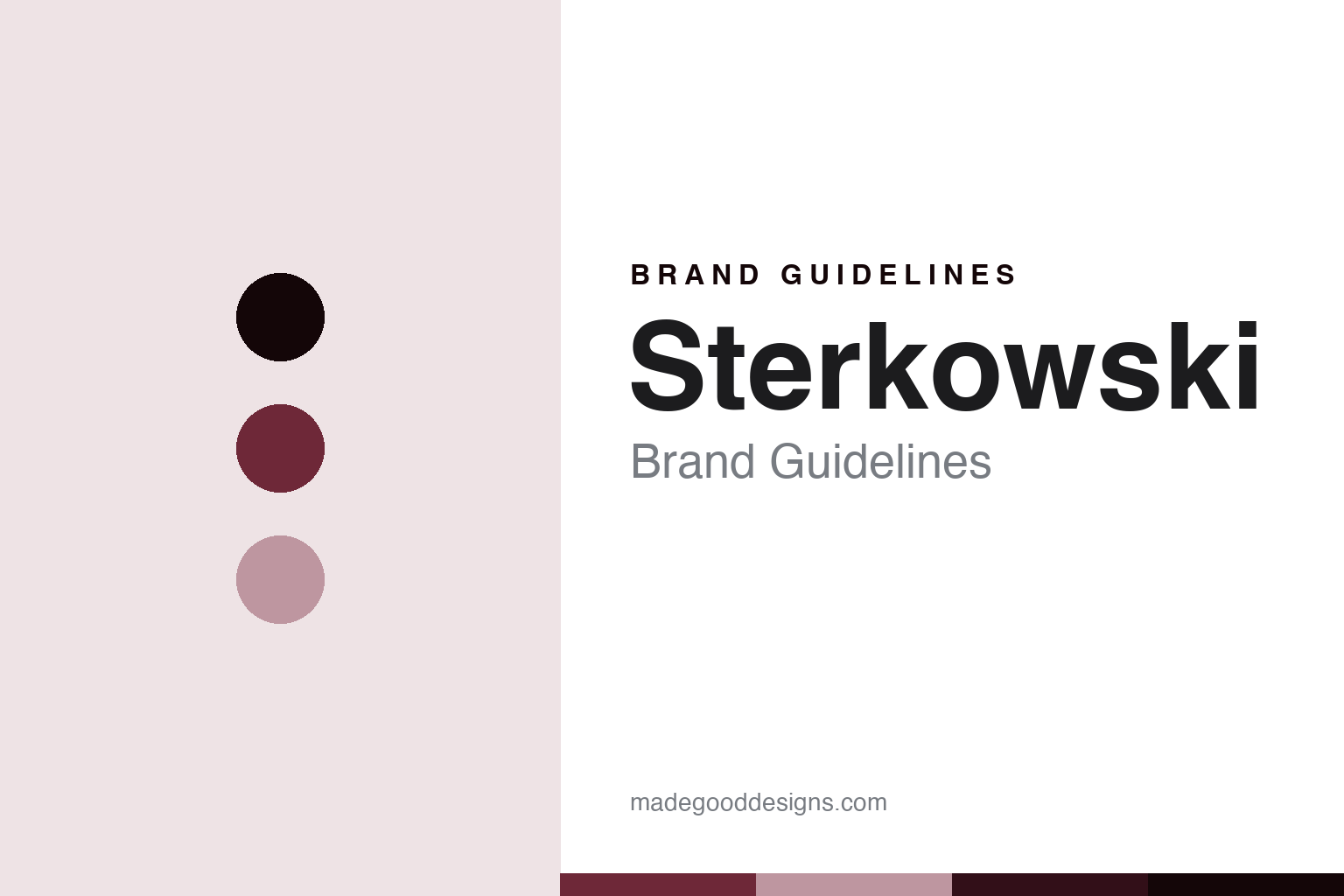
Sterkowski Brand Guidelines
The Warsaw flat cap.
Aa
Two constants: a burgundy palette and a Warsaw-sans register. Abstract homage — not a Sterkowski cap, label or style name.
The Warsaw cap workshop
Sterkowski is the Polish family cap workshop founded in Warsaw in 1926, reaching its centenary as a maker of flat and newsboy caps.
Sterkowski is a lesson in how a family workshop reaches a century. From Warsaw, Sterkowski is a family cap maker — flat caps, newsboy and ivy caps, and hats — handcrafted in its own workshop and shipped direct to customers around the world. Its answer to how a hat is made an everyday object is craft and range: make a wide family of flat-cap styles by hand, and sell them straight to the wearer, everywhere. A Warsaw workshop reaching its centenary.
Its identity is the Warsaw cap workshop. Sterkowski’s flat and newsboy caps, handmade in Warsaw and sold worldwide, are the work it is known for. A cap, made by hand in Poland. A family maker a century on.
(Honest notes, so the story stays precise. Sterkowski is a genuine cap maker — with its own workshop in Warsaw, not, as sometimes assumed, Kraków — rather than a reseller. It says it was founded in 1926 by Anna Sterkowska, a young widowed milliner, and has been family-run across four generations, reaching its centenary in 2026; we present the pre-war and mid-century history as the company’s own well-told account, plausible but not independently documented. Its range is wide — flat caps, newsboy, ivy, docker and more — and it ships direct to customers in dozens of countries; on sizing, we say it offers a broad range with a fitting guide rather than asserting bespoke made-to-measure. Its caps are made in its own Warsaw workshop, in Poland. One trademark note: some of its style names echo a television franchise, which we do not reference — we describe the styles only as flat or newsboy caps. Its name and marks are its IP, described but never reproduced, and there is no official brand hex; these tones are an unofficial interpretation. This is design commentary and does not promote any product.)
Colour
Sterkowski lives in a burgundy palette. Click a swatch to copy the hex.
Sterkowski’s identity is heritage, family and Central European — a burgundy, an ink, a rose, a wine, and a paper. The palette leans burgundy and rose: the register of a wool flat cap and a long-running family workshop. It signals craft and continuity over fashion. The honest caveat: with no published brand hex, these values are an original, unofficial interpretation, not first-party colours.
The lesson is a burgundy palette signals a family-workshop, made-in-Warsaw identity. Sterkowski’s world is a heritage, wool, Central European object. For designers, it is a reminder that a deep burgundy and a soft rose can carry a brand built on a craft and a century — the wine of a wool cap and the neutral of a workshop. Because these tones can fail as small text, keep type dark and let the colour live in the accents, palette and band. The takeaways: make by hand; range widely; date the heritage as the brand’s own; and treat any single hex as unofficial.
Typography
The register is a Warsaw sans — plain, sturdy, family.
Sterkowski’s identity carries a plain, sturdy, family spirit — a working cap workshop, not a fashion label. A Warsaw sans captures the mood: even, honest and unadorned, the register of a handmade flat cap. Set in a burgundy palette, the Warsaw sans feels plain and sturdy — exactly the personality Sterkowski carries. It is family-craft rather than glossy, mirroring a wool cap. (Sterkowski’s real labels and style names are things we describe but do not reproduce, and the exact typeface is not ours to use.) Because it is not ours to use, the honest description is “a Warsaw-sans spirit,” shown here in a stand-in. The type behaves like the workshop: plain, sturdy and family.
Aa
A Warsaw-sans spirit — plain and sturdy. (Specimen set in Manrope, a Warsaw-sans STAND-IN; NOT the Sterkowski wordmark or any label.)
The cap makers
Sterkowski stands for the family cap workshop at a century.
Sterkowski is a lesson in how a family workshop lasts a century. A burgundy palette, a Warsaw sans and a flat cap make one thing — a handmade Warsaw cap — the whole identity: heritage, family and Central European. The century of family making is the differentiator, and the wide flat-cap range is the meaning. The point is a Warsaw workshop, founded by a widowed milliner in 1926, that has made caps by hand across four generations, reaching its centenary still family-run.
Put to work, the identity is family continuity as design. A maker in this spirit would keep the workshop family-run, make by hand, and be honest about its story — a 1926 founding it tells itself, a Warsaw base, a direct-to-customer model. A brand learning from it would see that a century of family making is a durable identity — that a cap handmade in a family workshop has a continuity a factory cap cannot — and that being precise, founded 1926 by Anna Sterkowska, made in Warsaw, four generations to a centenary, keeps the story honest. A brand learning from it would also present a self-told heritage plainly, as the company’s own account, and avoid borrowing a television franchise its style names echo. The lesson Sterkowski teaches is that family continuity can hold an identity: the century gives it depth, and the honest, self-attributed history keeps it credible. The workshop is the personality, and the flat cap is the proof.
For designers and brand-builders, Sterkowski closes this round of the cap makers, from Poland: keep it in the family, and tell the heritage honestly. The lessons: make by hand; range widely; present a self-told history as the brand’s own; sell direct; and never borrow a franchise or reproduce a label. It is also a reminder to stay precise: Sterkowski is the Polish family cap workshop founded in Warsaw in 1926, reaching its centenary as a maker of flat and newsboy caps — with the palette here an unofficial interpretation. Sterkowski made family continuity the identity — proof that a century of handmade caps can be the difference.
Explore & save
Keep Sterkowski’s identity on hand — save it to a board in the Made Good inspiration library.
Sterkowski identity set
Pin the burgundy palette and the Warsaw-sans register to your own board.