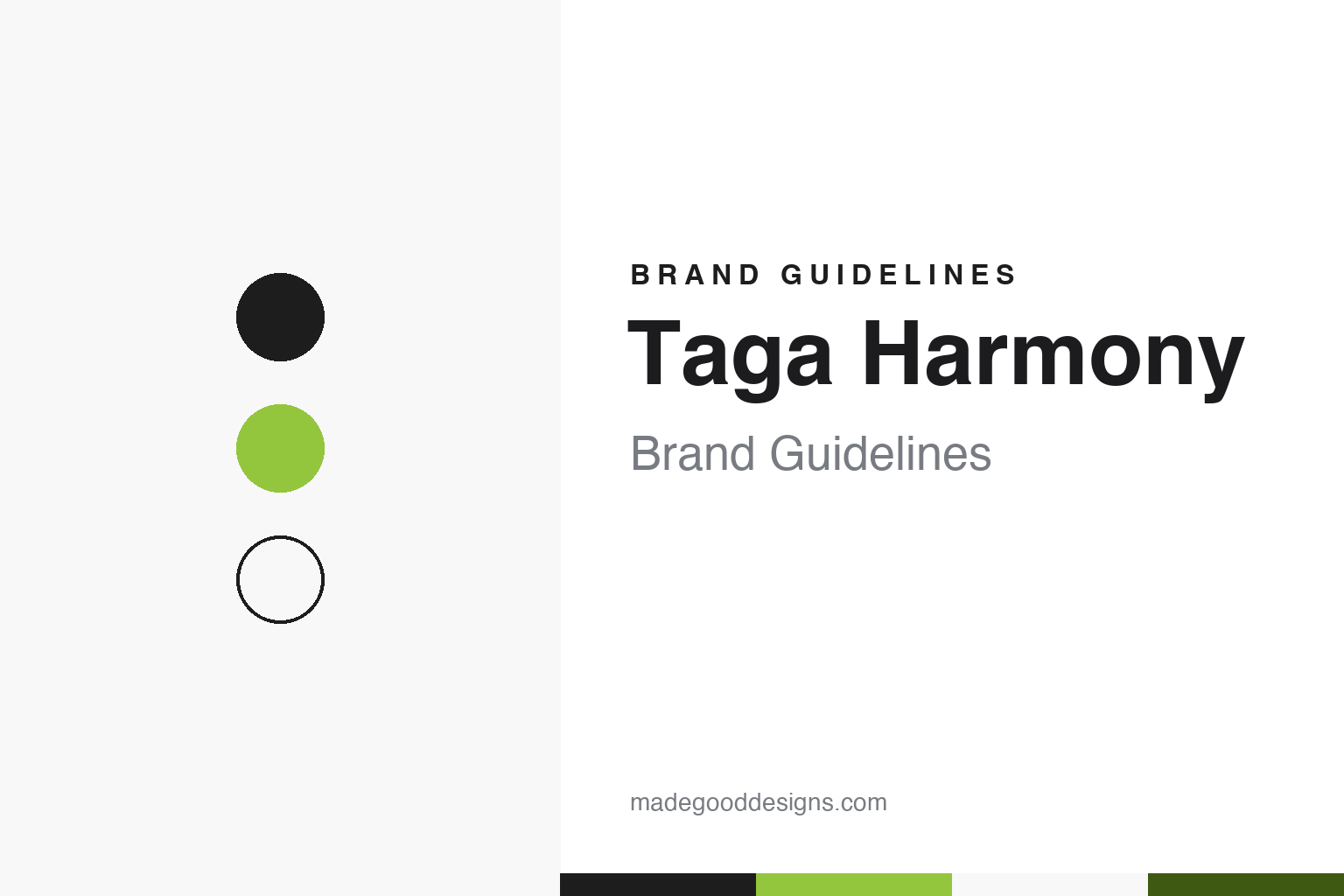
Taga Harmony Brand Guidelines
The Warsaw speaker brand that spells out its name: To Achieve Glorious Acoustics.
Aa
Two constants: a TAGA Harmony charcoal and wave green palette and a Clean sans register. Abstract homage — not a TAGA Harmony product or mark; no speaker, logo or nameplate is reproduced.
To Achieve Glorious Acoustics
From repairs and sales to a speaker brand.
TAGA Harmony, as the company styles its name, is a loudspeaker and hi-fi brand run from the edge of Warsaw. Its website gives its European address as Reguły, just south-west of the capital, and names the business behind it as Polpak Poland. The Polish court register lists that company, “Polpak Poland” Sp. z o.o., as a limited company with its registered seat in Warsaw, whose founding deed dates from December 1996 and which was entered in today’s National Court Register in 2001.
The company tells its origin story without a year. Its current website says its history “dates back to the early 1990s,” when P. Kokocinski and K. Richard, “passionate music lovers and high-end audio specialists,” decided that many acclaimed speaker brands did not deliver good sound for their prices, and set up their own. An archived version of the website from 2017 is more specific. It names Przemek Kokocinski as chief executive and co-founder, says he came from Poland and his partner, Mr. Richard, “from Germany,” and says the two started in the early 1990s “dealing with repair and sales of high-end audio equipment.” We found no source that gives a founding year for the brand itself, so we give none.
By the company’s account, it first offered sound-engineering services and improvements to existing audio products, and took “nearly two years” to develop its first loudspeaker prototypes. Today it calls itself “a family-owned company.” The court register is consistent with that: it lists two individual shareholders, holding two-thirds and one-third of the shares, who also form the management board. Their names are masked in the public extract, so we do not name them.
Colour
Diamond, Platinum and Nostalgic.
TAGA Harmony’s range is broad. Its website sorts products into speakers, electronics, installation, accessories and professional equipment: hi-fi and home-cinema loudspeakers; in-wall, in-ceiling and outdoor speakers; multimedia speakers; amplifiers and CD players; power conditioners and filters; cables, stands and feet; and point-source speakers for professional use.
At the top of the speaker range is the Diamond series, which the company calls its flagship. The Diamond B-60 v.3 is a two-way bookshelf speaker with what the company calls “a characteristic oval shape”: curved side walls and top, a cabinet tilted backwards, MDF up to 30 mm thick in places and wood-veneer finishes. The Platinum series, now in its fourth version, is described as “the most important speaker series” in its premium range, and the Nostalgic TH-12 and TH-15 are floorstanding speakers with vintage-style cabinets and grille cloth that the company says are each “handcrafted.” Its cabinets carry their own acronyms — TLIE and STLIE, for “Taga Low Interference Enclosures.”
Electronics followed the speakers. The range includes the HTA hybrid amplifiers, which combine valves and transistors; the HTR all-in-one players; and the TCD-30 CD player, built around an ESS SABRE ES9018 converter. The Polish magazine HighFidelity recorded TAGA Harmony at Warsaw’s Audio Video Show in 2015, showing HTA-700B v.2 amplifiers and speakers, and again in 2025, when it gave a first showing of a prototype hybrid amplifier, the HTA-2500B v.2, alongside a valve CD player, the TCD-70T, and the Nostalgic TH-15, with its 15-inch bass driver.
The company hosts English excerpts of reviews from Polish outlets: wstereo.pl on the Diamond B-60 v.3 in April 2024, Audio Video in June 2024 and hificlass, which gave the speaker a “Recommendation” in June 2025. We have read only those company-selected excerpts, not the full reviews.
Typography
Polish audio, then and now.
Poland’s audio industry was built by the state. From 1961 most of the country’s electronics works were grouped in UNITRA, a state industrial union run from Warsaw; from 1971 its factories carried “Unitra-” names, Polish Wikipedia records. The loudspeaker works at Września, near Poznań, renamed Tonsil in 1960, held a monopoly on loudspeakers and microphones throughout the communist period.
After 1989 the unions were dissolved and many factories failed. Tonsil became a joint-stock company, was one of the first five companies listed on the Warsaw Stock Exchange in 1991, and was declared bankrupt in 2004.
The old names have since been revived by new owners. A Września entrepreneur, Sławomir Wieszczeciński, bought the Tonsil brand rights in 2012 and the company says its speakers are again made entirely in the town. The Unitra trademark passed to a new Warsaw company backed by Michał Kiciński, a co-founder of the games firm CD Projekt, which showed prototypes of new Unitra hi-fi in 2022, Benchmark.pl reported; a separate company, Unitra S.A., descended from the state’s foreign-trade arm, now manages property.
A generation of small private makers grew up alongside them, from the 1990s onwards. Several work around Warsaw: Lampizator at Głosków, south of the city; Struss at Parzniew, to the west; and TAGA Harmony at Reguły, on its south-western edge. GigaWatt makes power products in Zgierz, next to Łódź, and Equilibrium, a loudspeaker and cable brand, belongs to Audiothlon of Zielona Góra, according to the magazine Hi-Fi i Muzyka.
This guide sets out what can be checked about each brand — who founded it, who owns it, and what it says about where its products are made — and marks clearly what rests only on the company’s own word.
Aa
A clean sans — the register of its website. (Specimen set in Source Sans 3, a sans STAND-IN; NOT the TAGA Harmony logo.)
TAGA Harmony
A wave, an acronym and a green.
The brand explains its own name. TAGA, it says, is an acronym of its tagline, “To Achieve Glorious Acoustics” — the same explanation appeared on its website in 2017 — while “Harmony” stands for creating its products “in harmony with nature.” In 2021 it introduced a new logo, which it says is preceded by an icon representing “the shape of an acoustic wave”; its homepage slogan today is “Let the wave play,” and a new logo badge now sits on the front of its speakers. Its website is set in Source Sans Pro, and its style sheet leans on a near-black and a bright lime green, #93C63D. We found no published brand guidelines.
Where its products are made is the hardest question. The current website does not say. Its Platinum pages use the slogan “Born in Europe – Crafted for the World,” and its About page credits “European know-how.” The archived 2017 website went further: it said TAGA Harmony had “divisions located in Europe and Asia,” that it “owns and operates an advanced production facility,” and that “almost all TAGA Harmony products and used components are designed and manufactured in-house” — without saying where that facility was. The same website’s contact page listed an Asian company, TAGA Audio Technology Company Limited, in Shunde, in the city of Foshan in China’s Guangdong province, and today’s contact page still gives an Asian sales address on a Chinese domain. We give those as the company’s own statements and draw no conclusion about the country of manufacture.
Its ambassador, by its own description, is the music journalist and DJ Hirek Wrona. Independent coverage we could reach is thin beyond show reports; we found no independent profile of the firm.
For a design guide, TAGA Harmony shows how a brand can carry one idea — a sound wave — across a very large product range. Compare Pylon Audio, another Polish loudspeaker maker, and Tonsil, the loudspeaker name of the state era. For this guide we use a charcoal and a lime green with a sans, an unofficial interpretation; no product or logo is reproduced.
Explore & save
Keep Taga Harmony’s identity on hand — save it to a board in the Made Good inspiration library.
TAGA Harmony identity set
Pin the TAGA Harmony charcoal and wave green palette and the Clean sans register to your own board.