J.Sikora Brand Guidelines
Janusz Sikora’s layered-metal turntables from Lublin.
Aa
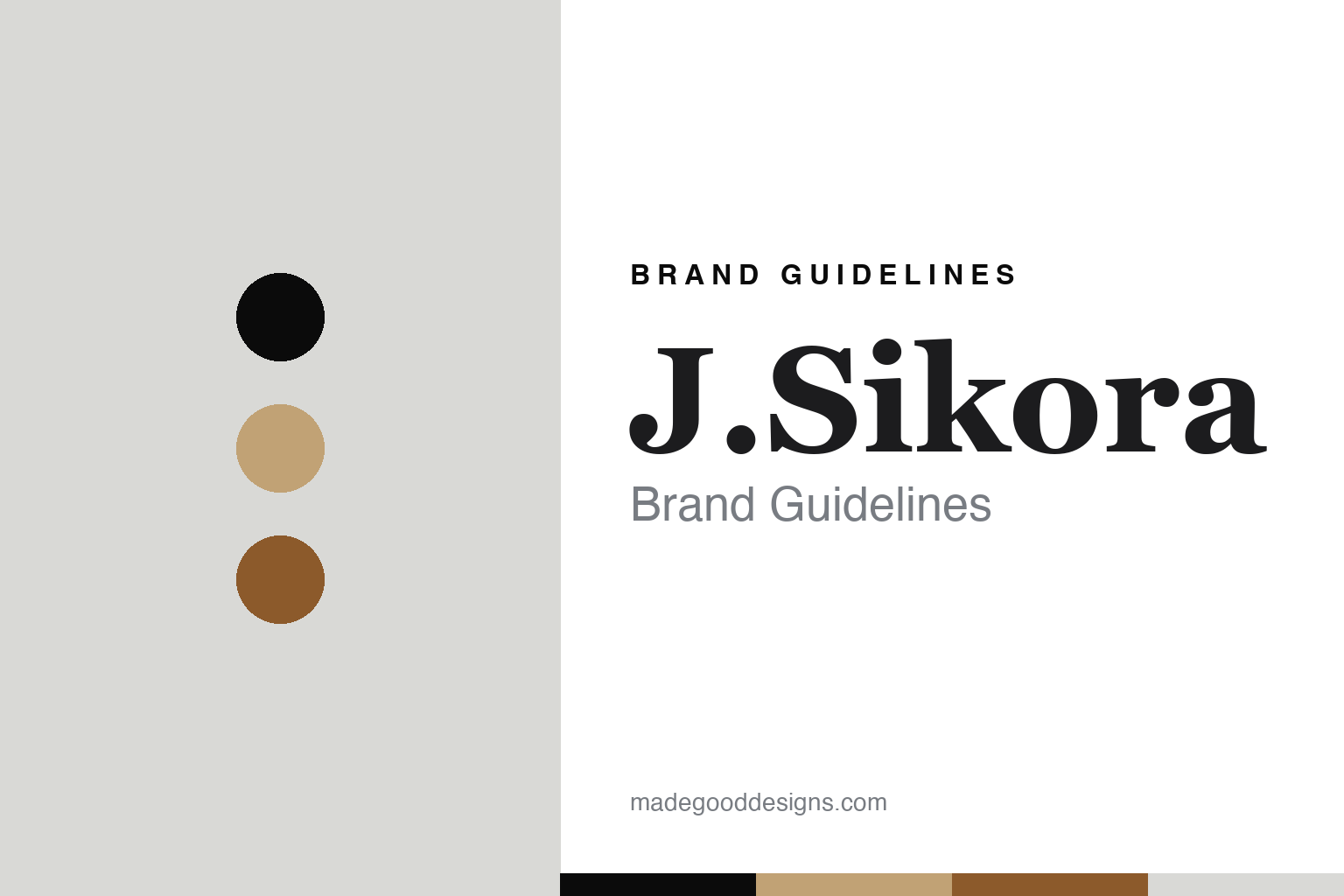
Two constants: a black, brass gold and bronze palette and a high-contrast serif register. Abstract homage — not a J.Sikora product or mark; no turntable, tonearm, logo or nameplate is reproduced.
Metal before music
A metals man from Lublin.
J.Sikora is a family company in Lublin, in eastern Poland. Its founder and designer, Janusz Sikora, came to turntables through metalwork. In a 2019 interview with Hifi Pig, reproduced on the company website, he said he had been an audiophile for more than 40 years, while the non-ferrous metals trade was “simply a source of income”; Stereophile’s Michael Fremer wrote in 2022 that Sikora had been a rock guitarist as a young man and later a locksmith, and that “metalwork is his main skillset.”
Audio began with valves. Sikora says that in 1994 he met a Ukrainian musician, Oleg Burdjak, in a Lublin audio shop; that in 1995 they built a balanced amplifier using Soviet 6C33C-B tubes; and that their Burdjak & Sikora brand appeared at the Audio Video Show in Warsaw in 1997 before the partnership ended. The turntable idea, in his telling, came from disappointment: he bought a high-end deck from a well-known brand he does not name, heard no gain over CD, took it apart and “burnt the plywood elements in the fireplace,” resolving to build in metal instead. Friends heard the result, he says, and the first orders came from them.
Sources differ slightly on the start date. The company’s history page says J.Sikora “began producing and selling turntables in 2007,” and HighFidelity.pl wrote in 2019 and again in 2024 that the firm was founded in Lublin in 2007, with the Standard as its first turntable. A 2024 anniversary page on the company website, however, marks fifteen years and says Sikora “completed the design of his first turntable” in 2009.
Colour
Layers of brass, bronze and cast iron.
The turntables are mass-loaders built from stacked metals. In the Hifi Pig interview Sikora described the aim as combining “different types of metals, layers which are losing the resonances from the bottom to the top one by one,” and gave the example of the 2 kg record clamp, whose mix of brass and bronze he said had to be settled by listening. HighFidelity.pl dated the range: the Standard from 2007, the flagship Reference shown in 2014 after seven years’ work, and the entry-level Initial added in 2016. The website now lists Initial, Initial Max, Standard, Standard Max, Standard Max Supreme and Reference models, all with inverted ceramic-ball bearings and DC motors — one on the Initial, four on the Reference — and a newer entry model, the Aspire. Fremer noted that the Reference’s 40 lb platter, of Delrin and cast iron, is the same one used on the Standard Max, which he priced at $21,500.
Tonearms followed. The KV12 and KV9 are oil-damped unipivots with conical tubes of Kevlar; Sikora told HighFidelity.pl he first came across the material in Focal loudspeaker cones. The company presents its arm as the first to use Kevlar, which we give as its claim. Fremer saw echoes of Kuzma and VPI arms in details such as the long counterweight stub, worked into what he called an “ingeniously compact original design.” Later Max Zirconium Series versions added more bronze parts.
The recognition is well documented. Stereophile named the Reference a joint Analog Component of the Year for 2022, alongside the Clearaudio Reference Jubilee, listing it at $47,000 without a tonearm; Fremer, who reviewed it in July 2022 with the $9,000 KV12 VTA arm, called it a “must audition” turntable “at and well above its price.” The KV12 Max Zirconium was Wojciech Pacuła’s choice for the Polish edition of the 2023 “Statement in High Fidelity” awards, hifistatement reported.
Typography
Design and documentation.
The seven brands in this group are small. Each makes turntables, tonearms or both, and several are still closely tied to the engineer who designed the first product. Between them they work from seven countries: the United States, Britain, Denmark, Poland, Lithuania, Switzerland and New Zealand.
In Britain, AVID Hifi Ltd has its registered office on an industrial park in Kimbolton, Cambridgeshire, Companies House shows. In Denmark, Bergmann Audio, which makes air-bearing turntables and linear-tracking arms, gives its address as Hobro. J.Sikora lists a street address in Lublin, in eastern Poland.
Reed tonearms come from Tonearms.lt, a Lithuanian company whose address is a village in the Kaunas district. Thales is made by HiFiction AG, which the Swiss commercial register places in Turbenthal, in the canton of Zurich.
Two brands need more care. Spiral Groove’s 2015 press releases were datelined Berkeley, California, but its website returned an error when we checked in October 2026, and its present status is unclear. Well Tempered Lab sells the designs of William Firebaugh. Its website gives a New Zealand phone number and says Opera Audio of Beijing makes the products, and TNT-Audio reported in 2016 that the brand is owned by a New Zealand company.
Small makers often say more about themselves than outsiders can confirm, from founding dates to materials to claims of hand assembly at home. Company registers, dated reviews and press releases settle some of this. The rest is the company’s word.
This guide sets out what can be checked about each brand — who founded it, who owns it, and what it says about where its products are made — and marks clearly what rests only on the company’s own word.
Aa
A high-contrast serif for a maker that sells weight and finish. (Specimen set in Playfair Display, a serif STAND-IN; NOT the J.Sikora logo. The company website happens to style quotations in Playfair Display.)
J.Sikora
Made in Lublin.
Production stays in Lublin. Fremer wrote that J.Sikora “manufactures turntables and tonearms in Lublin, Poland,” and that the Reference he reviewed was made at a local metal-fabrication works, which he named as Allmet; HighFidelity.pl’s review panels mark the products “Made in Poland,” and the company says its turntables are produced one at a time. Its website gives an address on ul. Poligonowa in Lublin and describes a showroom there used for listening sessions and visits from other audio makers.
The company remains in the family. The website lists Janusz Sikora as founder and designer, his son Robert Sikora as owner and managing director, and Adam Niezbecki as director; in 2019 HighFidelity.pl described Janusz as owner and Robert as head of sales, and in 2024 it named Niezbecki as production manager, also responsible for calibration. Fremer added that Robert plays in the band Crab Invasion with his brother Jakub. In 2024 the company issued a Standard Max Supreme 15th Anniversary model, with brass in place of aluminium in parts of the suspension and the first 15 sets numbered; HighFidelity.pl tested one, priced at €31,250, in September 2024. The website pairs black with a muted gold, though no official colour standard is published.
For a design guide, J.Sikora shows how materials can carry a brand: brass, bronze and cast iron, chosen by ear and stacked in layers. Compare Clearaudio, which shared Stereophile’s 2022 analog award, and Kuzma, whose arm-mounting pattern the KV12 uses, according to HighFidelity.pl. For this guide we use black, brass gold and bronze with a serif, an unofficial interpretation; no product or logo is reproduced.
Explore & save
Keep J.Sikora’s identity on hand — save it to a board in the Made Good inspiration library.
J.Sikora identity set
Pin the J.Sikora black, brass gold and bronze palette and the high-contrast serif register to your own board.