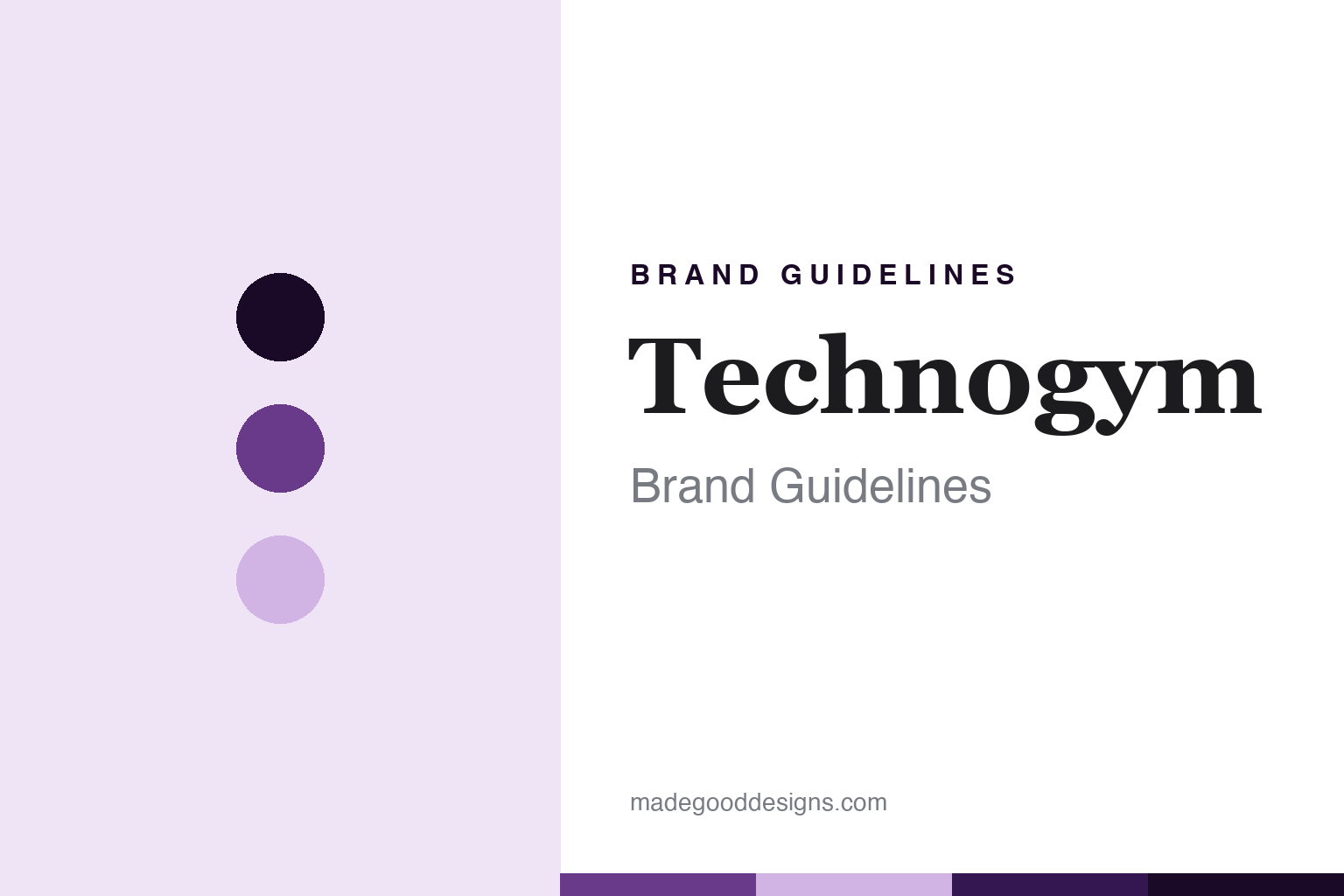
Technogym Brand Guidelines
The wellness machine.
Aa
Two constants: a wellness-violet palette and a wellness-serif register. Abstract homage — not a Technogym product or mark; no machine, console or logo is reproduced.
The wellness machine
Technogym is the Italian, publicly listed premium fitness-equipment maker and nine-time consecutive Olympic Games supplier, built in Cesena.
Technogym follows Eleiko as the round’s design-giant node — the Italian company that grew from a garage prototype into a publicly listed, premium fitness-equipment maker, the official supplier to nine consecutive Olympic Games. Its answer to a round about who owns the gear and where it is made is a design-led, European one: a founder-led public company that builds in Italy and pitched fitness as “wellness.”
Its identity is the wellness machine. The Italian design, the public ownership and the Olympic pedigree are the story here. Fitness as wellness. The wellness machine.
(Honest notes, so the ownership and the pedigree are framed accurately. Technogym sells premium fitness equipment as its heroes — the MyRun treadmill, the non-motorised Skillmill, the Technogym Bike, and a connected, AI-based training ecosystem; we report its language as the brand’s own. On origin: Technogym was founded in 1983 by Nerio Alessandri, who built his first prototype in his home garage at around twenty-two, and it is headquartered in Cesena, Italy, at a campus it calls the Technogym Village. On ownership: Technogym is publicly listed on Euronext Milan under the ticker TGYM, having floated in May 2016, and remains founder-controlled through the Alessandri family holding, which holds a minority of the capital but a majority of the voting rights; other reported holders include a vehicle linked to Saudi Arabia’s Public Investment Fund and the investor Ivan Glasenberg, and we report shareholdings as reported, since they shift over time. On where it is made: Technogym manufactures in Italy at its Cesena facilities, and we credit Italian manufacturing without claiming every product line is entirely Italy-made. On its pedigree: Technogym has been the official supplier to the athletes’ training centres at nine consecutive Olympic Games, from Sydney in 2000 to Paris in 2024. On the founder’s share sales, kept in proportion: Alessandri has sold roughly five hundred and fifty million dollars of shares since 2017 in a completed programme, which is routine founder monetisation and free-float expansion, not distress. Its designs and the Technogym name are IP we describe but do not reproduce; there is no official brand hex; these tones are an unofficial interpretation.)
Colour
Technogym lives in a wellness violet. Click a swatch to copy the hex.
Technogym’s identity is design-led, public and premium — a wellness violet, an ink, a pale violet, a deep violet, and a paper. The palette leans wellness violet and pale violet: a refined, design-forward register that nods to a premium, wellness-led pitch rather than a loud logo colour. It signals the wellness machine — design-led, public and premium. The honest caveat: with no official brand hex, these values are a design-led, unofficial interpretation, not first-party colours.
The lesson is a refined violet signals a design-led, premium identity. Technogym’s world is fitness reframed as wellness and design. For designers, it is a reminder that a refined violet and a soft pale can carry a premium, design-forward brand — a considered tone held as an accent, not a product shot. Because a mid hue can fail as small text, keep type dark and let the colour live in the accents, palette and band. The takeaways: credit Technogym for its design and the “wellness” idea; attribute the public listing on Euronext Milan and the founder’s voting control; state the Italian manufacturing; credit the nine consecutive Olympics; and keep the founder share sales in proportion.
Typography
The register is a wellness serif — design-led, public, premium.
Technogym’s identity carries a design-led, public, premium spirit — a founder-led public company with a design sensibility, not a commodity maker. A wellness serif captures the mood: refined, elegant and confident, the register of an Italian design house. Set in a wellness-violet palette, the wellness serif feels design-led and premium — exactly the personality Technogym carries. It behaves like a made, considered thing rather than a loud logo, mirroring a cable-arc and a load-gradient. (Technogym’s real products and the name are things we describe but do not reproduce, and the exact typeface is not ours to use.) Because it is not ours to use, the honest description is “a wellness-serif brand,” shown here in a stand-in. The type behaves like the brand: design-led, public and premium.
Aa
A wellness-serif brand — design-led and premium. (Specimen set in Playfair Display, a wellness-serif STAND-IN; NOT the Technogym logo or products.)
The iron node
Technogym stands for the wellness machine.
Technogym sits fifth in the round as its design-giant node. A wellness-violet palette, a wellness serif and a garage-to-public history make one thing — the wellness machine — the whole identity: design-led, public and premium. The Italian design is the pitch, the public ownership is the frame, and the Olympic pedigree is the proof. The point is a founder-led public company that reframed fitness as wellness, in a round about who owns the gear and where it is made.
Put to work, the identity is the brand told straight, the ownership named and the pedigree credited. A brand in this spirit would credit Technogym’s design and its “wellness” concept, attribute the public listing and the founder’s voting control, state the Italian manufacturing, credit the nine Olympics, and keep the founder share sales in proportion. A reader in this spirit would keep the facts right: Technogym sells MyRun, Skillmill, the Technogym Bike and a connected ecosystem as its heroes; it was founded in 1983 by Nerio Alessandri from a garage prototype, headquartered in Cesena, Italy; it is public on Euronext Milan as TGYM since 2016, founder-controlled by voting rights through the Alessandri holding, with other shareholders reported; it manufactures in Italy; it has supplied nine consecutive Olympic Games from Sydney 2000 to Paris 2024; and the founder’s roughly five-hundred-and-fifty-million-dollar share sales since 2017 are routine, not distress. Technogym sits after Eleiko and before Tonal. The honest editorial moves are to credit the design, to attribute the ownership, to state the making, to credit the Olympics, and to keep the share sales proportionate.
For designers and brand-builders, Technogym carries the iron node: credit a design pedigree — and keep a founder’s share sales in proportion. The lessons: a fitness maker can build a premium identity on design and a reframing idea, here “wellness”; a public listing is attributed with the founder’s continuing voting control explained rather than glossed; an Italian manufacturing base is credited without over-claiming every line; a genuine pedigree, nine consecutive Olympics, is credited as documented; and a founder’s large share sales are kept in proportion as routine monetisation, not spun into distress. It is also a reminder to stay precise: Technogym is the Italian public design giant and nine-time Olympic supplier — with the palette here an unofficial interpretation. The hook is that reframing: a garage prototype in Cesena grew into a public company that sells fitness as design and “wellness,” and equips the training halls of the Olympic Games. Read that way, Technogym is less a single machine than the wellness machine: design-led, public, premium. The lesson for a brand is that crediting the design pedigree and keeping the share sales proportionate reinforce each other, and attributing the ownership keeps the story earned. Technogym made the-wellness-machine the identity — proof that a design-led public giant can anchor a node.
Explore & save
Keep Technogym’s identity on hand — save it to a board in the Made Good inspiration library.
Technogym identity set
Pin the wellness-violet palette and the wellness-serif register to your own board.


