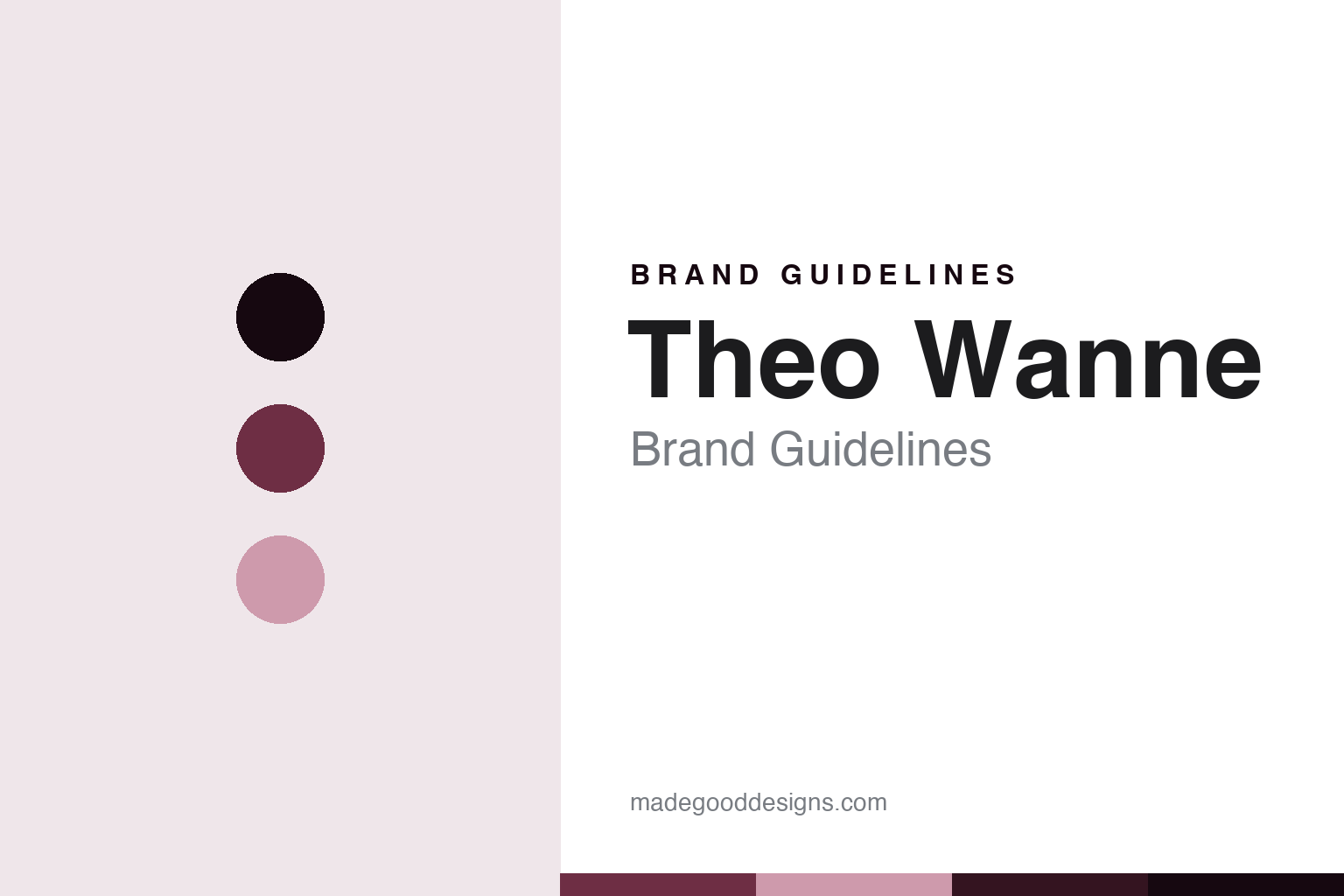
Theo Wanne Brand Guidelines
The machined mouthpiece.
Aa
Two constants: a machined-plum palette and a precision-sans register. Abstract homage — not a Theo Wanne mouthpiece or mark.
The machined mouthpiece
Theo Wanne is the American maker of precision CNC-machined saxophone mouthpieces founded by saxophonist Theo Wanne, made in Bellingham, Washington.
Theo Wanne is the round’s engineering answer to a hand-finished craft. From Bellingham, Washington, the company makes high-end saxophone mouthpieces — the part a player chooses to shape their sound — in metal and hard rubber, machined to precision rather than filed by hand. Its answer to how a maker becomes a name is CNC precision: bring aerospace-style machining to a craft traditionally finished by hand, and recreate great mouthpiece designs with modern accuracy. An American mouthpiece, machined to precision.
Its identity is the machined mouthpiece. Theo Wanne’s CNC-machined mouthpieces, its precision approach and its US making are the work it is known for. A mouthpiece, machined. The part a saxophonist chooses.
(Honest notes, so the story stays precise. Theo Wanne, a saxophonist and mouthpiece-refacing specialist, ran an earlier custom-mouthpiece business in the late 1990s and incorporated the modern branded company, Wanne, Inc., in 2007 (his brother left in 2013); its live official presence is at theowanne.com. On what it makes, it is saxophone mouthpieces in metal and hard rubber, plus ligatures and accessories; it also retails another brand’s reeds, so we do not describe reeds as its own product, and it has built saxophones in the past, though mouthpieces are the core identity. On where it is made — a theme of this round — the company states its mouthpieces are precision CNC-machined in the USA, in Bellingham, Washington, using aerospace-style CAD/CAM; we present that as the company’s own statement and note that no overseas line was found. On ownership, it is independent and founder-led as of the company’s own current materials. Its model names — Durga, Gaia, Shiva, Ambika — are Hindu deity names used as product trademarks, which we mention as names only, reproducing no deity imagery; its pro-player associations and patent counts we attribute as reported. Its name and marks are IP, described but never reproduced, and there is no official brand hex; these tones are an unofficial interpretation. This is design commentary and does not promote any product.)
Colour
Theo Wanne lives in a machined-plum palette. Click a swatch to copy the hex.
Theo Wanne’s identity is precise, American and modern — a machined plum, an ink, a rose, a deep plum, and a paper. The palette leans machined plum and rose: the register of an anodised metal mouthpiece and a machined finish. It signals precision over hand-filing. The honest caveat: with no published brand hex, these values are an original, unofficial interpretation, not first-party colours.
The lesson is a machined-plum palette signals a precision, CNC-made identity. Theo Wanne’s world is a precise, metal, American object. For designers, it is a reminder that a machined plum and a soft rose can carry a maker built on precision — the deep tone of an anodised mouthpiece and the sheen of machined metal. Because these tones can fail as small text, keep type dark and let the colour live in the accents, palette and band. The takeaways: machine with precision; recreate great designs accurately; attribute the maker’s claims; and treat any single hex as unofficial.
Typography
The register is a precision sans — clean, exact, modern.
Theo Wanne’s identity carries a clean, exact, modern spirit — a precision-machining maker, not a hand-filing bench. A precision sans captures the mood: even, exact and contemporary, the register of a CNC workshop. Set in a machined-plum palette, the precision sans feels clean and exact — exactly the personality Theo Wanne carries. It is precision machining rather than a marketing wall, mirroring a machined mouthpiece. (Theo Wanne’s real logo, its model-name marks and any deity imagery are things we describe but do not reproduce, and the exact typeface is not ours to use.) Because it is not ours to use, the honest description is “a precision-sans spirit,” shown here in a stand-in. The type behaves like the maker: clean, exact and modern.
Aa
A precision-sans spirit — clean and exact. (Specimen set in Manrope, a precision-sans STAND-IN; NOT the Theo Wanne logo or model marks.)
The parts players choose
Theo Wanne stands for the mouthpiece machined instead of hand-filed.
Theo Wanne is a lesson in how precision can be an identity. A machined-plum palette, a precision sans and a CNC mouthpiece make one thing — the machined mouthpiece — the whole identity: precise, American and modern. The CNC machining is the differentiator, and the recreation of great designs with accuracy is the meaning. The point is a maker who took a part traditionally finished by hand — the saxophone mouthpiece — and brought aerospace-style precision to it, so the part a player chooses is machined rather than filed.
Put to work, the identity is precision, honestly told, as design. A maker in this spirit would machine the part, recreate great designs accurately, and attribute its claims — CNC-machined mouthpieces, made in the USA, a founder who is a saxophonist. A brand learning from it would see that precision is a durable identity — that a mouthpiece machined to tolerance carries a consistency a hand-filed one cannot promise — and that being precise, incorporated 2007 by Theo Wanne, CNC-machined in Bellingham, keeps the story honest. Theo Wanne holds the round’s engineered pole against Melos’s natural one: where the rosin maker leans into the raw material and the hand, this maker leans into the machine — the same category, the parts players choose, made two opposite ways. The discipline is in the attribution: presenting the made-in-USA and precision claims as the company’s own, treating the deity model-names as names rather than imagery, and not calling reeds its own product when it retails another brand’s. The lesson Theo Wanne teaches is that precision can hold an identity: the machining gives it substance, and the honest attribution keeps it credible. The precision is the personality, and the machined mouthpiece is the proof.
For designers and brand-builders, Theo Wanne holds the USA pole in the parts players choose: machine the part, and attribute the claims. The lessons: bring precision to a hand-craft; recreate great designs accurately; present made-where as the company states it; keep model names as names; and never reproduce a logo or motif. It is also a reminder to stay precise: Theo Wanne is the American maker of precision CNC-machined saxophone mouthpieces founded by saxophonist Theo Wanne, made in Bellingham, Washington — with the palette here an unofficial interpretation. Theo Wanne made precision the identity — proof that a machined mouthpiece, honestly told, can be the difference.
Explore & save
Keep Theo Wanne’s identity on hand — save it to a board in the Made Good inspiration library.
Theo Wanne identity set
Pin the machined-plum palette and the precision-sans register to your own board.