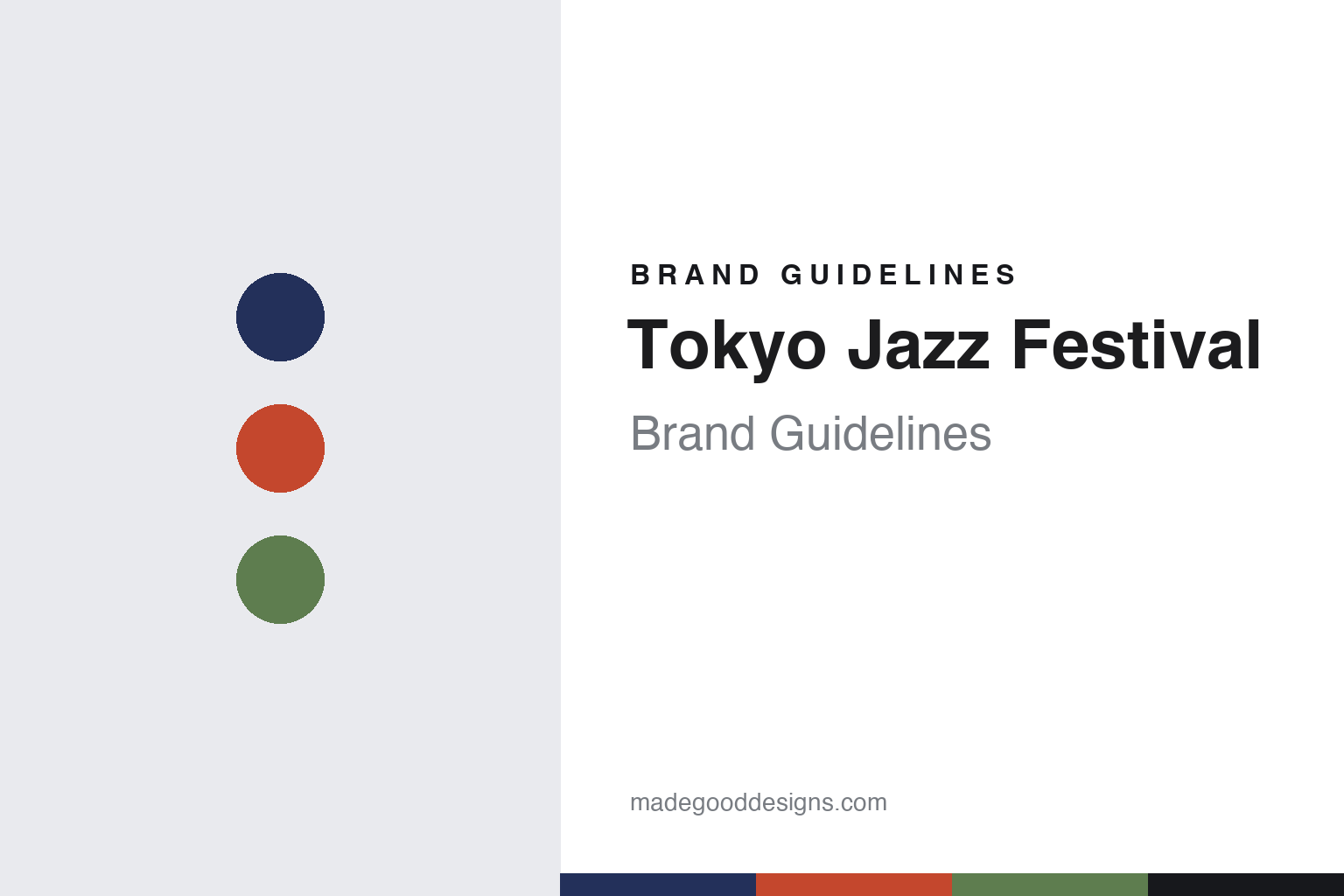
Tokyo Jazz Festival Brand Guidelines
A stadium weekend in 2002, then a hall, then a whole Shibuya neighbourhood.
Aa
Two constants: a Shibuya indigo, lantern vermilion and zelkova green palette and a broadcast gothic sans register. Abstract homage — not a Tokyo Jazz Festival poster or mark; no logo, artwork or ticket is reproduced.
A broadcaster’s festival
Three media organisations, one producer and a football stadium.
Tokyo Jazz began in the summer of 2002. The festival’s archived page for that year names the event TOKYO JAZZ 2002 and gives its dates as 24 and 25 August 2002, at Tokyo Stadium in Chofu, in the western part of the metropolis. The organiser was an executive committee formed by NHK, the national broadcaster, its production arm NHK Enterprises 21 and the newspaper publisher Nihon Keizai Shimbun, now Nikkei Inc. The same page credits Herbie Hancock as music producer and lists performers including Hancock, Michael Brecker and Wayne Shorter.
The first edition was reviewed by the English-language site Jazz in Japan, which reported that the festival Hancock directed drew 37,000 people over its two days to the stadium in west Tokyo, and described a programme that set Hancock’s electric band beside Shorter’s acoustic quartet before a closing jam session with more than twenty musicians on stage. The review closed with Hancock raising a toast to the following year’s festival.
He came back. The 2003 page gives the dates as 23 and 24 August 2003 at Ajinomoto Stadium, the same Chofu ground under a new name, with the same three organisers. Japanese Wikipedia says Hancock has served as the festival’s general producer since 2003, and an interview published on the festival’s 2004 website describes that year as the third edition, with Hancock bringing a new quartet that included Shorter.
The festival soon moved indoors. Japanese Wikipedia says the 2004 edition took place in September at Tokyo Big Sight, the exhibition centre on Tokyo Bay, and that 2005 was held there too. From 2006, it says, the festival moved to Tokyo International Forum in Marunouchi; the festival’s 2010 page confirms that pattern, listing 3 to 5 September 2010 in the Forum’s Hall A, with the organiser now named as the TOKYO JAZZ Executive Committee of NHK, NHK Enterprises and Nikkei Inc.
Colour
A hall, a street, a club and a noh stage.
In 2017 the festival changed its geography. The page for the 16th edition announced a “big move to Shibuya” and described the aim of becoming a “town-wide” event, with performances in tree-lined streets, parks and the station alongside the established hall concerts. It organised the programme by setting rather than by stage number, a structure that is useful to note for anyone designing for a multi-site event.
The 2017 page lists four parts. the HALL was NHK Hall, the broadcaster’s concert hall in Jinnan, Shibuya, on 2 and 3 September. the STREET, also called the PLAZA, used the zelkova-lined Keyaki street of Yoyogi Park from 1 to 3 September and was open without tickets. the CLUB took over the live venues WWW and WWW X in Udagawa-cho, and JAZZ at the NOH THEATRE placed concerts in the Cerulean Tower Noh Theatre. The lower-case “the” in each name is how the festival itself writes them. Japanese Wikipedia confirms that NHK Hall has been the main venue since 2017.
The same naming habit appears a year earlier. Japanese Wikipedia’s record of the 2016 edition, held from 2 to 4 September, divides the programme into the HALL, the PLAZA and the CLUB, with student big bands and workshops on the open-air stage and international and Japanese headliners in the hall. The festival’s slogan on its 2017 page was “Beyond Borders, Beyond Generations,” and its 2003 website already spoke of passing music on to a younger generation.
Broadcasting is part of the format. Japanese Wikipedia records that in 2020 the festival was presented online as TOKYO JAZZ+plus LIVE STREAM on 23 and 24 May, with NHK BS Premium airing three programmes from the 18th festival and NHK FM playing back recordings from the 2017 to 2019 editions. A book on the festival’s making, written by the Tokyo Jazz Project, was published by DU BOOKS in September 2016, according to the same article.
Typography
Design and documentation.
A jazz festival is often remembered first by where it happens and when. Some take over a city park in high summer, with stages set between lawns and old trees; others fill the courtyard of a former abbey, the seats of a concert hall, an island in a river or the streets of a small town that changes character for a week. The same name can stay attached to a place for decades, and when a festival does move, the old site often survives in its title.
The calendar works in the same way. A fixed weekend, a fortnight in July or a run of autumn evenings becomes part of the identity, as recognisable to regular visitors as any logo. Many festivals also carry a series of annual posters, and in some cases the designers and illustrators behind them become part of the festival’s own story, with each year’s image added to a visible archive.
Behind the name there is usually an organisation that keeps it going: a non-profit association, a public broadcaster, a municipal body, a foundation or a concert promoter. Names, owners and organisers can change over the years, and a festival title may be held by one body while another runs the days. Following those changes through dated sources is often the clearest way to understand how a festival has lasted.
Then there is the practical layer that audiences handle: programme booklets, day schedules, wristbands and payment cards, maps, stage signage and the names given to the stages themselves. These pieces are rarely documented as design, yet they are where a festival’s identity meets its visitors most directly. The guides in this collection describe them plainly, as their sources do.
Aa
A clean gothic sans, the register of broadcast captions and hall signage. (Specimen set in Zen Kaku Gothic New, a sans STAND-IN; NOT the Tokyo Jazz Festival logo.)
TOKYO JAZZ
A name written in capitals and in two scripts.
The festival writes its name in more than one way. Its websites use TOKYO JAZZ in capitals, TOKYO JAZZ FESTIVAL in English page titles and 東京JAZZ in Japanese, with the city in kanji and the genre left in Latin letters. Each year adds a numeral or the edition number, as in “The 16th TOKYO JAZZ FESTIVAL” of 2017. For a designer, the mixed-script name is the clearest identity fact the sources give: it is a pairing of Japanese and Latin type rather than a single mark.
Its line of descent is institutional. The festival’s pages for 2002, 2003, 2010 and 2017 all name the same three-part executive committee, and the official website carries an NHK Enterprises privacy notice. For design work that means a steady institutional voice: a dated page for each edition, a named stage for every setting, and, as in 2020, radio and television programmes that carry the festival beyond the weekend itself.
In November 2026 the festival’s website led with 東京JAZZ 2023 NEO-SYMPHONIC JAZZ at 芸劇 – Mirage Future –, a single concert on 25 August 2023 in the concert hall of Tokyo Metropolitan Theatre. The page describes it as a collaboration with the theatre’s NEO-SYMPHONIC JAZZ series, which has had Miho Hazama as producer since 2019; she produced and conducted the evening with the Tokyo Philharmonic Orchestra and guest soloists.
The practical layer follows the venues. The 2017 page sent ticket holders to reserved seats in NHK Hall and standing rooms in the clubs, while the street stage in Yoyogi Park needed no ticket, so wayfinding has to work for a seated audience and a passing crowd at once.
For a design guide, Tokyo Jazz Festival shows how an event run by media organisations can carry one name through a stadium, an exhibition centre, a forum and a neighbourhood, holding it together with plain stage names and a bilingual wordmark. Compare NHK, the broadcaster at the head of its organising committee, and Jarasum Jazz Festival, another East Asian jazz festival that took shape in 2004. For this guide we use an indigo, a vermilion and a zelkova green with a sans, an unofficial interpretation; no product or logo is reproduced.
Explore & save
Keep Tokyo Jazz Festival’s identity on hand — save it to a board in the Made Good inspiration library.
Tokyo Jazz Festival identity set
Pin the Shibuya indigo, lantern vermilion and zelkova green palette and the broadcast gothic sans register to your own board.
Source & notes
Frequently Asked Questions
What font can I use to match the Tokyo Jazz Festival look?
This guide describes Tokyo Jazz Festival’s type as “A clean gothic sans, the register of broadcast captions and hall signage”. Its type specimen is set in Zen Kaku Gothic New from Google Fonts as a stand-in; Zen Kaku Gothic New is not Tokyo Jazz Festival’s own lettering.
What colours are in the Tokyo Jazz Festival palette?
This guide’s Tokyo Jazz Festival palette is Shibuya indigo #23305A, Night ink #17181C, Lantern vermilion #C4472D, Zelkova green #5E7D4F and Paper #F6F4EF. The tones are the guide’s own unofficial interpretation, not official Tokyo Jazz Festival hex codes.
When was Tokyo Jazz Festival founded?
Tokyo Jazz Festival was founded in 2002, in Tokyo, Japan.


