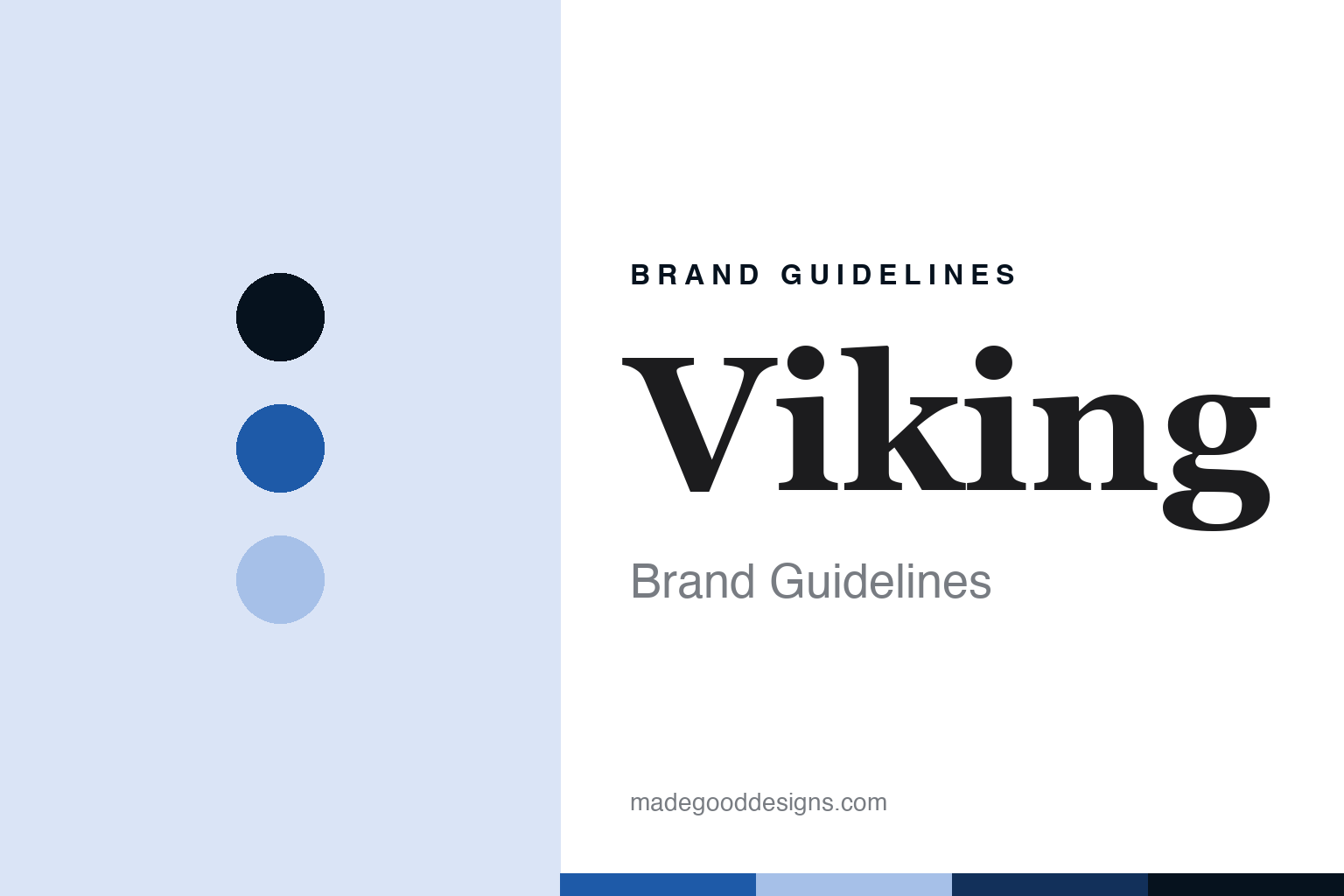
Viking Brand Guidelines
The brand that invented the pro-style home range.
Aa
Two constants: a Viking-blue palette and a pioneer-serif register. Abstract homage — not a Viking product or mark; no range, burner or logo is reproduced.
The brand that invented the pro-style home range
Viking is a 1987 Greenwood, Mississippi maker (Fred Carl Jr.), the first pro-grade home range — owned since 2013 by the US foodservice giant Middleby.
Viking opens the range round as its pioneer node — the brand credited with inventing the professional-style home range, now one of the famous cooking names rolled up by a US foodservice giant. Its answer to a round about who owns the range world is the pioneer one: the category creator, now Middleby-owned.
Its identity is the brand that invented the pro-style home range. The 1987 founding, the Middleby ownership and the original pro range are the story here. The one that started it. The brand that invented the pro-style home range.
(Honest notes, so the founding, the ownership, the making and documented recalls are framed accurately. Viking sells pro-style ranges as its heroes — the original 1987 range, plus cooktops and wall ovens; we report its language as the brand’s own. On founding: Viking Range was founded in 1987 by Fred Carl Jr. in Greenwood, Mississippi, and is credited with creating the professional segment of home appliances with the first pro-grade home range. On ownership: it was acquired by the Middleby Corporation, the US foodservice-equipment giant listed on the Nasdaq, in 2013 for 380 million dollars. On the making: Greenwood, Mississippi. On documented recalls, dated: Viking paid a 450-thousand-dollar civil penalty in 2011 over refrigerator defects, recalled about 52,000 gas ranges in 2015 for spontaneous ignition, and paid a 4.6-million-dollar civil penalty in 2017 for failing to promptly report gas-range defects, which we date and do not generalize to current products. Its designs and the Viking name are IP we describe but do not reproduce; there is no official brand hex; these tones are an unofficial interpretation.)
Colour
Viking lives in a Viking blue. Click a swatch to copy the hex.
Viking’s identity is pioneer, Middleby-owned and pro-grade — a Viking blue, an ink, a pale blue, a deep navy, and a paper. The palette leans Viking blue and deep navy: a solid, professional register that nods to a pro-kitchen brand rather than a loud logo colour. It signals the brand that invented the pro-style home range — pioneer, Middleby-owned and pro-grade. The honest caveat: with no official brand hex, these values are a professional, unofficial interpretation, not first-party colours.
The lesson is a Viking blue signals a pioneer, pro-grade identity. Viking’s world is the pro kitchen at home. For designers, it is a reminder that a solid blue and a deep navy can carry a pioneer, pro-grade brand — a professional tone held as an accent, not a product shot. Because a mid hue can fail as small text, keep type dark and let the colour live in the accents, palette and band. The takeaways: date the founding to 1987 and Greenwood; credit the pro-range invention; name the Middleby ownership since 2013; and date the CPSC recalls. A further design lesson is that a category creator earns a durable identity from the invention itself — leaning the brand on “we built the first one” gives a pro-grade product an origin story rivals can imitate but never claim, and a solid, professional palette signals that authority better than novelty ever could.
Typography
The register is a pioneer serif — pioneer, Middleby-owned, pro-grade.
Viking’s identity carries a pioneer, Middleby-owned spirit — the creator of its category. A pioneer serif captures the mood: solid, established and authoritative, the register of a category-defining brand. Set in a Viking-blue palette, the pioneer serif feels dependable and serious — exactly the personality Viking carries. It behaves like a made, professional thing rather than a loud logo, mirroring a burner-ring and a grate-line. (Viking’s real products and the name are things we describe but do not reproduce, and the exact typeface is not ours to use.) Because it is not ours to use, the honest description is “a pioneer-serif brand,” shown here in a stand-in. The type behaves like the brand: pioneer, Middleby-owned and pro-grade.
Aa
A pioneer-serif brand — dependable and serious. (Specimen set in Fraunces, a pioneer-serif STAND-IN; NOT the Viking logo or products.)
The range node
Viking stands for the brand that invented the pro-style home range.
Viking opens the round as its pioneer node. A Viking-blue palette, a pioneer serif and a 1987 founding make one thing — the brand that invented the pro-style home range — the whole identity: pioneer, Middleby-owned and pro-grade. The 1987 founding is the pitch, the category invention is the substance, and the Middleby ownership is the frame. The point is the category creator now Middleby-owned, the anchor of the round about who owns the range world.
Put to work, the identity is the brand told straight, the invention credited and the recalls dated. A brand in this spirit would date the founding to 1987 and Greenwood, credit the pro-range invention, name the Middleby ownership since 2013, and date the CPSC recalls. A reader in this spirit would keep the facts right: Viking sells pro-style ranges; it was founded in 1987 by Fred Carl Jr. in Greenwood, Mississippi; it created the pro-grade home range; and it is Middleby-owned since 2013. Viking opens the round, before Wolf. The honest editorial moves are to date the founding, to credit the invention, to name the owner, and to date the recalls.
For designers and brand-builders, Viking opens the range node: credit a category invention — and date real recalls. The lessons: a brand can be the creator of a whole category, here Viking and the pro-style home range; a founding is dated to 1987 and Fred Carl Jr. in Greenwood, Mississippi, with the first pro-grade home range; an ownership is named, acquired by the Nasdaq-listed US foodservice giant Middleby in 2013 for 380 million dollars; and documented recalls are dated, the 2011 refrigerator-defect civil penalty, the 2015 recall of about 52,000 gas ranges for spontaneous ignition, and the 2017 civil penalty for failing to promptly report gas-range defects, kept dated rather than generalized to current products. It is also a reminder to stay precise: Viking is the Middleby-owned pro-range pioneer of the range aisle — with the palette here an unofficial interpretation. The hook is that invention: Viking is the brand that invented the pro-style home range, a 1987 Greenwood, Mississippi maker under Fred Carl Jr., the first pro-grade home range, owned since 2013 by the US foodservice giant Middleby. Read that way, Viking is less a single range than the brand that invented the pro-style home range: pioneer, Middleby-owned, pro-grade. The lesson for a brand is that crediting a category invention and dating real recalls reinforce the honesty, and naming the owner keeps it earned. Viking made the-brand-that-invented-the-pro-style-home-range the identity — proof that the category creator can open a round.
Explore & save
Keep Viking’s identity on hand — save it to a board in the Made Good inspiration library.
Viking identity set
Pin the Viking-blue palette and the pioneer-serif register to your own board.