Vitavia Brand Guidelines
An aluminium greenhouse brand built by three partners across three countries.
Aa
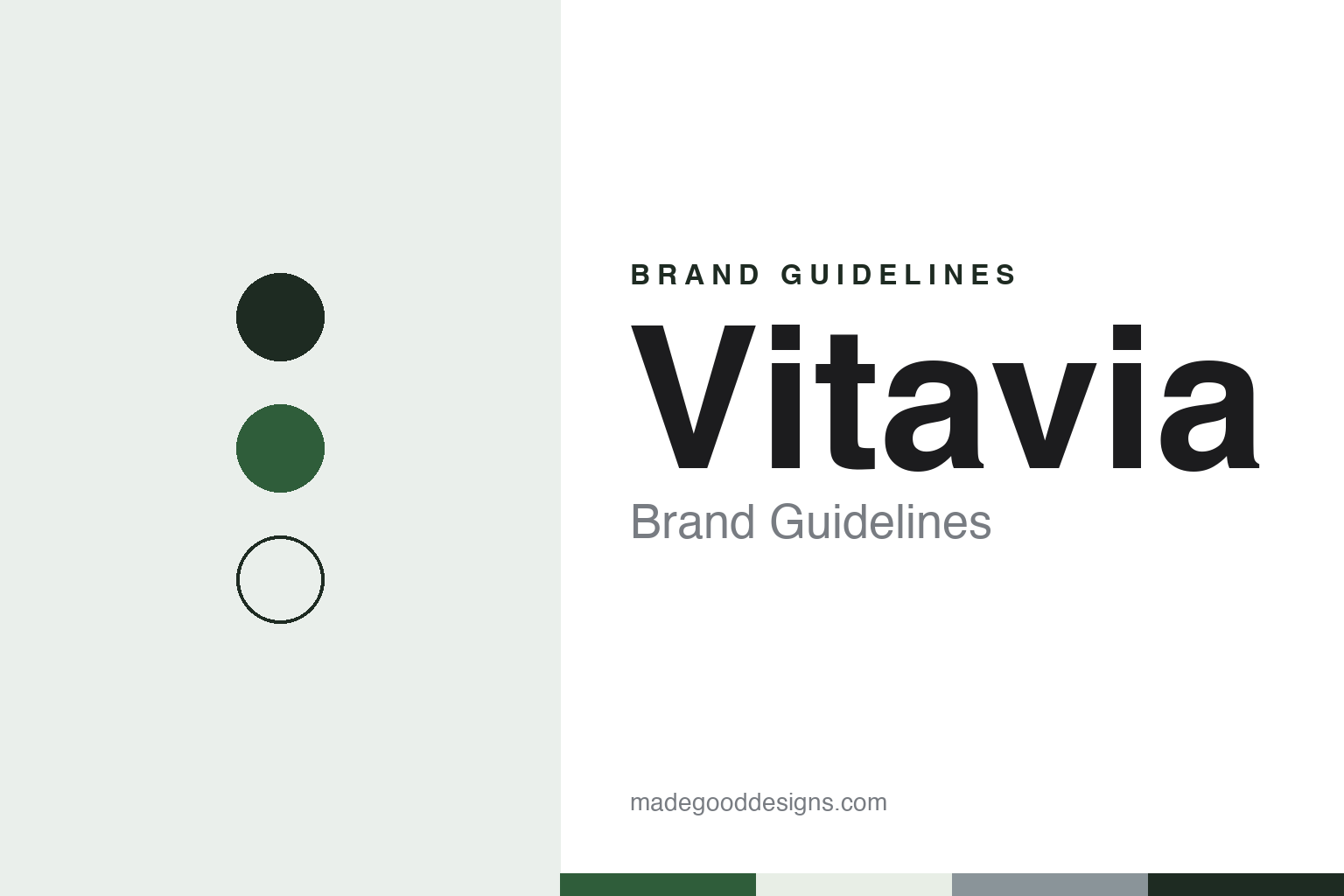
Two constants: a frame green, glass mist and anodised grey palette and a condensed sans register. Abstract homage — not a Vitavia product or mark; no greenhouse, logo or nameplate is reproduced.
Three partners
A Danish distributor, a German garden firm and a factory in China.
Vitavia is a brand of aluminium greenhouses run from Odense, on the Danish island of Funen. Its Danish website describes the brand as the product of a partnership behind Vitavia Garden Products Co., Ltd., which it calls a China-based joint venture. The website names three partners: OPJ A/S, the Odense company it credits with more than 36 years’ experience in selling and distributing garden products; E.P.H. Schmidt, the German garden-products company, which it credits with more than 90 years of ideas for active gardening; and Liu Jianzhong, credited with expertise in production and export from China.
Juliana, which announced its purchase of OPJ in November 2025, gives OPJ’s founding year as 1997 and says it handles the development and distribution of Vitavia in Denmark, the rest of the Nordic region, the Baltic states and Poland. From its office and warehouse in Odense, the company says, it sells directly to customers in Denmark, Norway, Sweden and Finland.
The Danish website says Vitavia has more than 35 years’ experience with greenhouses, that its greenhouses are sold in more than ten countries, and that they are “produced at our own factory”; we give those as the company’s claims. In Germany, Vitavia greenhouses are sold through E.P.H. Schmidt, whose German Vitavia website marked the company’s hundredth anniversary in 2022 and also carries news of its Pergart metal garden sheds, so that the greenhouses sit within a wider garden-products business there.
Colour
Greek gods and planets.
Vitavia names its greenhouses after figures from Greek myth and after planets and stars. The British range includes the Hera, Ida, Orion and Jupiter, alongside models such as the Apollo, Freya, Gaia, Neptune, Phoenix and Saturn, with frames listed in plain anodised aluminium or powder-coated black, dark grey, green or grey. The Danish range is grouped by form: freestanding greenhouses, lean-to wall greenhouses, balcony greenhouses, orangery and pavilion models, and cold frames. The company also sells accessories such as staging and shelves, window openers, decorative cresting, watering, shading and heating products, replacement glass, polycarbonate panels and spare parts, and its Danish shop extends to raised beds, log stores and rainwater collection. The Danish website runs in Danish and Swedish versions, and the British and German websites are run by the brand’s partners in those countries.
Much of the brand’s communication is practical rather than aspirational. Its Danish site offers step-by-step assembly videos and instructions, a dealer and showroom finder, and a spare-parts shop, and positions the range on affordability, saying it aims to keep prices at a level where everyone can share the pleasure of a Vitavia greenhouse. Its homepage tagline, translated from Danish, says Vitavia “makes room for both hygge and greenhouse dreams.”
In Britain the brand is sold by Vitavia UK. Its website says the business was established in 2008 by Tony Hutchinson, with business partners in Denmark and Germany; the Danish site adds that Hutchinson had been export manager at Halls, the British greenhouse maker. Companies House lists the British operating company, Vitavia Garden Products Limited of Ipswich, Suffolk, as incorporated in April 2006, earlier than the founding year the company gives. Vitavia UK describes itself as a family business, and its website also sells greenhouses from the Belgian maker Janssens.
Typography
Design and documentation.
Greenhouse makers sell a building, but they mostly sell a picture of a garden. The oldest visual language in the trade is Victorian: ridged roofs, finials, cast brackets and the steep pitch of a nineteenth-century glasshouse set against a brick wall. Some makers reproduce those proportions closely in aluminium; Alitex, for example, says it follows the width of Victorian glazing bars, a 45-degree roof pitch and traditional eaves heights. Others present slimmer, plainer frames as modern horticulture, and many sell polycarbonate kits that leave ornament out altogether.
Materials set the colour story. Timber greenhouses, often cedar, are shown in their warm natural tones, while aluminium frames are usually powder-coated in a short list of colours, from dark greens and blacks to softer creams and greys. The names attached to those structures borrow from gardens and estates: Alitex’s National Trust Greenhouse Collection is named after Trust gardens such as Hidcote, Scotney and Stourhead, and endorsements from bodies like the Royal Horticultural Society and the Royal Botanic Gardens, Kew are placed prominently.
The copy speaks the language of the kitchen garden & the potting shed: seed trays, tomatoes, pelargoniums, staging and benching, cold frames and walled gardens. Heritage is a common theme. Hartley Botanic, founded in Greenfield in 1938, has built its flower-show stands around vintage structures from each decade of its history, planted and propped to match.
Catalogue photography follows the same logic. Greenhouses are usually pictured planted up rather than empty, with terracotta pots, tools and sometimes a chair inside, so that the glass reads as a room as much as a structure. Flower shows such as RHS Chelsea, Hampton Court and Tatton Park act as live versions of those catalogues, and the makers’ stands are judged and reported on in their own right.
Aa
A condensed sans for an aluminium-greenhouse brand. (Specimen set in Barlow Condensed, a sans STAND-IN; NOT the Vitavia logo.)
Vitavia
From competitor to Juliana brand.
For years Vitavia competed with the other big name in Odense greenhouses, Juliana. That changed in late 2025. On 6 November 2025 Juliana Group announced that it would acquire OPJ A/S, the company behind Vitavia’s distribution in Denmark and neighbouring markets, describing the two as long-time competitors in the greenhouse business and OPJ as a team of about ten people, whose founder and owner, Jørgen Hjorth, would stay on for a transition period; Juliana’s company history dates the completed acquisition to January 2026. The horticulture trade site The Dirt, reporting in April 2026, listed Vitavia alongside Juliana and Halls as brands owned by the Juliana Group and said Vitavia had been acquired in November 2025.
Juliana, founded in Odense in 1963 by Mogens A. Stærmose, has grown partly by buying rivals: its company history lists two British competitors in the 1990s, Halls in 2009 and the cedar-greenhouse maker Gabriel Ash in 2010, and it describes Vitavia as a range of aluminium greenhouses. The deal came months before Juliana announced that it was closing its cedar-greenhouse brand Gabriel Ash to new sales, leaving the group with Juliana, Halls and Vitavia as its greenhouse names, according to The Dirt. Vitavia’s Danish and British websites continue to trade under the Vitavia name, and the Danish site still describes the brand through its original three-way partnership.
For a design guide, Vitavia shows how a value-led greenhouse brand speaks through model names, frame colours and how-to material rather than heritage. Compare Juliana, its new owner, and Halls, the British maker where its UK founder once worked. For this guide we use a frame green, glass mist and anodised grey with a sans, an unofficial interpretation; no product or logo is reproduced.
Explore & save
Keep Vitavia’s identity on hand — save it to a board in the Made Good inspiration library.
Vitavia identity set
Pin the Vitavia frame green, glass mist and anodised grey palette and the condensed sans register to your own board.