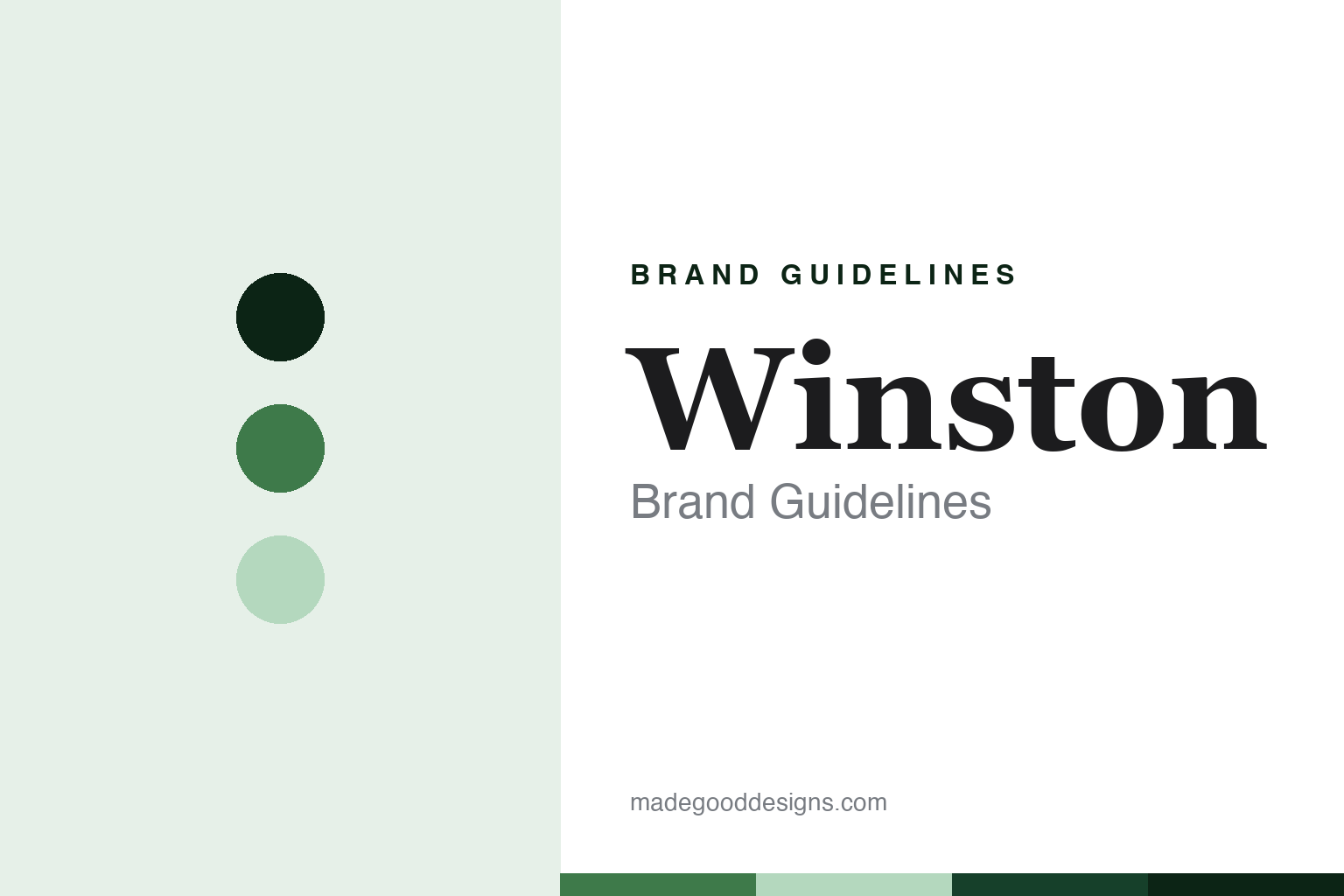
Winston Brand Guidelines
The Montana rod, hand-built since 1929.
Aa
Two constants: a Winston-green palette and a heritage-serif register. Abstract homage — not a Winston product or mark; no rod, reel or logo is reproduced.
The Montana rod, hand-built since 1929
Winston is the R.L. Winston Rod Company, a premium fly-rod maker hand-building in Twin Bridges, Montana since 1929 — under new ownership in 2026.
Winston opens the fishing round as its heritage node — the R.L. Winston Rod Company, a premium fly-rod house founded in 1929, hand-building its rods in a small Montana town, and one that has just changed hands after three and a half decades of single ownership. Its answer to a round about who owns the tackle and where it is made is the purest one in the set: a genuinely US-made rod, built on site, from a founding brand of American fly fishing — freshly under new ownership.
Its identity is the Montana rod, hand-built since 1929. The 1929 founding, the Montana making and the 2026 ownership change are the story here. Built by hand, on the Beaverhead. The Montana rod, hand-built since 1929.
(Honest notes, so the founding, the making and the ownership are framed accurately. Winston sells premium fly rods as its heroes — graphite rods in lines such as the Air 2 and Pure 2, plus a small annual run of hand-built bamboo rods, and it also sells Bauer fly reels, acquired in 2016; we report its language as the brand’s own. On origin: Winston was founded in 1929 in San Francisco by Robert Winther and Lew Stoner, originally as the Winther-Stoner Manufacturing Company, the name later blended into R.L. Winston; note the founder is spelled Winther. On the making: Winston moved to Twin Bridges, Montana in 1976 and built a fully integrated facility there in 1995, so its rods — including its hand-built bamboo — are genuinely made on site in the USA. On ownership, updated carefully: David Ondaatje owned Winston from 1991, not “since around 2000,” and in May 2026 he sold the company to Lance Robertson, a businessman and engineer from near Twin Bridges, staying on as an advisor for a year; the firm remains privately held with no public parent, and we treat the exact legal acquiring entity as unverified. On technology: Winston is historically famous for boron and graphite rods, but we do not confirm boron in the current 2026 lineup, so we hold that loosely. There is no official brand hex for “Winston green”; these tones are an unofficial interpretation.)
Colour
Winston lives in a Winston green. Click a swatch to copy the hex.
Winston’s identity is heritage, US-made and hand-built — a Winston green, an ink, a pale green, a deep green, and a paper. The palette leans Winston green and pale green: a river-and-timber register that nods to Montana water and trout country rather than a loud logo colour. It signals the Montana rod, hand-built since 1929 — heritage, US-made and hand-built. The honest caveat: with no official brand hex, and “Winston green” a famous but undocumented shorthand, these values are a considered, unofficial interpretation, not first-party colours.
The lesson is a deep green signals a heritage, made-by-hand identity. Winston’s world is the hand-built rod from a Montana workshop. For designers, it is a reminder that a forest green and a soft pale can carry a heritage, craft brand — a quiet tone held as an accent, not a product shot. Because a mid hue can fail as small text, keep type dark and let the colour live in the accents, palette and band. The takeaways: credit the 1929 founding by Winther and Stoner; credit the genuine US making in Twin Bridges, Montana; update the ownership to Lance Robertson after the May 2026 sale, not Ondaatje; and hold “boron in the current lineup” loosely.
Typography
The register is a heritage serif — heritage, US-made, hand-built.
Winston’s identity carries a heritage, US-made, hand-built spirit — a founding brand of American fly fishing, still built by hand at home. A heritage serif captures the mood: warm, classic and considered, the register of a workshop that keeps a journal for every rod. Set in a Winston-green palette, the heritage serif feels storied and crafted — exactly the personality Winston carries. It behaves like a made, catalogued thing rather than a loud logo, mirroring a river-gradient and a cast-arc. (Winston’s real products and the name are things we describe but do not reproduce, and the exact typeface is not ours to use.) Because it is not ours to use, the honest description is “a heritage-serif brand,” shown here in a stand-in. The type behaves like the brand: heritage, US-made and hand-built.
Aa
A heritage-serif brand — storied and crafted. (Specimen set in Cormorant Garamond, a heritage-serif STAND-IN; NOT the Winston logo or products.)
The fishing node
Winston stands for the Montana rod, hand-built since 1929.
Winston opens the round as its heritage node. A Winston-green palette, a heritage serif and a 1929 founding make one thing — the Montana rod, hand-built since 1929 — the whole identity: heritage, US-made and hand-built. The 1929 founding is the pitch, the Montana making is the pride, and the 2026 ownership change is the frame. The point is a founding brand of American fly fishing still built by hand at home, in a round about who owns the tackle and where it is made.
Put to work, the identity is the brand told straight, the making credited and the ownership updated at its current state. A brand in this spirit would credit the 1929 founding by Winther and Stoner, credit the genuine US making in Twin Bridges, update the ownership to Lance Robertson after the May 2026 sale, and hold “current boron” loosely. A reader in this spirit would keep the facts right: Winston sells graphite fly rods like the Air 2 and Pure 2, plus small annual runs of hand-built bamboo and Bauer reels, as its heroes; it was founded in 1929 in San Francisco by Robert Winther and Lew Stoner as Winther-Stoner Manufacturing, moved to Twin Bridges, Montana in 1976, and builds on site there; David Ondaatje owned it from 1991 until May 2026, when he sold to Lance Robertson and stayed on as an advisor; and it remains privately held. Winston opens the round, before Van Staal. The honest editorial moves are to credit the founding, to credit the US making, to update the ownership, and to hold the technology claim loosely.
For designers and brand-builders, Winston opens the fishing node: credit a genuine made-by-hand heritage — and update the owner, not the old one. The lessons: a brand can rest on a near-century of hand-building, here since 1929; a founding is credited to the real founders, Winther and Stoner; a US manufacturing base, Twin Bridges, Montana, is credited as genuine on-site making; and an ownership that changed in May 2026 is updated to Lance Robertson rather than left as a decades-old name. It is also a reminder to stay precise: Winston is the US-made Montana fly-rod house, newly under Robertson — with “Winston green” and any boron claim held as unofficial or unverified. The hook is that continuity: Winston has archived every rod it has made with a serial number and a journal entry since 1929, and still hand-builds bamboo in small annual runs in a Montana town — a record of craft, kept for nearly a century. Read that way, Winston is less a single rod than the Montana rod, hand-built since 1929: heritage, US-made, hand-built. The lesson for a brand is that crediting the making and updating the owner reinforce each other, and holding an unverified claim loosely keeps the story earned. Winston made the-Montana-rod-hand-built-since-1929 the identity — proof that a genuine craft heritage can open a round.
Explore & save
Keep Winston’s identity on hand — save it to a board in the Made Good inspiration library.
Winston identity set
Pin the Winston-green palette and the heritage-serif register to your own board.


