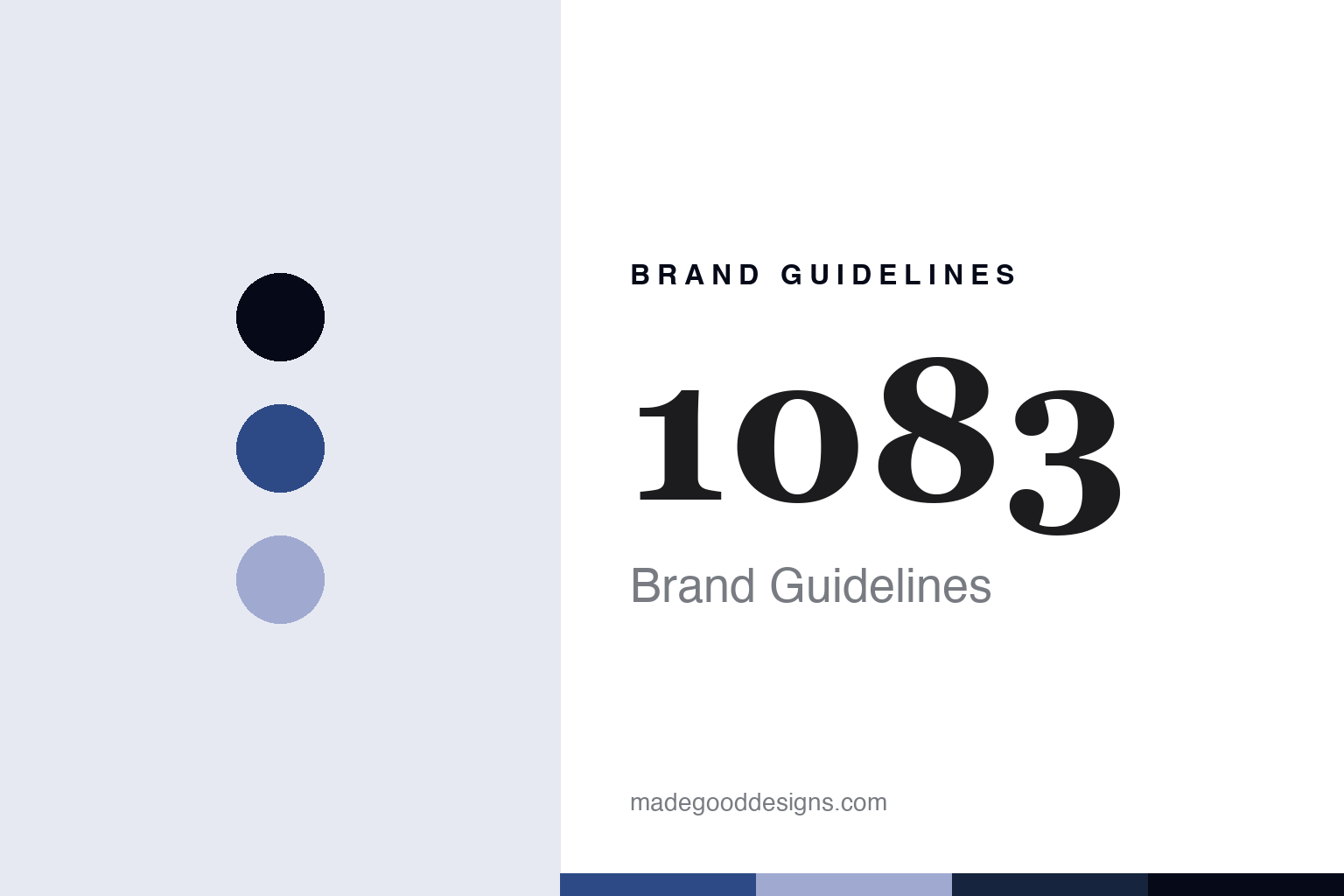
1083 Brand Guidelines
The made-in-France jean.
Aa
Two constants: a France-indigo palette and a France-serif register. Abstract homage — not a 1083 jean, stitch or mark.
The made-in-France jean
1083 is the French denim brand named for the 1,083 kilometres between the country’s two farthest towns, making jeans in France with a short supply chain and a recyclable, closed-loop jean.
1083 carries the round’s short-chain idea, and its name is the whole thesis. It is the distance, in kilometres, between the two farthest towns in mainland France — the greatest distance a jean should ever have to travel to reach the person who buys it. From France, it makes jeans and shoes with as much of the process kept in the country as possible. Its answer to how a jean becomes a name is proximity: make it close to home, keep the chain short, and design the jean to be recyclable at the end. A French jean, made not to travel far.
Its identity is the made-in-France jean. 1083’s short domestic supply chain, its distance-as-a-name concept and its recyclable jean are the work it is known for. A jean, made in France. A number that stands for staying close.
(Honest notes, so the story stays precise. 1083 is a French denim brand, founded in 2013 by Thomas Huriez, whose name refers to the 1,083 kilometres between the two most distant towns in mainland France — a manifesto for local making. On where it is made — the point of this round — it manufactures jeans in France and keeps an unusually short, largely domestic supply chain; honestly, the raw cotton fibre itself is imported, as France grows no cotton, so “made in France” refers to spinning, weaving, dyeing and confection kept in-country rather than a fully home-grown fibre. On what it makes, alongside its standard jeans it has developed a recyclable, closed-loop jean concept (which it has branded, and which we attribute to the brand rather than describe as an independent claim) designed to be returned and remade. Huriez is a living individual described only from public professional facts. Its name and marks are IP, described but never reproduced, and there is no official brand hex; these tones are an unofficial interpretation. This is design commentary and does not promote any product.)
Colour
1083 lives in a France-indigo palette. Click a swatch to copy the hex.
1083’s identity is local, French and considered — a France indigo, an ink, a chambray, a midnight, and a paper. The palette leans France indigo and chambray: the register of a jean made close to home and a chain kept short. It signals proximity over global sourcing. The honest caveat: with no published brand hex, these values are an original, unofficial interpretation, not first-party colours.
The lesson is a France-indigo palette signals a made-in-France, short-chain identity. 1083’s world is a local, French, considered object. For designers, it is a reminder that a France indigo and a soft chambray can carry a brand built on a distance — the blue of denim made near where it is sold, and the neutral of a chain kept short. Because these tones can fail as small text, keep type dark and let the colour live in the accents, palette and band. The takeaways: make close to home; keep the chain short; design for the jean’s end of life; be honest that the fibre is imported; and treat any single hex as unofficial.
Typography
The register is a France serif — considered, refined, local.
1083’s identity carries a considered, refined, local spirit — a manifesto brand with a number for a name, not a fast label. A France serif captures the mood: classic, elegant and rooted, the register of a jean made a short distance from home. Set in a France-indigo palette, the France serif feels considered and local — exactly the personality 1083 carries. It is a distance and a principle rather than a logo, mirroring a made-in-France jean. (1083’s real logo and marks are things we describe but do not reproduce, and the exact typeface is not ours to use.) Because it is not ours to use, the honest description is “a France-serif spirit,” shown here in a stand-in. The type behaves like the brand: considered, refined and local.
Aa
A France-serif spirit — considered and local. (Specimen set in Cormorant Garamond, a France-serif STAND-IN; NOT the 1083 logo or any mark.)
Circular denim
1083 stands for the jean made close to home.
1083 is a lesson in how a distance can be an identity. A France-indigo palette, a France serif and a made-in-France jean make one thing — the made-in-France jean — the whole identity: local, French and considered. The short domestic chain is the differentiator, and the recyclable jean is the meaning. The point is a brand that turned a number — the greatest distance across mainland France — into a manifesto: no jean should travel farther than that to reach you.
Put to work, the identity is proximity, honestly told, as design. A brand in this spirit would keep the making at home, shorten the chain, and design the product to come back — spinning, weaving, dyeing and sewing in France, a recyclable closed-loop jean, a name that is literally a distance. A brand learning from it would see that local making can be a durable identity — that a jean made a short distance from where it is sold carries a meaning an imported label cannot — and that being precise, founded 2013 by Thomas Huriez, made in France with an imported fibre, keeps the story honest. 1083 sits at the round’s short-chain pole, a deliberate contrast to the makers whose cloth crosses continents: where they optimise the fabric or the fibre, 1083 optimises the distance, and its recyclable jean adds a genuine end-of-life dimension to a round otherwise focused on how a jean is made. The discipline is in one honest caveat — that France grows no cotton, so the fibre is imported and “made in France” means the transformation, not the raw material — because a short-chain claim only holds if it says exactly what is and isn’t kept at home. The lesson 1083 teaches is that a distance can hold an identity: the made-in-France chain gives it substance, and the honesty about the imported fibre keeps it credible. The proximity is the personality, and the short-chain jean is the proof.
For designers and brand-builders, 1083 holds the short-chain pole in circular denim, from France: make close to home, and design for the return. The lessons: shorten the chain; keep the transformation local; build a recyclable end-of-life; be candid about the imported fibre; and never reproduce a logo. It is also a reminder to stay precise: 1083 is the French denim brand named for the 1,083 kilometres between the country’s two farthest towns, making jeans in France with a short supply chain and a recyclable, closed-loop jean — with the palette here an unofficial interpretation. 1083 made a distance the identity — proof that a jean made close to home, honestly told, can be the difference.
Explore & save
Keep 1083’s identity on hand — save it to a board in the Made Good inspiration library.
1083 identity set
Pin the France-indigo palette and the France-serif register to your own board.