Eastman Brand Guidelines
Kodak’s Tennessee supply plant, now a materials company of its own.
Aa
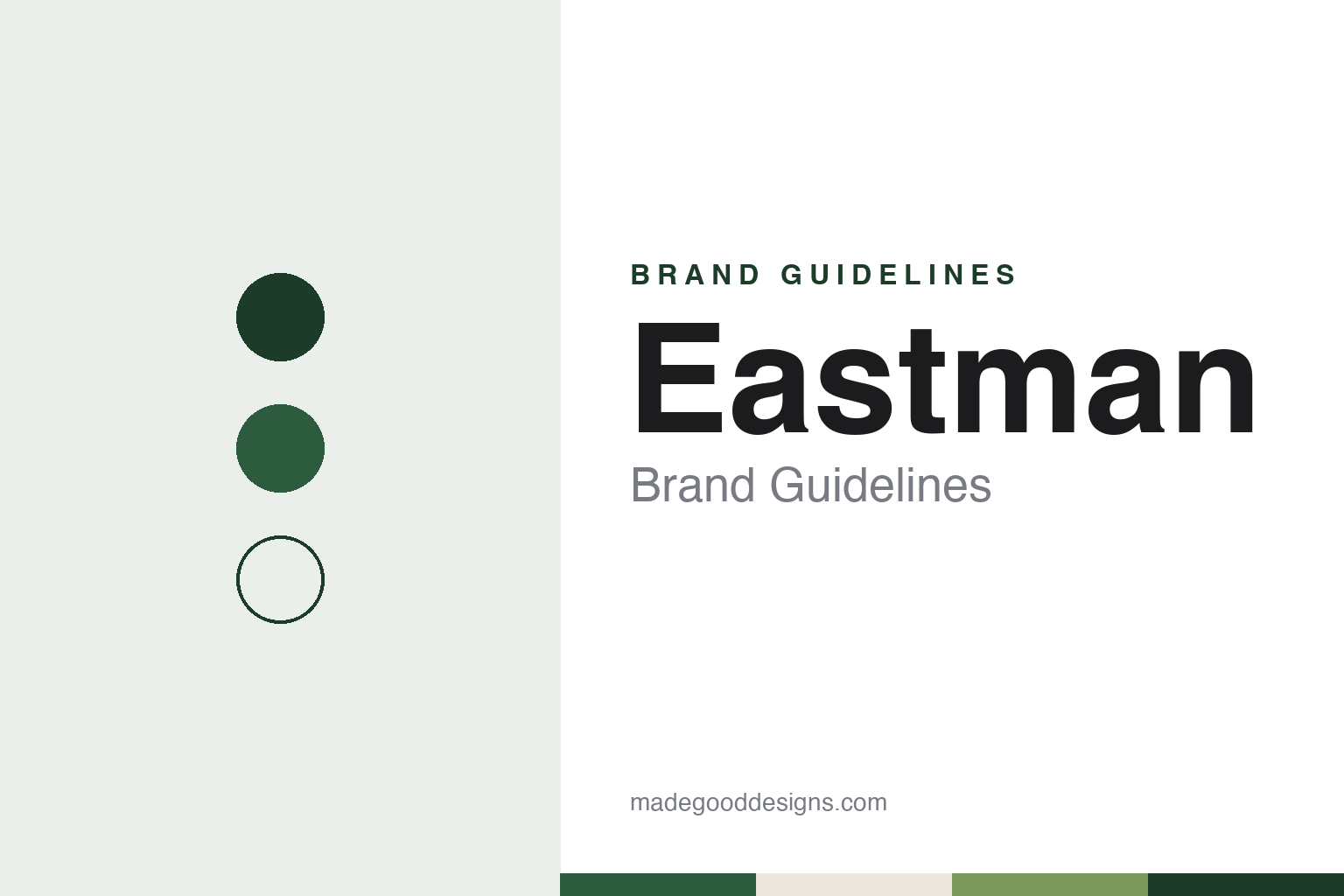
Two constants: a forest, charcoal and stone palette and an industrial sans register. Abstract homage — not an Eastman product or mark; no logo, label or material sample is reproduced.
Tennessee Eastman
A Kodak supply plant in the Appalachian South.
Eastman began as a supplier to Kodak. When the First World War disrupted Kodak’s supply of photographic paper, optical glass, gelatin and chemicals such as methanol, acetic acid and acetone, George Eastman, Kodak’s founder, looked to the forests of the Appalachian South, the Tennessee Encyclopedia says. He visited East Tennessee in July 1920 and bought the site and factory buildings of the American Wood Reduction Company at Kingsport from the U.S. government. Tennessee Eastman Corporation was incorporated on 17 July 1920, with Perley S. Wilcox as general manager.
At first the plant made methanol and related products by the dry distillation of wood, with charcoal, acetic acid and wood oils as by-products. In the late 1920s it moved into photographic chemistry: production of cellulose acetate was transferred to Kingsport from Kodak Park in 1929, the same year it began making acetic anhydride, and by 1931 it was producing acetate yarn on a large scale, according to the encyclopedia. Its Tenite cellulosic plastics followed; the company’s own timeline lists steering wheels, radio knobs and poker chips among their uses.
The Second World War changed the scale of the site. Hydroquinone made at Kingsport became part of a process for synthetic rubber. In 1941 the National Defense Research Committee asked Tennessee Eastman to start a pilot plant for the explosive RDX, and in June 1942 the company was authorised by U.S. Army Ordnance to design and operate Holston Ordnance Works, which with the Kingsport works received the Army-Navy “E” Award in 1943 for the production of war materials. From January 1943 to May 1947 it also managed the Y-12 plant at Oak Ridge, part of the Manhattan Project, until it asked to be relieved of that role, the Tennessee Encyclopedia says.
Colour
Acetate, polyester and chemicals from coal.
After the war the company spread beyond Tennessee. In the early 1950s it formed Texas Eastman at Longview, and at Kingsport began large-scale production of Chromspun, a solution-dyed acetate fibre, and of cellulose acetate filter tow; Verel, a modified acrylic fibre, followed in 1956, and Eastman 910 adhesive in 1959, according to the encyclopedia. English Wikipedia credits the development of cyanoacrylate instant adhesives, patented in 1956, to the Eastman employee Harry Coover. The company’s timeline says its first manufacturing plant outside the United States opened in England in the 1960s.
In 1968 Kodak grouped Tennessee Eastman, Texas Eastman, Carolina Eastman and related businesses into an Eastman Chemicals Division. Kodapak polyester plastic for beverage bottles followed in the late 1970s. After the oil embargoes of that decade, the company built a plant at Kingsport to make chemicals from coal rather than petroleum; English Wikipedia dates its opening to 1983, and says the American Chemical Society recognised the “Chemicals from Coal Facility” as a National Historic Chemical Landmark in 1995. In between, Texas Eastman introduced Tenite polypropylene, Kingsport began making UVEX cellulose acetate butyrate sheet for large outdoor signs, and in the 1970s the company expanded to Batesville, Arkansas, the encyclopedia says.
In December 1993 President Bill Clinton presented Eastman with the Malcolm Baldrige National Quality Award. On 1 January 1994 Eastman Kodak and Eastman Chemical Company became separate concerns, and Eastman became a publicly owned company on the New York Stock Exchange, with its headquarters still in Kingsport, the Tennessee Encyclopedia says. Earnest W. Deavenport Jr. was its first chief executive; the company’s timeline lists Brian Ferguson from 2002, Jim Rogers from 2009 and Mark Costa from 2014 as his successors, and a regional headquarters in the Netherlands opened in the 2000s.
Typography
Design and documentation.
Specialty chemicals makers sell mostly to other companies, so their brands rarely appear on a shelf. What they make ends up inside shampoo, paint, crop sprays, plastics and circuit boards under someone else’s name. Their identities have to work for buyers, chemists, investors and job seekers at once, and most of them settle on a similar, restrained toolkit.
The marks tend to be precise sans-serif wordmarks, often a coined or shortened name set in lower case or in a clean capital form, sometimes paired with a small symbol that suggests a molecule, a droplet, a leaf or a ring. Colour usually runs through blues, greens and teals, the shades a reader links with water, science and the outdoors, with one brighter accent kept for highlights and charts. Photography leans on laboratories, gloved hands, pilot plants and pipework, alongside close-ups of the everyday products that the chemistry ends up in.
Websites in the category are organised by end market rather than by chemical family. A visitor picks personal care, home care, coatings, adhesives, agriculture, mining, energy or electronics, and lands on pages of named product ranges. Product finders, technical data sheets, certificates and sample requests sit close to the top of the navigation, because that is what formulators come for. Many groups also run regional sites and separate pages for each business unit.
The rest of the site carries the corporate story. Sustainability reports, innovation pages, purpose statements and annual reports explain strategy to investors and the wider public, while careers pages show researchers, plant teams and graduate programmes. For a designer, the category is a study in clarity: a calm palette, a readable sans and a structure that lets very technical material stay easy to find.
Aa
An industrial sans for a materials-catalogue register. (Specimen set in Work Sans, a sans STAND-IN; NOT the Eastman logo.)
Eastman
A specialty materials company in Kingsport.
As an independent company Eastman has reshaped its portfolio. It launched Tritan copolyester in 2007, the company says, and its timeline describes Solutia, bought in 2012, and Taminco, bought in 2014, as two of the largest acquisitions in its history; English Wikipedia dates their completion to July 2012 and December 2014. On 4 October 2017 an explosion occurred near the coal gasification building at Kingsport; in April 2018 the Tennessee Department of Environment and Conservation determined that the cause was a valve blockage from slurry or debris, English Wikipedia says.
Today Eastman calls itself a global specialty materials company, with about 13,000 employees, four segments (Additives & Functional Products, Advanced Materials, Chemical Intermediates and Fibers) and brands including Saflex, LLumar, Naia and Therminol. Recycling is central to its current message. English Wikipedia says commercial operation of its carbon renewal technology began at Kingsport in October 2019, and on 29 October 2026 the company announced that the U.S. Department of Energy had reinstated an earlier award supporting its methanolysis process, which it says turns hard-to-recycle polyester waste into virgin-quality materials; the updated plan includes raising the Kingsport plant’s output by about 30%, the company says.
For a design guide, Eastman shows how a captive supply plant can grow into a company with its own name and a catalogue of material brands. Compare Celanese, another American company built on cellulose acetate, and Dow, a fellow American chemical maker. For this guide we use a forest green, a charcoal and a pale stone with a sans, an unofficial interpretation; no product or logo is reproduced.
Explore & save
Keep Eastman’s identity on hand — save it to a board in the Made Good inspiration library.
Eastman identity set
Save the Eastman forest, charcoal and stone palette and the industrial sans register to your own board.