Nouryon Brand Guidelines
A new name, formed in 2018, for chemistry with Dutch and Swedish roots.
Aa
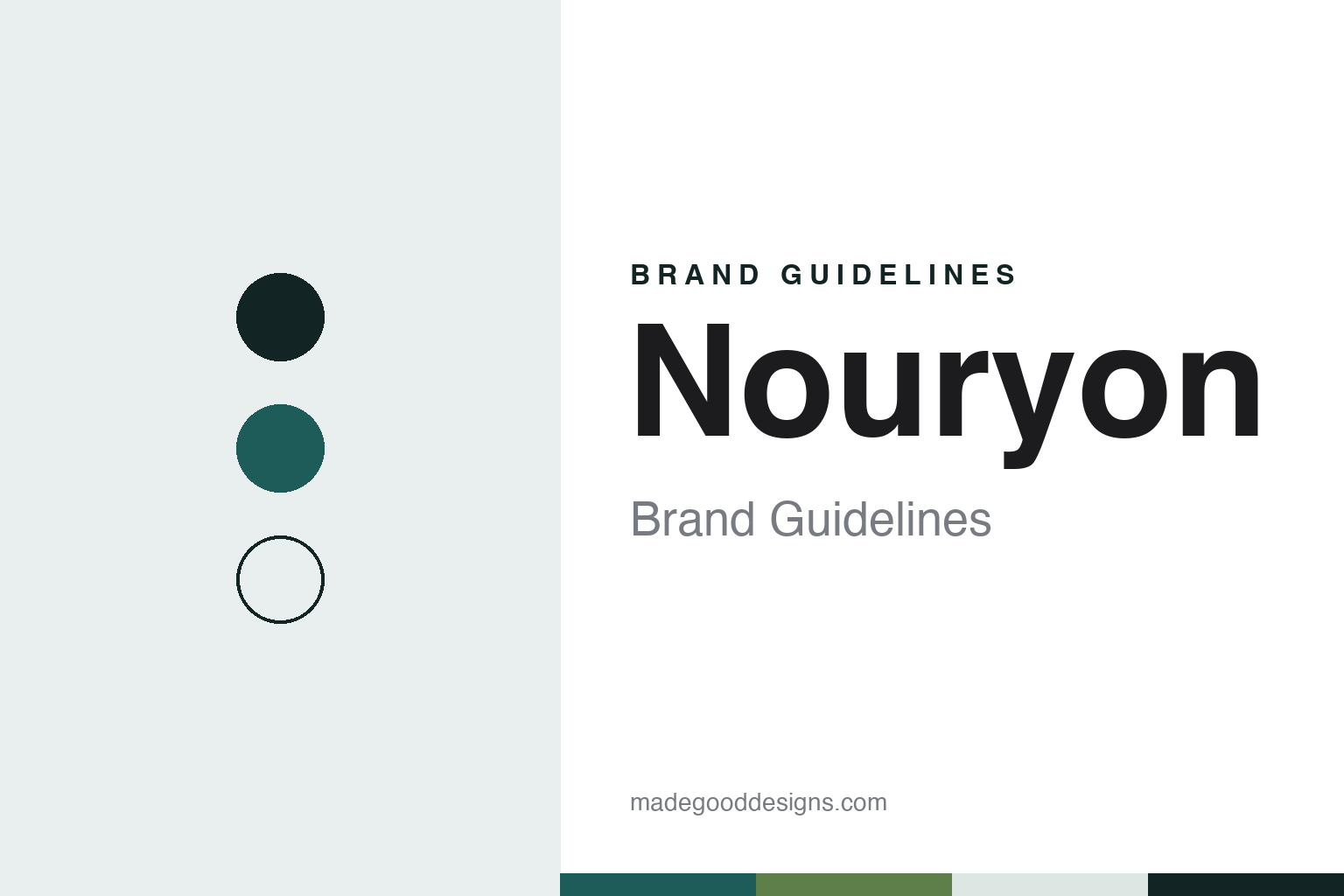
Two constants: a teal, salt white and moss palette and a geometric sans register. Abstract homage — not a Nouryon product or mark; no logo, label or package is reproduced.
Dutch and Swedish roots
A young name on old works.
Nouryon is a young name on old works. The company says its specialty chemistry “dates back more than 150 years” to predecessor chemical operations in the Netherlands, Sweden and the United States. The name itself dates from October 2018, when AkzoNobel’s specialty chemicals business passed to the investment firm The Carlyle Group and Singapore’s sovereign wealth fund GIC. C&EN reported in September 2019 that the new owners had taken over in October 2018 and that Nouryon still shared AkzoNobel’s building in Amsterdam; English Wikipedia dates the rebrand to 9 October 2018.
The Dutch side of the family tree runs through Akzo, formed in 1969 by merging the fibre group AKU with Koninklijke Zout Organon (KZO). KZO’s chemical roots were the salt producer Koninklijke Nederlandse Zoutindustrie (KNZ), founded in June 1918 by partners including the salt boiler Ko Vis after a new law opened the salt deposits of Twente to mining, and Ketjen, a sulphuric acid maker founded in Amsterdam on 1 April 1835, Dutch Wikipedia says. The two merged in 1962 as Koninklijke Zout Ketjen.
Both firms lay in the Netherlands under German occupation from 1940 to 1945. Dutch Wikipedia says Ketjen’s Amsterdam works made substitute sugar and saccharin in 1941, that an Allied bombing raid on 28 July 1943 hit its storage, and that German forces halted its production in September 1944; it restarted in October 1945. KNZ’s salt works at Hengelo and Boekelo, in Twente, were likewise in occupied territory throughout those years; the sources used for this guide do not say how they operated during the occupation of 1940–1945.
The Swedish side began in 1895, when Elektrokemiska AB was founded at Bengtsfors by Rudolf Lilljeqvist, Alfred Nobel and Carl Wilhelm Collander to make chlorine and alkali, Swedish Wikipedia says. It moved to Bohus in 1924, passed to Iggesunds Bruk in 1951 and became Eka AB in the 1970s. Nobel Industries bought it in 1986, and after Nobel Industries merged with Akzo in 1994 it became Eka Chemicals. Bohus is still listed among Nouryon’s Swedish plants and innovation centres.
Colour
From AkzoNobel to Carlyle and GIC.
The separation began as a defence. In 2017, while resisting an unsolicited takeover approach from PPG Industries, AkzoNobel outlined a plan to separate its chemicals division, English Wikipedia says; the sale to Carlyle and GIC followed, and AkzoNobel kept its paints and coatings. C&EN listed Nouryon’s key businesses in 2019 as surfactants, chlorine, caustic soda, polymer additives and water treatment chemicals. The same report described a research tie-up with the Dutch company Photanol, which was using modified cyanobacteria in a pilot plant to make a precursor for monochloroacetic acid from carbon dioxide and sunlight. Monochloroacetic acid remains on the product list on Nouryon’s website, next to ethylene amines, organic peroxides and Thioplast polysulfides.
The portfolio narrowed in 2021. The salt and chlor-alkali business — the line descended from KNZ — was spun off that year as Nobian, a separate company under the same owners with its headquarters in Amersfoort, Nobian says. In September 2021 C&EN reported that Nouryon planned to list shares on the New York Stock Exchange; in September 2024 Bloomberg, in a report carried by Mint, said Carlyle had revived plans for a New York listing that could come as soon as early 2025, with no final decision made. In 2026 Nouryon’s website describes it as privately held, jointly owned by Carlyle and GIC.
Nouryon now organises itself into three segments — Consumer and Life Sciences, Performance Materials and Resource Solutions — and says it has headquarters in Amsterdam and Radnor, Pennsylvania, is incorporated in Ireland, and keeps key offices in Houston, Gothenburg, Shanghai and Mumbai. Its named product lines include Expancel microspheres, Kromasil chromatography media and Levasil colloidal silica, alongside Eka Engineering in bleaching chemicals. Its list of locations includes plants at Deventer, Delfzijl and Rotterdam in the Netherlands and at Bohus, Stenungsund and Sundsvall in Sweden.
Typography
Specialty chemicals makers.
Specialty chemicals makers sell mostly to other companies, so their brands rarely appear on a shelf. What they make ends up inside shampoo, paint, crop sprays, plastics and circuit boards under someone else’s name. Their identities have to work for buyers, chemists, investors and job seekers at once, and most of them settle on a similar, restrained toolkit.
The marks tend to be precise sans-serif wordmarks, often a coined or shortened name set in lower case or in a clean capital form, sometimes paired with a small symbol that suggests a molecule, a droplet, a leaf or a ring. Colour usually runs through blues, greens and teals, the shades a reader links with water, science and the outdoors, with one brighter accent kept for highlights and charts. Photography leans on laboratories, gloved hands, pilot plants and pipework, alongside close-ups of the everyday products that the chemistry ends up in.
Websites in the category are organised by end market rather than by chemical family. A visitor picks personal care, home care, coatings, adhesives, agriculture, mining, energy or electronics, and lands on pages of named product ranges. Product finders, technical data sheets, certificates and sample requests sit close to the top of the navigation, because that is what formulators come for. Many groups also run regional sites and separate pages for each business unit.
The rest of the site carries the corporate story. Sustainability reports, innovation pages, purpose statements and annual reports explain strategy to investors and the wider public, while careers pages show researchers, plant teams and graduate programmes. For a designer, the category is a study in clarity: a calm palette, a readable sans and a structure that lets very technical material stay easy to find.
Aa
A geometric sans for a coined name. (Specimen set in Manrope, a sans STAND-IN; NOT the Nouryon logo.)
Nouryon
A coined name for an old business.
Recent announcements from the company concern plants rather than owners. On 5 November 2026 Nouryon said it would begin producing modified methylaluminoxane, or MMAO, a catalyst activator used in making plastics, at its existing site in Jiaxing, China, with production planned for the first half of 2028. The company describes itself as having more than 8,000 employees and 14 innovation centres.
The ownership picture is simpler than the family tree. AkzoNobel, which still carries the Nobel half of the old name, is the paints company; Nobian holds the salt and chlor-alkali works that began with KNZ; and Nouryon holds the rest of the specialty chemicals business sold in 2018, including the Swedish works that began with Eka. Its owners have twice explored a stock market listing, in 2021 and 2024, and the company remained privately held in 2026.
For a design guide, Nouryon shows how a coined name can sit on top of more than a century of inherited plants and product lines. Compare AkzoNobel, its former parent, and Kemira, another supplier of chemistry to the pulp and paper trade. For this guide we use a canal teal, salt white and a moss green with a sans, an unofficial interpretation; no product or logo is reproduced.
Explore & save
Keep Nouryon’s identity on hand — save it to a board in the Made Good inspiration library.
Nouryon identity set
Pin the Nouryon teal, salt white and moss palette and the geometric sans register to your own board.