Komerční banka Brand Guidelines
The Prague bank of 1990, part of the Société Générale group since 2001.
Aa
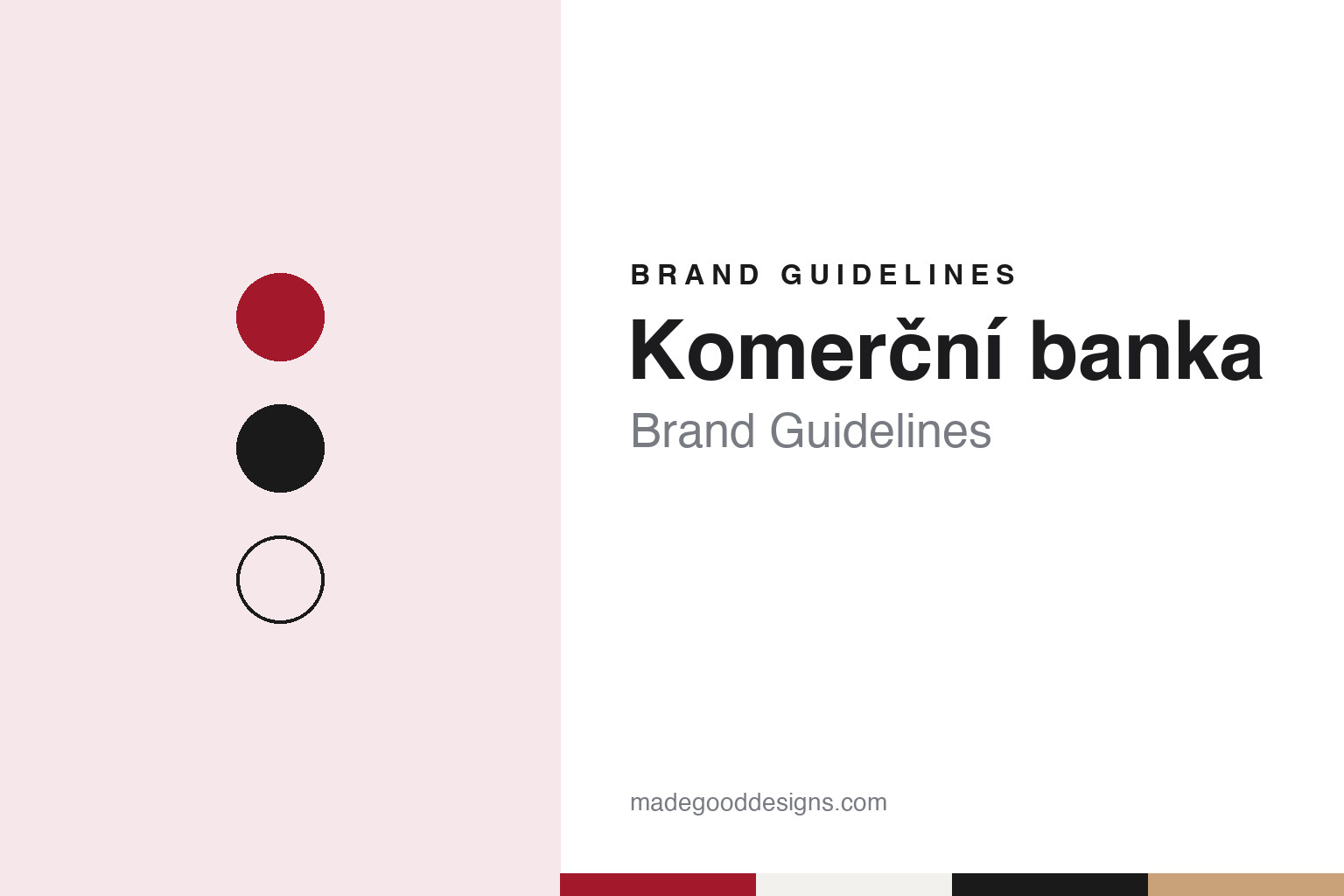
Two constants: a red, black and paper palette and a corporate grotesque register. Abstract homage — not a Komerční banka asset; no logo, card or app screen is reproduced.
Out of the state bank
A commercial bank carved from Czechoslovakia’s central bank.
Komerční banka, usually shortened to KB, was founded in Prague when Czechoslovakia split its old single-tier banking system. The bank says it was created after the commercial activity of the former Státní banka československá, the Czechoslovak state bank, was divided, taking the part in the Czech lands, and it marked its 30th anniversary on 1 January 2020, which puts its start on 1 January 1990.
Privatisation came in stages. In 1992 the government of the Czech and Slovak Federative Republic approved the bank’s privatisation project, and KB became a public limited company, the bank says, with the national property funds of the Czech and Slovak republics as its main shareholders; part of its shares went into the country’s voucher privatisation. KB says it entered international capital markets in 1995 with an issue of global depositary receipts, followed by a second issue in May 1996.
The state kept a controlling block for most of the decade. KB says the Czech government approved the sale of the state’s shares to a strategic partner in 1997, advertised for investors in 1999, and that a capital increase in 2000 raised the National Property Fund’s holding to 60 per cent.
Colour
Société Générale and a new identity.
The strategic partner was French. The Czech government decided on 28 June 2001 to sell its stake in KB to Société Générale, and the purchase contract for the state’s 60 per cent holding was signed in July, Radio Prague International reported on 13 July 2001, describing KB as the last Czech bank still waiting to be privatised. The same report quoted Société Générale’s chairman as saying that KB would remain a Czech bank and keep its own name, and noted that Société Générale had been in the Czech market since 1982, when it opened a representative office in Prague. KB says the French group took over its management rights in 2001 and a new board was elected.
In April 2002 the business news site Patria.cz reported KB’s new strategy, under which it would remain a universal bank with a strong domestic position, and that the majority owner did not plan to raise its stake. KB says it presented a new corporate identity in 2002, alongside a new customer segmentation, to express its strategy and its affiliation with the Société Générale group; the same year shareholders approved the purchase of Société Générale’s own Prague branch.
The group grew around the bank, which kept its own name and its two-letter short form under its new owner. KB says it raised its stake in the building society Modrá pyramida from 40 to 100 per cent in October 2006, buying out BHW and Česká pojišťovna, and bought a 50.1 per cent stake in the asset-finance company SGEF in May 2011. Its website still introduces KB as a member of the international Société Générale group.
Typography
Banks of the region.
Banks in Central and Eastern Europe often carry long national-language names with diacritics, such as Powszechna Kasa Oszczędności, Česká spořitelna or Komerční banka, and shorten them to initials or a single word for everyday use. Many of today’s large banks also descend from state institutions of the communist period, so their identities can show several layers of history: a mark kept for decades, a new owner’s colours, or a symbol brought back. PKO Bank Polski still uses a logo drawn in the late 1960s, English Wikipedia says, while Bank Pekao made a bison its group logo in 1997, moved to its parent UniCredit’s style in 2012 and restored the bison after its change of owners in 2017.
Colour does much of the work. Blue, green, red and yellow appear again and again on the region’s bank signs, cards and apps, usually in a bold wordmark or a simple symbol that has to read clearly on a branch fascia, a cash machine and a phone screen. Ownership by international groups adds another layer, when a local bank takes on a parent’s colours or a shared mark, and sometimes sheds them again.
The banks’ websites follow a familiar pattern: pages on everyday accounts and cards, mortgages, savings and business banking, with prominent space for mobile apps and for the industry awards those apps win. Photography tends to show cities, branches and customers rather than abstract imagery, and sponsorship, from national football leagues to international championships, gives several of these brands a large public stage.
Annual reports, investor pages and a growing number of sustainability reports, often published in the home language and in English, complete the public record. This guide sets out what can be checked about each bank — when it was founded, who owns it and how its identity has changed — and marks clearly what rests only on the bank’s own word.
Aa
A clean corporate grotesque for a plain, direct register. (Specimen set in IBM Plex Sans, a sans STAND-IN; NOT the Komerční banka logo.)
Komerční banka
From MojeBanka to KB+.
KB’s own timeline is a list of products and prizes. It says it launched the first EMV chip card in the Czech Republic in 2003, appointed a KB ombudsman for client disputes in 2005, introduced the KB Klíč smartphone log-in in 2018 and Apple Pay in 2019, and in 2023 helped launch a Contact Payment service for sending money without an account number. In 2022 it agreed with MONETA Money Bank to share cash machines, and from 2021 it offered log-in through the Czech Bank Identity service to other companies. Its charitable foundation, the Komerční banka Foundation, marked 25 years in 2023, the bank says. Since 2021 it has been general partner of the Czech Extraliga ice hockey league and the national team, the bank says.
The biggest recent change was digital. KB presented KB+ as a “new era of banking” in April 2023, with an advertising campaign aimed at new customers, and spent three years moving its personal customers from the old MojeBanka and Mobilní banka services into it, Peníze.cz reported in May 2026; more than 1.3 million people made the move, the bank told the site, and business customers began moving in 2025.
Prizes appear throughout its history pages. KB says it has been voted bank of the year seven times; it lists Fincentrum Bank of the Year titles including 2011, 2012 and 2017, the Mastercard Bank of the Year in 2022 and again in 2023, and Czech Bank of the Year from The Banker in 2021. In 2024 it agreed to sell the company that owns its Wenceslas Square headquarters building to the City of Prague, as staff moved to an office centre in Prague-Stodůlky.
For a design guide, Komerční banka shows how a bank born in 1990 can keep a plain Czech name and a two-letter short form through privatisation, foreign ownership and a full rebuild of its digital bank. Compare it with Česká spořitelna, another Prague bank, and with mBank, another bank of the region. For this guide we use a brick red, near-black ink and warm paper with a sans, an unofficial interpretation; no product or logo is reproduced.
Explore & save
Keep Komerční banka’s identity on hand — save it to a board in the Made Good inspiration library.
Komerční banka identity set
Pin the Komerční banka red, ink and paper palette and the corporate grotesque register to your own board.