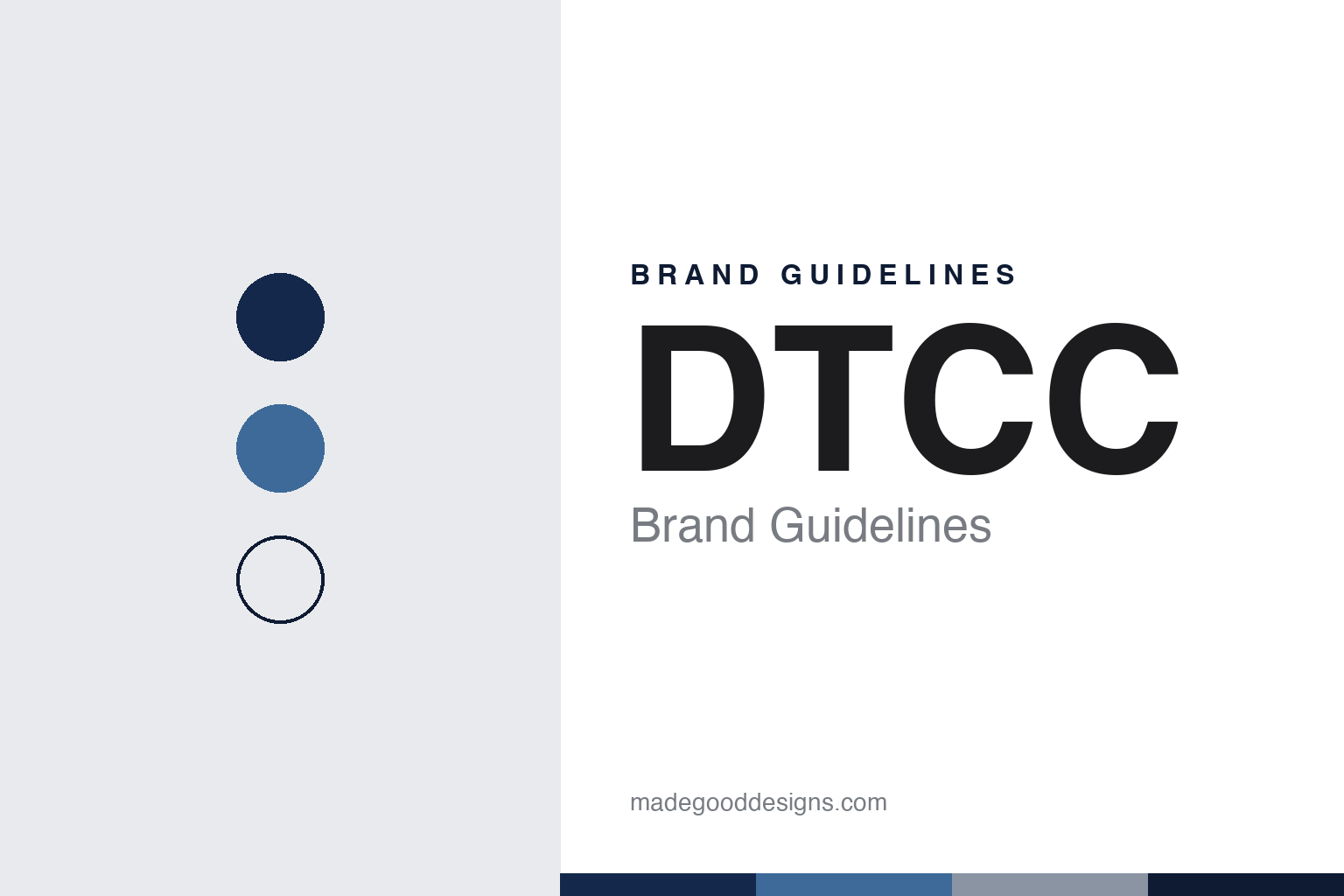
DTCC Brand Guidelines
DTC of 1973, NSCC of 1976 and a 1999 holding company.
Aa
Two constants: a navy, steel blue and grey palette and an institutional sans register. Abstract homage — not a DTCC asset or mark; no logo or document is reproduced.
DTC and NSCC
An answer to the paperwork crisis of the late 1960s.
The Depository Trust & Clearing Corporation was set up in 1999 as a holding company to bring together two older New York institutions: the Depository Trust Company (DTC), founded in 1973, and the National Securities Clearing Corporation (NSCC), formed in 1976, English Wikipedia says. Both grew out of the Wall Street paperwork problem of the late 1960s. Trades were then settled by physically handing over stock certificates, carried between firms by messengers, and as volumes rose the backlog grew so large that the exchanges closed on Wednesdays to let back offices catch up.
One early answer was the New York Stock Exchange’s Central Certificate Service of 1968, which moved securities by electronic record rather than by hand. DTC followed in 1973, formed under New York’s special incorporation law for trust companies, with the major New York banks represented on its board. It holds deposited securities in “fungible bulk” and records changes of ownership by book entry; its nominee, Cede and Company, appears in issuers’ registers as the holder of record. NSCC came out of multilateral netting: it nets trades among its members and acts as central counterparty for broker-to-broker trades in US equities, corporate and municipal bonds, exchange-traded funds and unit investment trusts.
DTCC calls itself user-owned and directed. Wikipedia notes that DTC’s participants own its non-voting stock while DTCC holds all the voting stock. A third clearing house, the Fixed Income Clearing Corporation (FICC), was created in 2003 by joining the Government Securities Clearing Corporation and the Mortgage-Backed Securities Clearing Corporation; it clears US Treasury securities, repurchase agreements and mortgage-backed securities.
Colour
Clearing, settlement, custody and reporting.
DTCC’s work is post-trade: clearing, settlement, custody and trade reporting. Through its subsidiaries it handles equities, corporate and municipal bonds, government and mortgage-backed securities, money-market instruments and over-the-counter derivatives, and it processes transactions between mutual funds, insurers and their investors, Wikipedia says. In 2022, according to the same article, DTC held custody of about 3.5 million securities issues, from the United States and more than 170 other countries, and NSCC had roughly 4,000 participants.
The derivatives side began in 2003 with Deriv/SERV, a matching and confirmation service. From 2006 the Trade Information Warehouse recorded credit-derivative trades, and after the G20 decided in 2009 to require derivatives trade reporting, DTCC built trade repositories that were branded the Global Trade Repository in 2012 and now work under supervisors in the United States, the European Union, Australia, Hong Kong, Japan and Singapore. After Brexit it set up an EU entity in Dublin, which ESMA registered in late 2020. In 2019 these businesses were renamed Repository and Derivatives Services.
Two recent changes stand out. On 30 June 2026 The TRADE reported that NSCC had gone live with 24/5 clearing, from 8pm Eastern time on Sunday to 8pm on Friday, after an industry testing phase that opened in January 2026; an earlier step, in September 2024, had opened its window about two and a half hours sooner. On 28 October 2026 DTC launched the DTCC Tokenization Service, which the company says lets eligible users convert securities held at DTC between traditional and tokenised forms; it named 20 participants that had signed up, including State Street, Citi and Brown Brothers Harriman. That launch followed a no-action letter from the Securities and Exchange Commission in December 2025, which Wikipedia says lets DTCC offer such services on approved blockchains for three years.
Typography
Design and documentation.
Post-trade institutions do the work that follows a trade: settlement, clearing, custody, collateral management and asset servicing. Central securities depositories, or CSDs, hold securities in book-entry form and settle transfers between accounts; international CSDs such as Euroclear Bank in Brussels and Clearstream Banking in Luxembourg do the same for bonds issued across borders; clearing houses stand between buyers and sellers; and custody banks hold assets for investors. Global Custodian noted in 2010 that this business is sometimes called the “plumbing of the financial system.”
The names can mislead. English Wikipedia points out that neither Euroclear nor Clearstream runs central counterparty clearing, despite the word in their names, which date from a time when clearing and settlement were treated as a single activity. For a designer, that makes plain service pages important: settlement, custody, collateral and fund services each tend to get their own section, written for banks, brokers and central banks rather than private investors.
Much of what these institutions publish is documentation. Clearstream’s website, for example, groups banking licences, articles of association, disclosure reports and regulatory information under the EU’s settlement and digital-resilience rules on one regulation page, alongside due-diligence questionnaires and factsheets. Rulebooks, operating manuals and annual reports sit beside those pages, so for a design system a clear type hierarchy and readable tables do much of the work.
The palettes in this guide lean on deep blue, teal and grey, set with a sans for long technical text, and the imagery stays abstract: networks, links and data rather than people or products. These are unofficial interpretations of our own, not brand colours; no logo, wordmark or document from any institution is reproduced.
Aa
An institutional sans for a four-letter acronym. (Specimen set in IBM Plex Sans, a sans STAND-IN; NOT the DTCC logo.)
DTCC
A holding company named for what it does.
DTCC has also built and sold businesses around the core, Wikipedia says. It acquired Avox, a data company in Wrexham, North Wales, in July 2010, and Thomson Reuters acquired Avox in March 2017. It formed Omgeo, a trade-processing hub for brokers, investment managers and custodians, as a joint venture with Thomson Reuters in 2001 and bought back the partner’s interest in November 2013. And it owned EuroCCP, a London equities clearing house, from 2008 until 2020, after Cboe Global Markets announced its purchase in December 2019. Wikipedia lists Frank La Salla as president and chief executive since 2022.
Its website today speaks of more than 50 years in the markets and more than 5,600 client firms, figures it gives as of the third quarter of 2026, and presents DTCC as a post-trade market infrastructure working on tokenisation and collateral mobility. The site is organised around clearing and settlement, trade processing, asset services, digital assets, repository and derivatives services, and data. Bylaws, rules and procedures, regulatory rule filings and financial statements sit alongside the service pages, and annual reports are published each year. The subsidiaries keep their full names in the company’s own announcements, so an October 2026 release begins with “The Depository Trust Company (DTC), a subsidiary of The Depository Trust & Clearing Corporation (DTCC).”
For a design guide, DTCC shows how a post-trade institution presents itself through an acronym, subsidiary names spelled out in full and rulebooks published beside its service pages. Compare LCH, the London clearing house, and Euroclear, the Brussels securities depository. For this guide we use a deep navy, a steel blue and a cool grey with a sans, an unofficial interpretation; no product or logo is reproduced.
Explore & save
Keep DTCC’s identity on hand — save it to a board in the Made Good inspiration library.
DTCC identity set
Pin the DTCC navy, steel blue and grey palette and the institutional sans register to your own board.