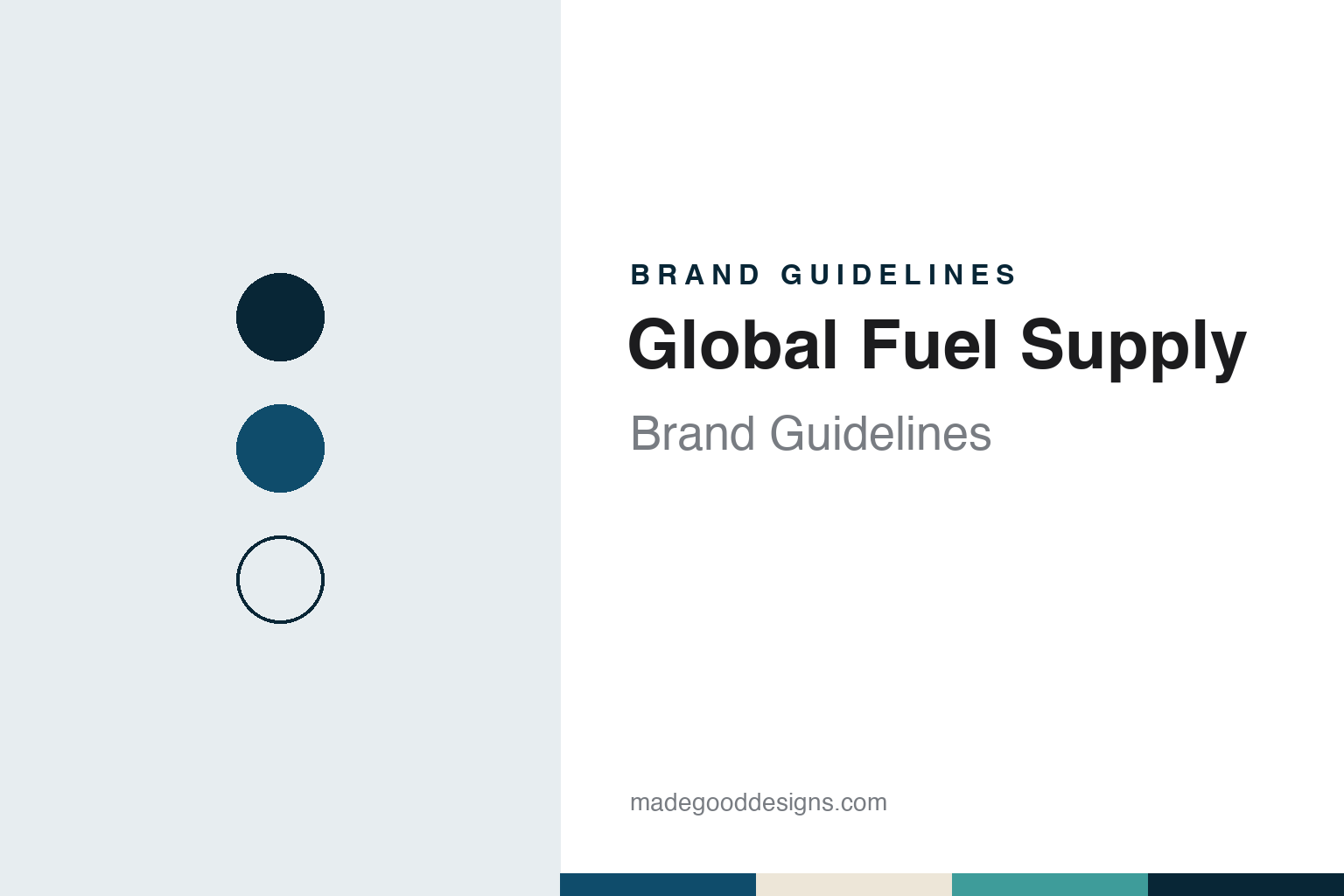
Global Fuel Supply Brand Guidelines
A 2022 Copenhagen fuel trader that renamed itself Blue Energy Partners.
Aa
Two constants: an ocean blue, teal and sand palette and a rounded sans register. Abstract homage — not a Global Fuel Supply or Blue Energy Partners product or mark; no vessel, logo or nameplate is reproduced.
Two traders, one firm
Copenhagen, 2022.
Global Fuel Supply is a young company, and since 26 May 2026 it has traded under a new name, Blue Energy Partners. Ship & Bunker reported the change the next day and gave the founding facts: GFS was set up in Copenhagen in 2022 by Bijan Shahbaz and Lamin Bara. The company’s own account says the two had spent years on opposite sides of the industry, as competitors, before deciding to build a business together.
It expanded abroad within a year. The company’s timeline says it built full operations in Dubai in 2023, covering trading, compliance, credit, finance and IT, and opened legal entities in Mexico and Singapore in 2024. In 2025 it added an office and barge operations in Angola, and an office in Norway that brought in environmental expertise. In January 2026, together with that Norwegian unit, it opened an office in Cape Town, announced during Maritime Week Africa. Those dates come from the company; the Angola and South Africa steps were also reported by Ship & Bunker.
Today the company lists offices in Copenhagen, Dubai, Oslo, Angola, South Africa, Singapore and Mexico, and both the company and Ship & Bunker describe it as working from seven offices on four continents. Lamin Bara is chief commercial officer and Bijan Shahbaz chief operating officer. The company describes itself as built on long-term partnerships, and its website introduces its staff as “traders and captains, lawyers and credit managers, marketers and analysts.”
Colour
From trader to barge owner.
GFS began as a fuel trader, buying marine fuel from suppliers and arranging delivery to ships for their operators. Its move into physical supply came in West Africa. On 21 February 2025 Ship & Bunker reported that it had chartered the 5,498-dwt tanker RLO Explorer to deliver fuel from the Luanda anchorage in Angola. In April 2025 the software company Ofiniti said GFS had joined its FuelBoss platform to run those deliveries digitally, the trade site reported.
In December 2025 the company became a shipowner. It bought the 7,695-dwt tanker MV Atticus, renamed it MV Blue Alliance and sent it to dry dock in Dubai before service in Angola, Ship & Bunker reported on 19 December 2025; until then it had worked only with chartered ships. In February 2026 the company said the work in Dubai had been carried out in line with Bureau Veritas class requirements and included mass-flow meters compliant with ISO 22192, which measure deliveries by mass rather than volume. The company said the ship would be the first bunker vessel in Angola fitted with such meters; that is its own claim.
Alongside fuel, the company now offers what it calls environmental solutions. Its website says it supplies conventional fuels from VLSFO to MGO and HFO, certified biofuels including FAME and HVO from ISCC-certified sources, and EU, UK and Swiss ETS carbon credits, with regulatory advice on those schemes and on FuelEU Maritime. Ship & Bunker reported in May 2026 that it runs an environmental desk and trades those carbon credits.
Typography
How bunker suppliers present themselves.
Marine fuel suppliers sell to a small, technical audience: ship operators, charterers and fuel buyers who order bunkers for a vessel arriving at a given port on a given day. Their identities tend to be simple. Many use a plain wordmark in a single strong colour — often a deep blue, sometimes an orange or a green — with a short symbol beside it, and the name usually says what the company does: bunkering, marine fuels, oil or energy. Several have shortened or changed those names as they add new fuels or change owners.
Photography does much of the work. The companies publish pictures of their own bunker barges and tankers moored alongside container ships, bulk carriers and cruise ships, of hoses and fuel lines at the ship’s side, and of new vessels at their naming ceremonies. Port-coverage maps are the other recurring image: a world map marked with the hubs where a supplier delivers fuel itself and the wider set of ports where it arranges supply through others.
Product pages are written plainly, by fuel grade rather than by brand name: very low sulphur fuel oil (VLSFO), high-sulphur fuel oil (HSFO), marine gasoil (MGO), LNG, and biofuel blends described by their bio-component share, such as B20 or B30. Larger suppliers add pages for their trading desks — buying fuel for delivery across many ports, and managing fuel-price exposure for customers — and for delivery records, including mass flow meters and digital delivery notes.
Sustainability pages have grown alongside these. Suppliers describe the alternative fuels they offer or plan to offer, newer vessels able to run on LNG, and their own codes of conduct, usually in the company’s own words. This guide separates those descriptions from what dated trade-press reports show about each company: who founded it, who owns it, and where it supplies fuel.
Aa
A rounded, open sans for a young trading firm. (Specimen set in Manrope, a sans STAND-IN; NOT the Global Fuel Supply or Blue Energy Partners logo.)
Blue Energy Partners
A new name in May 2026.
The name Blue Energy Partners came from inside the business. According to Ship & Bunker, it had first been used by the GFS office in Norway, a unit focused on environmental and regulation-driven energy services. On 26 May 2026 the company applied it to the whole firm, with what it called a new visual identity, saying the change reflected its growth from a fuel trader into a broader energy business covering physical supply, marine energy trading, alternative fuels and environmental services. Its marketing and events manager said in the announcement that the rebrand followed months of conversations with the founders and the team.
The older name has not vanished. The globalfuelsupply.com address now forwards to blueenergypartners.com, the company’s LinkedIn page keeps a Global Fuel Supply address, and its terms and conditions document carries both names. The phrase “global fuel supply” is also common in general energy news, where it has nothing to do with this firm. In April 2026, shortly before the rename, the company hired a head of operations in Oslo, Ship & Bunker reported.
The founders have framed each step as part of a longer plan. When the company bought its first ship in December 2025, Bijan Shahbaz said becoming shipowners had always been part of its long-term vision, and Lamin Bara credited the team for getting there, Ship & Bunker reported. In January 2026 Bara described the Cape Town office as a natural development alongside the company’s physical supply in Angola, and the company said its first hire there was a senior fuel supplier with 25 years in the industry, whose work had included offshore logistics and the relocation of drilling rigs. In October 2026 the company announced new vessel and trade financing from two partners, which it said would support both its physical operations and its trading.
For a design guide, Global Fuel Supply shows how a young trading firm can rename itself around a unit it already had. Compare Bunker Holding, a much older Danish bunker group, and Monjasa, another marine fuel supplier from Denmark. For this guide we use an ocean blue, a sea-glass teal and a warm sand with a sans, an unofficial interpretation; no product or logo is reproduced.
Explore & save
Keep Global Fuel Supply’s identity on hand — save it to a board in the Made Good inspiration library.
Global Fuel Supply identity set
Save the Global Fuel Supply ocean blue, teal & sand palette and the rounded sans register to your own board.