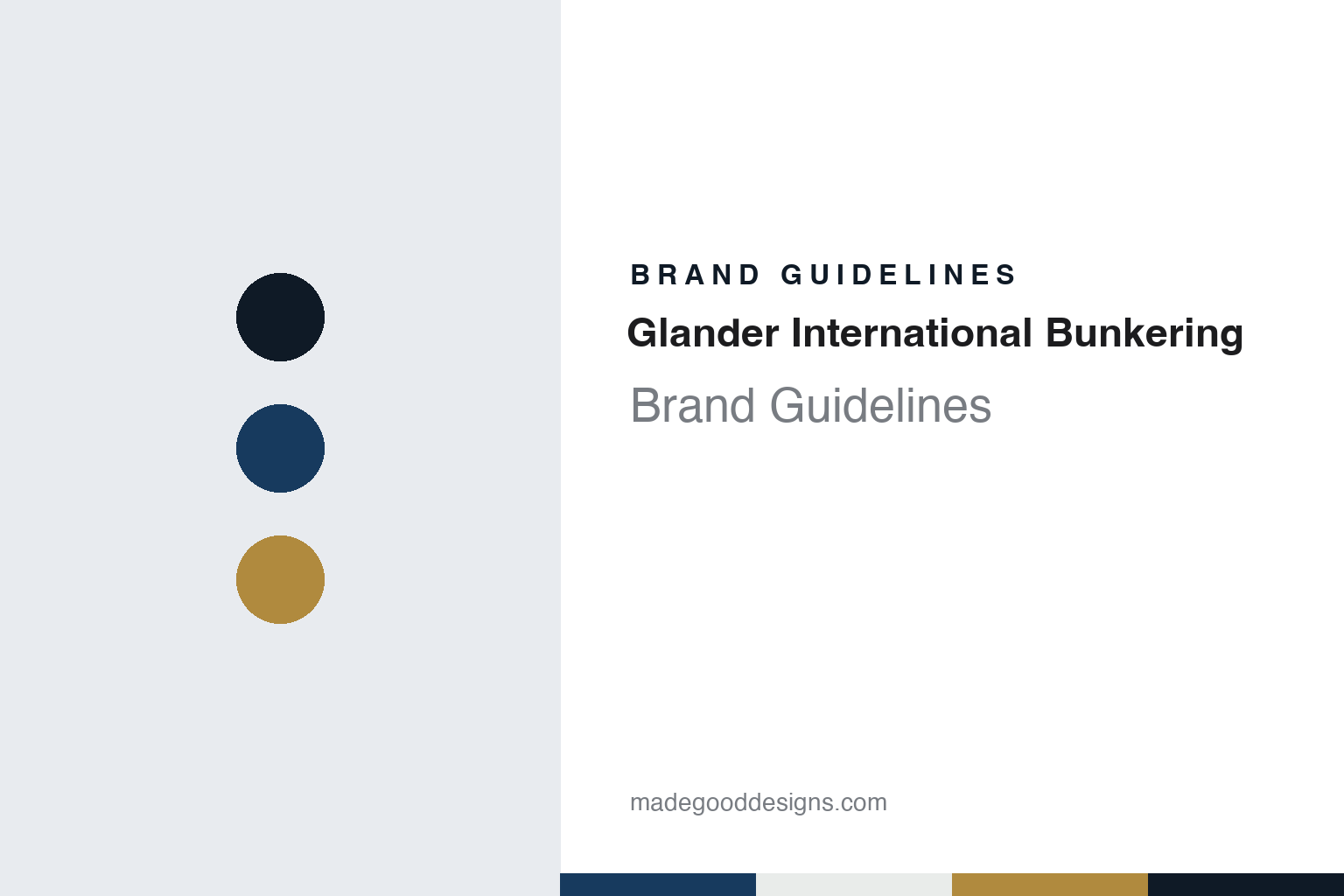
Glander International Bunkering Brand Guidelines
A 1961 New York tanker brokerage that became a global bunker trader.
Aa
Two constants: a deep sea blue and brass palette and a classic serif register. Abstract homage — not a Glander International Bunkering product or mark; no logo or nameplate is reproduced.
C.D. Mallory
Two tanker brokers in New York.
Glander International Bunkering traces itself to New York in 1961. The company says the tanker brokers Clifford Mallory and Otto Glander founded C.D. Mallory & Co. there that year, a brokerage that, by its account, combined tanker, dry cargo, sale-and-purchase and bunkering work under one roof. Mallory came from a family of shipowners and shipbuilders in Connecticut and New York, the company says, and Glander later served as president of the Association of Ship Brokers and Agents.
The company credits Glander with helping, in 1969, to form the American Tanker Rate Schedule, which it says evolved into the Worldscale system still used to price tanker charters. In 1977 Louis Cammarata, a broker who had joined the firm, became its president and moved it from tanker broking towards bunker broking. In 1980, when Mallory retired, the firm was renamed after Otto Glander as Glander International Bunkering Inc. and turned to bunkers alone, according to the company’s history page.
The company calls itself “the birthplace of the bunker broker” and says it was the first US brokerage with a full-time telex operation in London; both are its own claims. In September 2016 the trade site MarineLink described Glander as one of the industry’s oldest bunker trading and brokering firms. In 1991 the business moved to Florida, where it was owned by Larry Messina, Michael Cammarata and Anthony Cammarata after Louis Cammarata retired, the company says.
Colour
From Dubai to nine offices.
The present group was built from the Gulf. The company’s timeline says International Bunkering Middle East DMCC was set up in Dubai in 2006, opened in Mumbai in 2011 and in Singapore in 2012, and in 2013 acquired Glander International Bunkering, rebranding its Florida, Dubai, Singapore and Mumbai offices under the Glander name. In 2014 the group bought Valhalla Marine Sàrl in Switzerland; Geneva is now one of its offices.
In September 2016 Glander merged with the Norwegian trader Scandinavian Bunkering AS. MarineLink reported on 29 September 2016 that the Norwegian company, established in 1993, would take the name Glander International Bunkering (Norway) AS from 26 September, giving the group its second office in Europe and a larger office in Singapore. Scandinavian Bunkering’s traders in Norway and Singapore would stay on, the report said, and its managing director would run the Norwegian operation. English Wikipedia adds that Scandinavian Bunkering, based in Tønsberg, had bought Sea Bunker, a company founded in 1981, in 1997. Glander opened in Valencia in 2018 and in Oslo in 2019, and in 2020 the Montréal company CANDEN Marine Fuel Services joined as its ninth office, the company says.
Today its website lists nine offices: Dubai, Florida, Geneva, Montreal, Mumbai, Oslo, Singapore, Tønsberg and Valencia. It describes the business as worldwide marine fuel and lubricant trading, and organises its work by type of ship and operator, from container ships, tankers and bulkers to cruise ships, yachts and fishing vessels, tugs and barges, and offshore units. Its corporate brochure is offered in six languages, and the website itself in English, Spanish, French and Chinese.
Typography
Design and documentation.
Marine fuel suppliers sell to a small, technical audience: ship operators, charterers and fuel buyers who order bunkers for a vessel arriving at a given port on a given day. Their identities tend to be simple. Many use a plain wordmark in a single strong colour — often a deep blue, sometimes an orange or a green — with a short symbol beside it, and the name usually says what the company does: bunkering, marine fuels, oil or energy. Several have shortened or changed those names as they add new fuels or change owners.
Photography does much of the work. The companies publish pictures of their own bunker barges and tankers moored alongside container ships, bulk carriers and cruise ships, of hoses and fuel lines at the ship’s side, and of new vessels at their naming ceremonies. Port-coverage maps are the other recurring image: a world map marked with the hubs where a supplier delivers fuel itself and the wider set of ports where it arranges supply through others.
Product pages are written plainly, by fuel grade rather than by brand name: very low sulphur fuel oil (VLSFO), high-sulphur fuel oil (HSFO), marine gasoil (MGO), LNG, and biofuel blends described by their bio-component share, such as B20 or B30. Larger suppliers add pages for their trading desks — buying fuel for delivery across many ports, and managing fuel-price exposure for customers — and for delivery records, including mass flow meters and digital delivery notes.
Sustainability pages have grown alongside these. Suppliers describe the alternative fuels they offer or plan to offer, newer vessels able to run on LNG, and their own codes of conduct, usually in the company’s own words. This guide separates those descriptions from what dated trade-press reports show about each company: who founded it, who owns it, and where it supplies fuel.
Aa
A classic serif — a broker’s name kept since 1980. (Specimen set in Fraunces, a serif STAND-IN; NOT the Glander International Bunkering logo.)
Glander
A Bunker Holding brand.
Glander is part of the Danish Bunker Holding group of Middelfart, which describes itself as family-owned. In a release of 16 September 2026, Bunker Holding named Glander International Bunkering among its brands, alongside KPI OceanConnect and Dan-Bunkering, and said Michael Cammarata would become head of the Glander brand. Glander’s own announcement the same day said Carsten Ladekjær, its chief executive for almost a decade and a member of the Bunker Holding group for more than 30 years, would move to the newly launched Bunker Holding Academy; Cammarata, it said, had become managing director of the Florida office earlier in 2026.
Its recent announcements centre on new fuels. The company says it set up a new-fuels team and received ISCC certificates for biofuels in 2023. Releases reprinted by Hellenic Shipping News describe an LNG delivery by truck, arranged with the supplier Rohe Solutions, to a tanker at Kokkola in Finland in December 2023, which the company called the port’s first LNG supply, and, in July 2026, a portfolio of biofuels and blends, LNG and bio-LNG, pooling and insetting under what it calls “well-to-wake bunker management.” Its website also has pages on methanol, LPG, hydrogen and ammonia. The company’s timeline says its Dubai office had been named a Great Place to Work in the UAE for five consecutive years by 2022.
The company also presents itself as an adviser on regulation. In its release for the 2023/24 financial year, reprinted by Hellenic Shipping News in July 2024, it listed six ISCC-certified offices and EU allowance purchasing and advisory services from the start of the EU emissions trading system for shipping in January 2024, and said it had taken a larger advisory role on EU ETS, FuelEU Maritime and IMO targets. When the Norwegian merger was announced in 2016, its managing director and chief executive was Christoffer Berg Lassen, MarineLink reported.
For a design guide, Glander International Bunkering shows how an old broker’s name can carry a group that was rebuilt elsewhere. Compare Bunker Holding, its Danish parent group, and KPI OceanConnect, another Bunker Holding brand. For this guide we use a deep sea blue and a brass with a serif, an unofficial interpretation; no product or logo is reproduced.
Explore & save
Keep Glander International Bunkering’s identity on hand — save it to a board in the Made Good inspiration library.
Glander International Bunkering identity set
Pin the Glander deep sea blue and brass palette and the classic serif register to your own board.