Bergen Engines Brand Guidelines
A Norwegian engine works that began as a steamship yard and still builds every engine on one site north of Bergen.
Aa
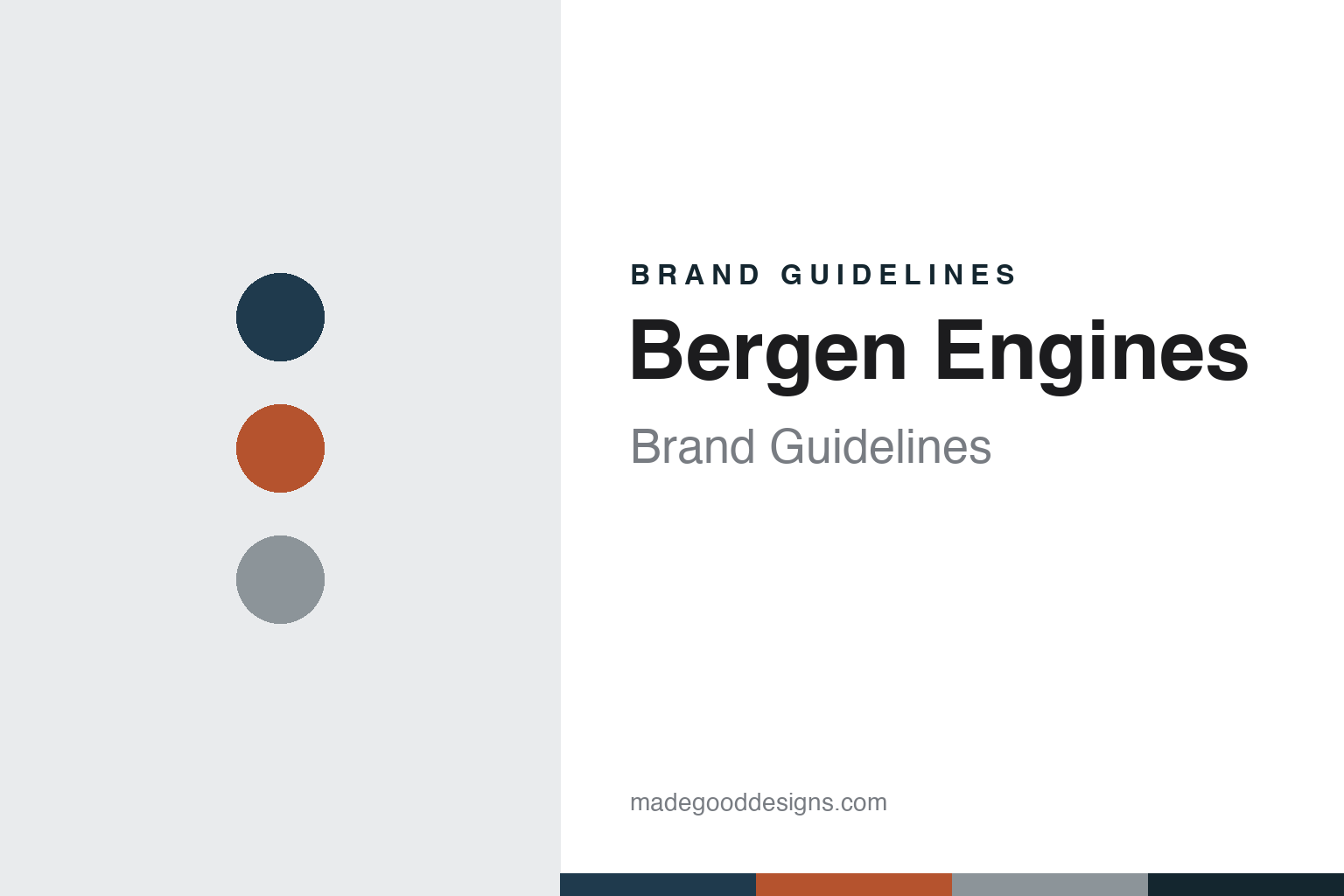
Two constants: a fjord blue, foundry rust and granite grey palette and a condensed sans register. Abstract homage — not a Bergen Engines product or mark; no engine, logo or nameplate is reproduced.
Solheimsviken, 1855
A steamship yard founded by Michael Krohn.
Bergen Engines traces its roots to 1855, when A/S Bergen Mekaniske Verksted was set up at Solheimsviken in Bergen on the initiative of Michael Krohn, according to the Norwegian encyclopaedia Store norske leksikon. Krohn had founded the coastal shipping line Det Bergenske Dampskibsselskab four years earlier, and the encyclopaedia says the yard was meant to work alongside it, building and repairing steamships. Its build lists were local: 84 of the 103 ships the yard delivered between 1855 and 1898 went to owners in Bergen and the surrounding districts.
The same year a second works, Laxevaags Værk, opened across the water at Laksevåg, first casting parts for ships and household goods before moving into repairs and steamship building. Store norske leksikon calls the two yards the largest in the Bergen region at the start of the twentieth century, and dates their most profitable period to 1912–1914. After a difficult decade they merged in 1929 under the group name Bergens Mekaniske Verksteder, or BMV: Laksevåg took the repair work and Solheimsviken the newbuilding.
Engines came later. The company’s own timeline says BMV took a licence in 1939 to build small auxiliary combustion engines, because steam plant was too big for fishing boats, and began developing engines of its own design in 1942. During the occupation of Norway the yard was busy: Store norske leksikon records that in May 1940 the German civil administration asked BMV to report on its production, and that heavy German demand for repair and other work meant only three of the four cargo ships then on the slipways were delivered before 1945. The yard earned well and put much of the money into its pension fund and a modernisation programme.
Colour
From the DP6 to the B3X platform.
The first engine of BMV’s own design followed in 1946. The company says it was a six-cylinder propulsion engine called the DP6, installed in the 105-foot wooden fishing vessel Draupne, and it calls it the forerunner of today’s Bergen series. English Wikipedia adds a second early delivery, to the Arcturus, in 1947. In the company’s telling, the post-war decades brought a run of types — a small four-stroke D engine in 1948, the R engine in 1953 for auxiliary sets, and the L engine of 1961, built first for locomotives and then for ships — with engine production organised as BMV Motorfabrikken from 1951.
The works moved in stages. The company says the Norwegian industrial group Aker became BMV’s majority shareholder in 1965 and that engine building was moved to a new factory at Hordvikneset, at the northern tip of the Bergen peninsula, whose first part opened in 1968 and second in 1971. Oil and gas finds in the North Sea, the timeline adds, sent Bergen engines into rigs and supply vessels. When the offshore market slowed in the 1980s, BMV turned to gas: its first gas engine was completed in 1985, and in 1991 a lean-burn K-series gas engine went to a power plant in Denmark, which the company describes as a commercial first for an engine of that kind.
Today’s range is built around the B and C series. The company lists the B33:45 and C25:33 for liquid fuel and the B35:40, B36:45 and C26:33 for natural gas, in inline and V forms; Store norske leksikon puts the range at roughly 1,400 to 12,000 kW. The B3X:45 platform entered the marine market in 2014, its first engine going into the Norwegian fishing vessel Holmøy, the company says, and the land market in 2018. Its website presents the engines in two halves, “At Sea” for ferries, offshore, fishing and tugs and “On Land” for power plants, combined heat and power, mining and data centres, and it describes research into hydrogen, methanol and ammonia as future fuels.
Typography
Design and documentation.
Marine engine makers sell to shipyards, shipowners and ship managers rather than to the public, and their websites read like technical catalogues. The core of most is an engine range sorted by bore and output. WinGD names its two-stroke engines by cylinder bore in centimetres, from the X52 to the X92, while Everllence gives its four-stroke engines bore-and-stroke numbers such as 32/44 and 49/60. Letters added to those numbers mark the fuel, the generation or the version.
The pictures follow the product. These companies publish cutaway renderings that open an engine to show its cylinders, pistons and crankshaft, alongside photographs of finished engines on test beds and in engine rooms. Model names, cylinder counts and output figures sit beside the images, so a page often reads more like a data sheet than an advertisement.
Fuel has become one of the main ways these makers describe themselves. Their websites sort engines by fuel type as well as by vessel type, with pages for liquefied natural gas, methanol, ammonia and LPG; WinGD adds ethanol, and Everllence marks its alternative-fuel two-stroke engines with a suffix for each fuel. Dual-fuel engines, which run on gas or on liquid fuel, are presented through type designations and technical descriptions in the companies’ own terms.
Two other features recur. Service network maps and location finders show where parts and field engineers can be found; Everllence speaks of more than 140 service locations, and WinGD runs a lifecycle-support arm under its own name. Heritage timelines, meanwhile, tie current engines to Rudolf Diesel, whose engine was developed with MAN in Augsburg in the 1890s and licensed to Sulzer in Winterthur, giving the oldest names in the field more than a century of dates to show.
Aa
A condensed sans for engine-type names such as B36:45. (Specimen set in IBM Plex Sans Condensed, a sans STAND-IN; NOT the Bergen Engines logo.)
Bergen Engines
From Bergen Diesel to Rolls-Royce and Langley.
The engine works became a company of its own in 1984, when BMV spun it off as BMV Maskin AS. Store norske leksikon says the Ulstein group bought it in 1985 and renamed it Bergen Diesel, the name by which most Norwegians still know it. In 1999 Ulstein was bought by Vickers, which Rolls-Royce acquired the same year; the business then traded as Rolls-Royce Marine Engines – Bergen. In 2013 it was placed in Tognum, the German engine group that Rolls-Royce and Daimler had bought together in 2011, as the separate company Bergen Engines AS, and Tognum was renamed Rolls-Royce Power Systems in 2014.
Rolls-Royce sold the business to the British engineering group Langley Holdings, and the sale was completed on 31 December 2021, according to both the company and English Wikipedia. Bergen Engines now sits in Langley’s power solutions division beside the Italian alternator maker Marelli Motori and the German firm Piller Power Systems. In June 2026 the company announced an agreement with Crusoe for about 750 megawatts of generating capacity for data centres in the United States. Store norske leksikon describes it as the last remaining maker of large piston engines in Norway.
The company says every Bergen engine is built at Hordvikneset, about 20 kilometres north of central Bergen, on a 23-hectare site with machine shops, paint booths, test beds, a foundry it calls Norway’s largest, a museum of its own history and a deep-water quay for loading engines onto ships. It says it has built more than 7,000 engines since 1946 and that about half are still in service, and it lists twelve sales and service subsidiaries abroad.
For a design guide, Bergen Engines shows how an engine maker presents a long industrial lineage: a timeline that runs from a steamship yard to data-centre gensets, engine types named by bore and stroke, and a site pictured as one factory beside the sea. Compare it with Wärtsilä, another Nordic maker of medium-speed engines, and with Volvo Penta. For this guide we use a fjord blue, a foundry rust and a granite grey with a condensed sans, an unofficial interpretation; no product or logo is reproduced.
Explore & save
Keep Bergen Engines’s identity on hand — save it to a board in the Made Good inspiration library.
Bergen Engines identity set
Pin the Bergen Engines fjord blue, foundry rust and granite grey palette and the condensed sans register to your own board.