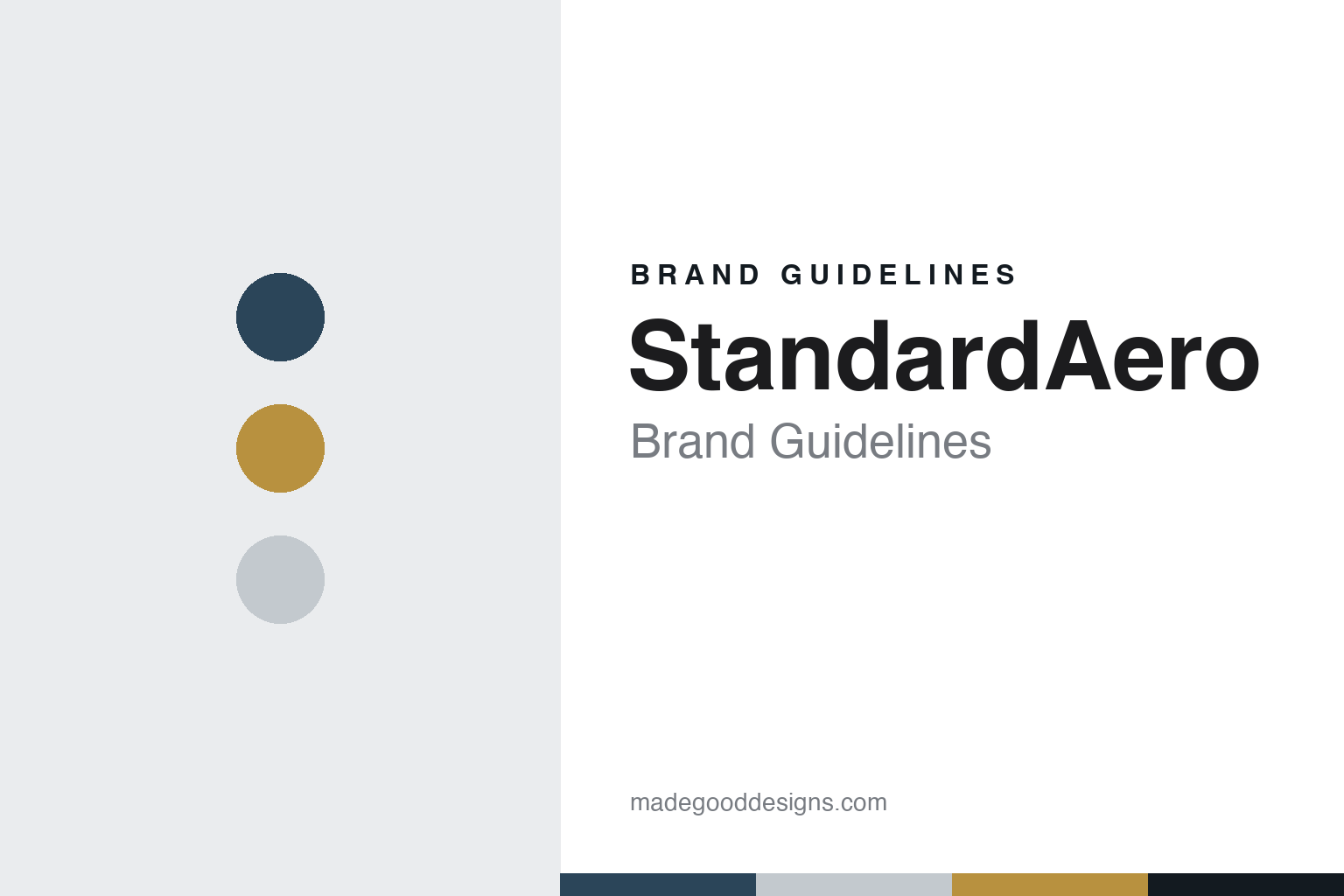
StandardAero Brand Guidelines
A 1911 Winnipeg workshop, a Scottsdale head office and a 2024 listing.
Aa
Two constants: a StandardAero steel, grey and wheat palette and a Workshop sans register. Abstract homage — not a StandardAero asset or mark; no engine, aircraft or logo is reproduced.
Standard Machine Works
A Winnipeg engine shop that turned to aircraft.
StandardAero is now an engine-services company based in Scottsdale, Arizona, but it began as a car-engine workshop in Canada. The company says it was founded in 1911 in Winnipeg, Manitoba, by Charles Pearce and William Bickell as Standard Machine Works, repairing and rebuilding automobile, truck and tractor engines. As civil aviation grew on the prairies in the mid-1920s, it says, the workshop added an Aero Engine Division at its St. Matthews premises rather than ship engines to manufacturers in the east. In April 1936 the team rebuilt its first aircraft engine, an Armstrong Siddeley Cheetah, and by November that year makers including Canadian Pratt & Whitney, de Havilland and Jacobs had appointed it an authorised service station, the company says.
Accounts differ on how the aviation business became a company of its own. English Wikipedia, citing a 1974 Winnipeg Free Press article, says StandardAero was formed in 1937 as an offshoot of Standard Machine Works and became fully independent in 1940; the company’s own history says it incorporated as Standard Aero Engine Limited in 1949. Standard Machine Works continues as a separate business in Winnipeg’s west end, English Wikipedia adds. By 1960, the company says, it had begun overhauling turbine engines, sharing a test cell with Trans-Canada Air Lines.
Over the following decades the business changed hands often. English Wikipedia, citing Winnipeg Free Press reports, says the Federal Grain Company of Winnipeg agreed to buy it in September 1968, and that it was held by the successor company Federal Industries after 1972. By 1974, the article says, the company was overhauling piston engines for aeroplanes and turboshaft engines for helicopters, and had expressed interest in adding jet engines. It was sold to Avcorp of Montreal in 1987 and to Britain’s Hawker Siddeley Group in 1989. The same article says it passed to BTR in 1992 and became part of Dunlop Standard Aerospace Group under the investment firm Doughty Hanson in 1998.
Colour
Investment owners, an identity and a listing.
The modern owners were investment firms. English Wikipedia says The Carlyle Group acquired StandardAero in 2004, and that Dubai Aerospace Enterprise bought it, together with the Phoenix-based Landmark Aviation, from Carlyle in 2007, after which the head office moved to the Phoenix area. In March 2008 the two businesses were integrated under the single corporate identity of StandardAero, according to the same article. Veritas Capital of New York bought the company from DAE in 2015, and in November 2017 StandardAero acquired Vector Aerospace, a maintenance group then employing about 2,200 people, from Airbus. Carlyle returned when it closed its purchase from Veritas on 5 April 2019, Vertical magazine reported; StandardAero then had more than 6,000 employees at 38 primary locations.
The company then went public. StandardAero priced its initial public offering on 1 October 2024, with shares due to begin trading on the New York Stock Exchange under the symbol SARO the next day, its release said; at the time it described itself as majority owned by Carlyle. English Wikipedia also records the October 2024 listing.
Engines are the core of what it sells. The company describes itself as a provider of engine aftermarket services for fixed- and rotary-wing aircraft: engine maintenance, repair and overhaul, component repair, on-wing and field service, asset management and engineering. Its website lists engine programmes from makers including CFM International, GE Aerospace, Honeywell and Rolls-Royce, alongside airframe work on business jets, avionics upgrades and paint and interior refurbishment, and says more than 8,000 people work in over 50 StandardAero facilities. English Wikipedia, citing the San Antonio Express-News in July 2024, adds that Boom Supersonic selected StandardAero to build Symphony, the engine planned for Boom’s Overture airliner.
Typography
Hangars, capabilities and approvals.
Aircraft maintenance, repair and overhaul companies, known in the trade as MRO providers, sell work that passengers rarely see. Their public pages tend to start with the places where that work is done: hangars photographed with aircraft inside, often in the liveries of the airlines that own the maintenance company or send their fleets to it, shown as the companies publish them.
The second common element is the capability list. Providers set out what they can handle by aircraft type and by engine type, and by level of work, from line checks between flights to heavy base checks, component overhaul and passenger-to-freighter conversion. GAMECO’s website, for example, names the Boeing, Airbus, Embraer and COMAC types it works on one by one.
Approvals are usually stated plainly rather than designed. A maintenance organisation’s certificates from the European Union Aviation Safety Agency, the US Federal Aviation Administration, the Civil Aviation Administration of China and other national authorities tend to appear as a named list, sometimes with the certificate type beside each authority. Hangar sizes, bay counts and staff numbers appear the same way, as figures in company statements that trade titles such as Aviation Week and AviTrader then report.
The rest of a typical MRO site speaks to two audiences. Airlines and aircraft lessors looking for capacity are addressed through customer, news and contact pages, where new contracts and hangar openings are announced; technicians and engineers looking for work are addressed through careers pages. Many of these companies belong to an airline, or are joint ventures with one, so the parent’s name often sits close to the provider’s own.
Aa
A sturdy workshop sans — one compound word with a capital A in the middle. (Specimen set in Archivo, a sans STAND-IN; NOT the StandardAero logo.)
StandardAero
Still rooted in Winnipeg.
Winnipeg remains the company’s anchor. On 3 September 2026 StandardAero opened a 70,000-square-foot expansion at one of its Winnipeg sites, adding overhaul capacity for the GE Aerospace CF34-3/8 and CFM International CFM56 engines, AviTrader reported; the company said 1,500 of its staff work across eight facilities in the city, and marked 115 years of presence there. Its release adds that it has been a GE-branded service partner for the CF34-3 and CF34-8 since 2001 and has held a CFM licence for the CFM56-5B and CFM56-7B since 2009. Since February 2012, English Wikipedia says, it has also operated GE’s aircraft engine testing, research and development centre at Winnipeg’s James A. Richardson International Airport.
The name carries the history in compressed form. Standard Machine Works became Standard Aero Engine Limited, and the one-word StandardAero, written with a capital A in the middle, became the identity of the combined group in 2008. The company’s website is organised by what is being serviced, under the headings Engines, Airframes, Avionics and Component Repair, with each engine programme listed by its maker and model number, and its About page carries the heading “Founded in 1911.”
For a design guide, StandardAero shows how a long company history can be carried by a compact one-word name, while the website does its work through manufacturer names and model numbers. Compare AAR, another North American aviation-services group, and SR Technics, the maintenance company based at Zurich Airport. For this guide we use a steel blue, an engine ink, a test-cell grey and a prairie wheat with a sans, an unofficial interpretation; no product or logo is reproduced.
Explore & save
Keep StandardAero’s identity on hand — save it to a board in the Made Good inspiration library.
StandardAero identity set
Pin the StandardAero steel, test-cell grey and prairie wheat palette and the Workshop sans register to your own board.