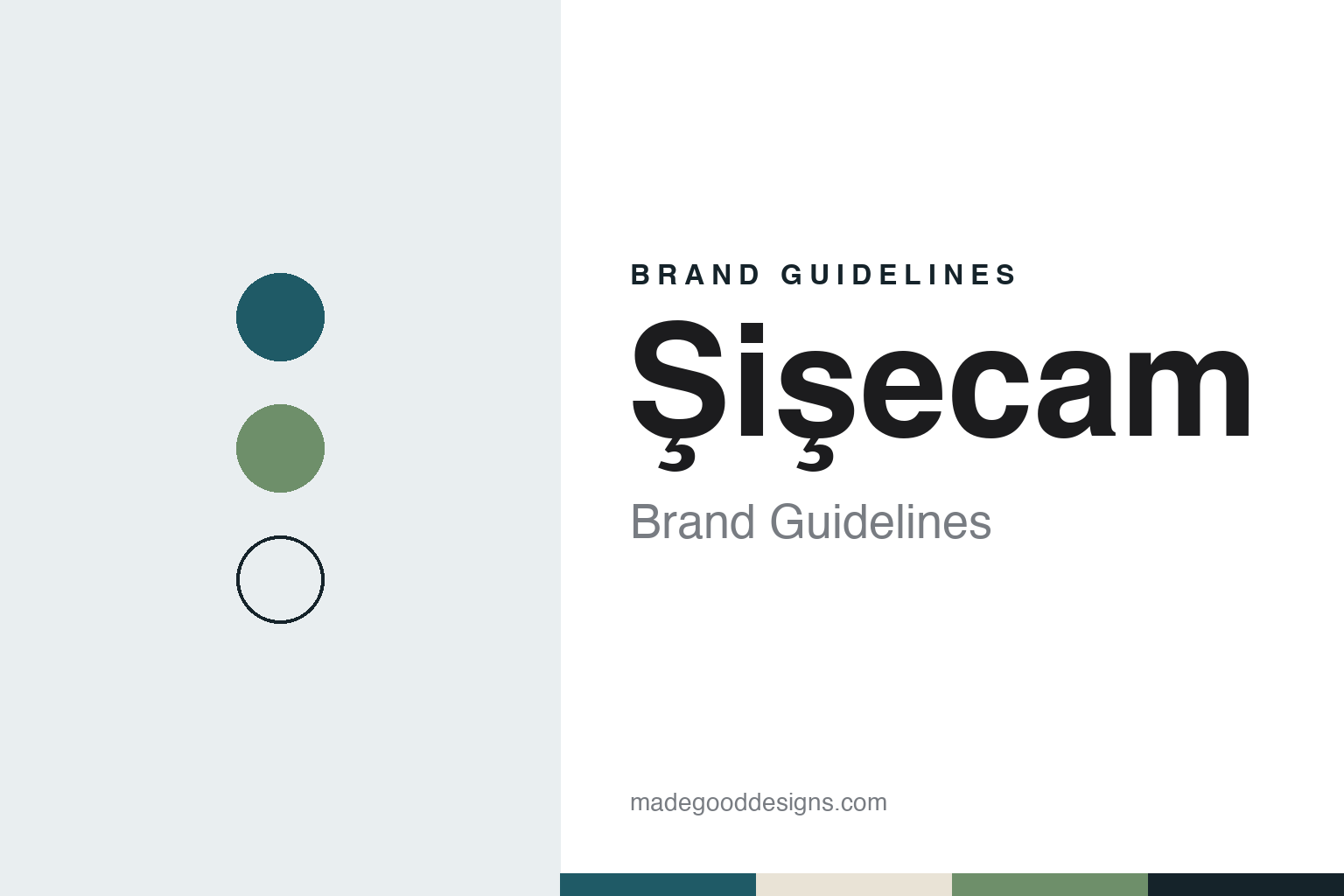
Şişecam Brand Guidelines
A bank-founded Istanbul glassworks that became a glass and chemicals group.
Aa
Two constants: a Şişecam teal, sand and green palette and a geometric sans register. Abstract homage — not a Şişecam product or mark; no glass, logo or nameplate is reproduced.
Paşabahçe, 1935
A glassworks founded by a bank.
Şişecam’s formal name is Türkiye Şişe ve Cam Fabrikaları, literally “Turkey Bottle and Glass Factories,” and the company began with a government decision rather than with a single founder. Turkish Wikipedia says a Council of Ministers decision of 17 February 1934, taken under the Industry Incentive Law and the First Five-Year Industrial Plan, gave the task of building a national glassworks to Türkiye İş Bankası, the bank usually called İşbank. The company was registered on 25 October 1935 as Türkiye Şişe ve Cam Fabrikaları Anonim Sosyetesi. İşbank put up 97.75 per cent of the founding capital and Türk Tecim Anonim Sosyetesi the remaining 2.25 per cent, the same article says.
The first plant stood in the Paşabahçe district of Istanbul. Its foundation stone was laid on 14 August 1934 by Prime Minister İsmet İnönü and Economy Minister Celâl Bayar, in a ceremony filmed by İpek Film, and İnönü opened the works on 29 November 1935. Turkish Wikipedia gives its starting capacity as about six tonnes of glass a day with some 400 workers; English Wikipedia describes the same opening as a works of around 400 employees able to make 25,000 bottles a day. Output reached roughly 2,500 to 3,000 tonnes of bottles and glassware in 1936 and 4,767 tonnes in 1939, according to Turkish Wikipedia.
The district already had a glassmaking past. Turkish Wikipedia records an earlier bottle factory at Paşabahçe, founded in 1885 by a foreign entrepreneur named Modyanu, which employed hundreds of workers and was still running in the early twentieth century. The same article treats the Beykoz glass and crystal works built under Sultan Abdülmecid in the nineteenth century as a milestone for the country’s glass industry, and notes that the Beykoz works stopped production for economic reasons after struggling against imported European glass.
Colour
Bottles, then shops, window glass and fibre.
Retail came early. In 1957 two shops opened in Istanbul and Ankara to sell the company’s glassware directly, English Wikipedia says; they grew into the Paşabahçe store chain, which now trades across Türkiye and in Qatar. Turkish Wikipedia dates the company’s first export, to Cyprus, to 1958, and Paşabahçe’s first shipments to the United States to 1960.
Flat glass followed. A factory at Çayırova, whose foundation stone was laid in 1959, began working in 1961, making window glass that English Wikipedia puts at 19,000 tonnes a year. In 1966 a joint plant with Germany’s Schott, named TACAM, began making glass tubing and laboratory glassware, and automotive glass production started at Çayırova in the same year. Glass fibre came in 1971; English Wikipedia says the first glass-fibre mats went into Anadol cars built in Turkey. A research laboratory opened in 1976, and from the 1970s the group also moved into the raw materials of glass, including soda ash, chrome chemicals, sand, dolomite, feldspar and limestone.
Turkish Wikipedia now sorts the business into flat glass, glassware, glass packaging, automotive glass, chemicals and glass fibre, alongside mining, energy and recycling. Flat glass covers architectural, patterned, mirror, laminated, coated and solar glass, with Turkish plants in Kırklareli, Mersin, Bursa and Ankara and plants abroad in Bulgaria, Italy, India, Egypt and Russia. The glassware arm makes soda-lime, crystalline, borosilicate and lead-free crystal pieces by machine and by hand. The packaging arm makes bottles and jars in many sizes and colours for food, drinks, pharmaceuticals and cosmetics. The automotive arm lists windscreens, side and roof glass and glass for head-up displays, with plants in Türkiye and several European countries, among them Richard Fritz of Besigheim in Germany, a supplier that English Wikipedia says Şişecam bought in 2013.
Typography
Glass makers and their pages.
Glass makers sell mainly to builders, carmakers and bottlers rather than to shoppers, and their brand pages are written for those buyers. The material does much of the visual work. Many of the large producers fill their websites and annual reports with photographs of their own float lines, furnaces and forming machines, shot and published the way each company chooses, next to close-ups of finished sheets, windscreens and bottles.
Product pages tend to follow the three big markets. Architectural ranges cover clear and tinted float glass, coated glass for solar control and insulation, laminated glass and mirrors, each usually with a range name and a technical data sheet. Automotive pages describe windscreens, side and roof glass, and glass with heating, acoustic layers or head-up-display areas. Container makers show bottles and jars by capacity, colour and finish, often with catalogue pages of standard shapes for wine, beer, spirits and food.
Colour belongs to the catalogue as much as to the logo. Flat-glass makers publish swatches for body tints and reflective coatings, and packaging makers name their glass colours, such as flint, amber and green, and show the same bottle shape in each. Corporate pages carry a second kind of identity: maps of plants, lists of countries, ownership histories and stock-market listings, which matter in an industry where many groups have grown by buying or merging with other glassworks.
The guides in this group read those public materials: founding records, owners, plants and product families, as the companies and independent sources describe them. The colours and type samples shown here are our own interpretation, not official brand assets, and no product or mark is reproduced.
Aa
A geometric sans for an industrial group. (Specimen set in Manrope, a sans STAND-IN; NOT the Şişecam logo.)
Şişecam
One company under one name.
The company went public on 13 January 1986, when its shares began trading on what is now Borsa İstanbul, Turkish Wikipedia says. English Wikipedia lists it in the BIST 100 index and says İşbank owns around half of the shares. Expansion abroad began in the 1990s: the first foreign plant was the Mina works in Georgia, bought in a privatisation, which started making glass packaging in 1998. In the 2000s the group bought, invested or formed partnerships in Russia, Bulgaria, Bosnia and Herzegovina, Egypt and Italy.
For years Şişecam worked through separate subsidiaries with their own names. In October 2020 Anadolu Cam, Denizli Cam, Paşabahçe, Soda Sanayii and Trakya Cam were merged into the parent under the Şişecam name; Turkish Wikipedia calls it the largest merger in the Turkish capital market at the time. The same article counts 47 plants in 13 countries and more than 23,000 employees in 2025, and a company release carried by glassonweb in November 2026 describes production in 13 countries on four continents and a sales network reaching more than 150 countries. English Wikipedia adds that, by the company’s own estimates, Şişecam is the largest flat-glass maker in Europe by capacity.
The group has also faced regulatory scrutiny. In October 2025 Turkey’s Competition Board fined Şişecam and its subsidiary Şişecam Çevre Sistemleri for failing to keep commitments, set under a 2021 decision, on purchases of unprocessed glass, Daily Sabah reported; the company said it planned to appeal. In November 2026 Şişecam took part as a Climate Supporter in the COP31 summit in Antalya, where chief executive Can Yücel moderated a panel on glass in buildings, according to the company release. Turkish Wikipedia names Adnan Bali as chairman.
For a design guide, Şişecam shows how one industrial group can carry a single corporate name above long-standing trade names such as Paşabahçe. Compare Saint-Gobain, another group that spans many glass trades, and NSG Group, home of the Pilkington name. For this guide we use a deep Bosphorus teal, ink, sand and a muted green with a geometric sans, an unofficial interpretation; no product or logo is reproduced.
Explore & save
Keep Şişecam’s identity on hand — save it to a board in the Made Good inspiration library.
Şişecam identity set
Pin the Şişecam teal, sand and green palette and the geometric sans register to your own board.