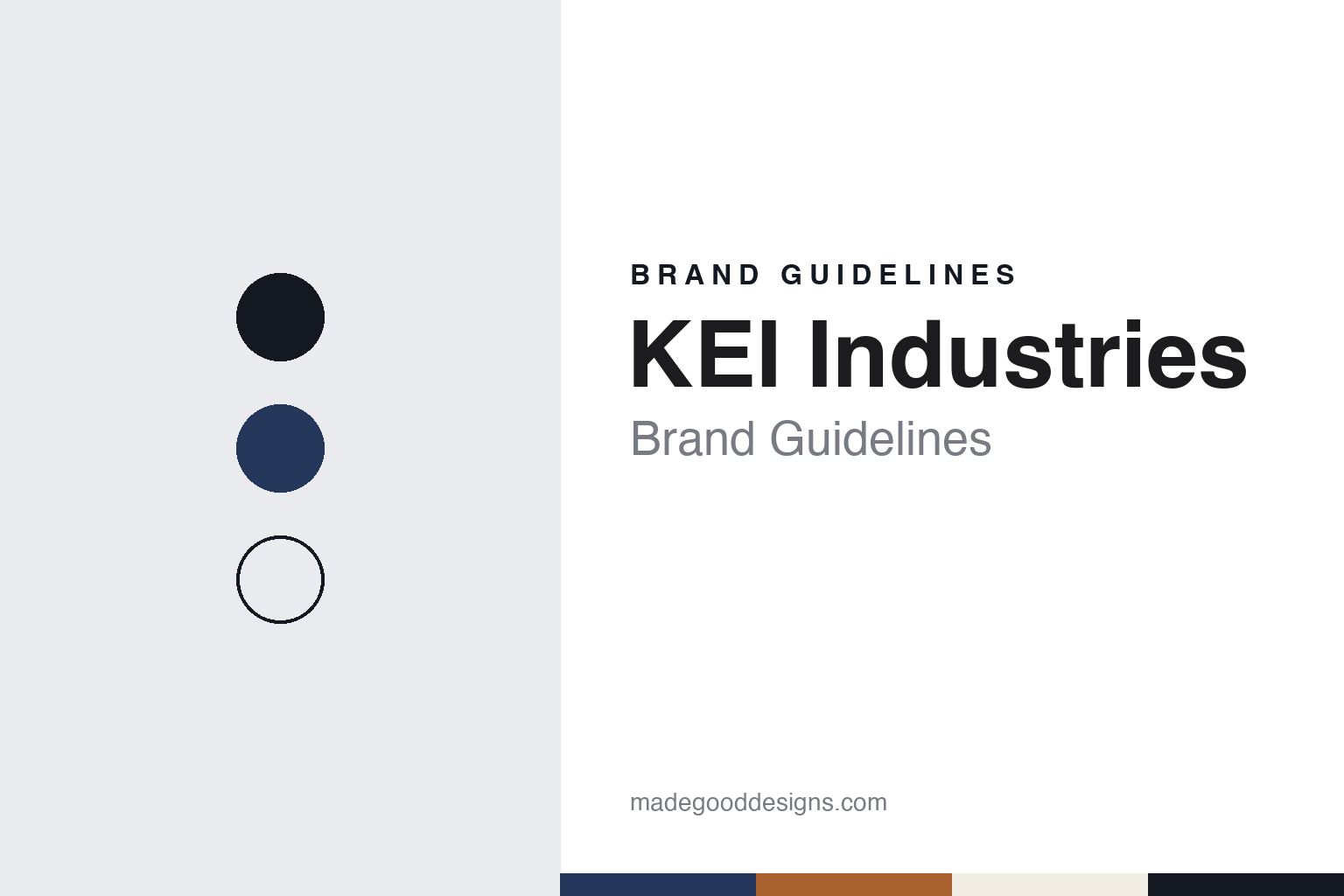
KEI Industries Brand Guidelines
A 1968 Delhi partnership grown into cables up to 400 kV.
Aa
Two constants: a deep blue, copper and cream palette and an engineering sans register. Abstract homage — not a KEI Industries product or mark; no cable, logo or nameplate is reproduced.
A 1968 partnership
From a partnership firm to a listed cable maker.
KEI Industries dates itself to 1968. Its “Our Company” page says it was founded that year as a partnership, with a first focus on rubber cables for house wiring; its “Genesis & Evolution” timeline describes the partnership firm’s first products as switchboard cables for the DOT, as the timeline puts it. The company’s leadership page says its chairman and managing director, Anil Gupta, began as a partner in “the erstwhile Krishna Electrical Industries” and rose to run the business, which he has led for more than four decades.
The timeline then traces a steady widening of the range. The partnership became a public limited company; control, instrumentation and thermocouple cables were added; PVC and XLPE power cables up to 3.3 kV followed, along with a move into drawn stainless-steel wire; and the company issued its first public offering and became listed. Its milestone list puts its first power-cable factory at Okhla, in Delhi, in 1993, and the Bhiwadi plant in Rajasthan in 1997.
In the 2000s, the timeline says, KEI began making rubber cables up to 11 kV, set up a plant at Silvassa, added 33 kV high-tension cable and opened plants at Chopanki in Rajasthan, one of them a fully export-oriented unit. It records a technical know-how agreement with Brugg Kabel AG of Switzerland for extra-high-voltage cables from 66 kV to 220 kV, later extended to 400 kV, and a first overseas office in Dubai, followed by offices in Singapore, Nigeria and Kazakhstan. Its milestone list dates its first 220 kV cable order to 2011 and its first overseas extra-high-voltage and EPC contract, in Singapore, to 2017.
Colour
Plants, voltages and a new Gujarat site.
Today KEI describes itself as headquartered in New Delhi, with around 34 branch offices, 26 warehouses, more than 2,000 channel partners and customers in more than 60 countries. It makes extra-high-voltage, medium-voltage and low-voltage power cables, and its product pages run through control, instrumentation and communication cables, solar and rubber cables, marine and offshore cables, winding wires, stainless-steel wire and EV charging cables. It also runs an engineering, procurement and construction (EPC) business for power projects, and splits its work into retail, institutional and export segments. Its shares are listed on the Bombay Stock Exchange, the National Stock Exchange and the Kolkata exchange, the company says, and it puts its workforce at about 2,050 people. Its high-voltage page says the plant making those cables uses German technology and can make cables rated up to 220 kV, while the stainless-steel side of the business sells welding, cold-heading and fine wire.
The plant map has kept growing. After the Rajasthan plants at Bhiwadi, Chopanki and Pathredi, the timeline lists a wires and flexible-cables plant at Chinchpada, in Dadra and Nagar Haveli, which later also began making communication cables. The newest site is in Gujarat. Wire & Cable India reported on 11 December 2025 that KEI had begun the first phase of commercial production at its greenfield plant in the Sanand-II industrial estate near Ahmedabad on 10 December 2025, starting with LT and HT cables. The same report gave the company’s annual capacity as of November 2025 as about 226,700 km of cable and 9,000 tonnes of stainless-steel wire, and said Sanand would add 60,732 km of cable capacity once fully scaled.
The company keeps its own record of that growth: the timeline page links to a coffee-table book, “A Journey of 50 years of KEI,” and splits the story into eras from 1960–2000 to 2018–2026, each one marked by a new plant or a higher voltage.
Typography
How cable makers present themselves.
Cable makers sell products that most people never see once they are installed. Power lines run under streets and seabeds, data cable sits inside walls, and magnet wire is wound into motors. Their public image therefore leans on what can be photographed before installation: the cable itself, the plant that makes it and the ships that lay it.
The most common picture is the cut end. Company pages and catalogues show a cable in cross-section, with copper or aluminium conductor, insulation, screens and outer sheath set out in rings, often against a plain background. Wide shots of full reels and drums stacked in a yard do the same job at a larger scale, turning a long product into a single object that a camera can frame.
Submarine work has added another set of images. Press releases about offshore wind and grid links are often illustrated with cable-laying vessels, carousels of coiled cable and tall factory towers where high-voltage cable is made. These photographs carry the story of size and reach without needing a consumer product, and they are usually credited to the company that issued them.
Words matter as much as pictures. Makers organise their ranges into product families with short trade names, voltage classes and standard codes, and their corporate pages spend a lot of space on plants, subsidiaries and owners: where a factory stands, when it opened and which group holds the shares. For a designer, the category offers a practical vocabulary of rings, coils, ships and site maps, and a reminder that an industrial identity is often built from documentation rather than from packaging.
Aa
An engineering sans for a maker of power cable and house wire. (Specimen set in Barlow, a sans STAND-IN; NOT the KEI Industries logo.)
KEI Wires & Cables
House-wire names, cricket and an ambassador.
On the retail side the house-wire ranges carry their own names. Homecab is the company’s multi-stranded flexible house wire, and ConFlame Green+ is what Anil Gupta, in a November 2025 interview with Wire & Cable India, called a “next-gen” eco-friendly wire line, shown along with EV charging cables and guns at the Cable & Wire Fair. In the same interview he said the KEI logo had appeared on the back of the RCB match jersey, seen by cricket fans, as part of a push through sports alliances and retail marketing. The company’s timeline also records repeated Superbrand awards, which it says it has received nine times in a row.
In June 2026 the company named the actor Rashmika Mandanna as its brand ambassador. India TV, publishing the announcement on 25 June 2026, reported a nationwide campaign across television, digital and social media, print and outdoor advertising, with a new television commercial, and a Hindi closing line for KEI Wires & Cables: “Har Tension Sahe Chalti Rahe.” The same announcement describes the company’s range as running from 1.1 kV to 400 kV, sold in India and in more than 60 other countries. It also quoted the director Archana Gupta and the executive director Akshit Diviaj Gupta, both welcoming the actor to what they called the KEI family.
For a design guide, KEI Industries shows how an industrial cable maker builds a consumer-facing name, with named house-wire ranges, cricket sponsorship and a film-star ambassador, while its own timeline stays rooted in plants and voltage ratings. Compare Polycab, another Indian wire maker that has courted homeowners, and Finolex Cables, a cable maker from Pune. For this guide we use a deep blue, a drawn-copper tone and cream with a sans, an unofficial interpretation; no product or logo is reproduced.
Explore & save
Keep KEI Industries’s identity on hand — save it to a board in the Made Good inspiration library.
KEI Industries identity set
Pin the KEI Industries deep blue, copper and cream palette and the engineering sans register to your own board.