Vitens Brand Guidelines
The Dutch drinking-water company named for life, drawn from deep groundwater.
Aa
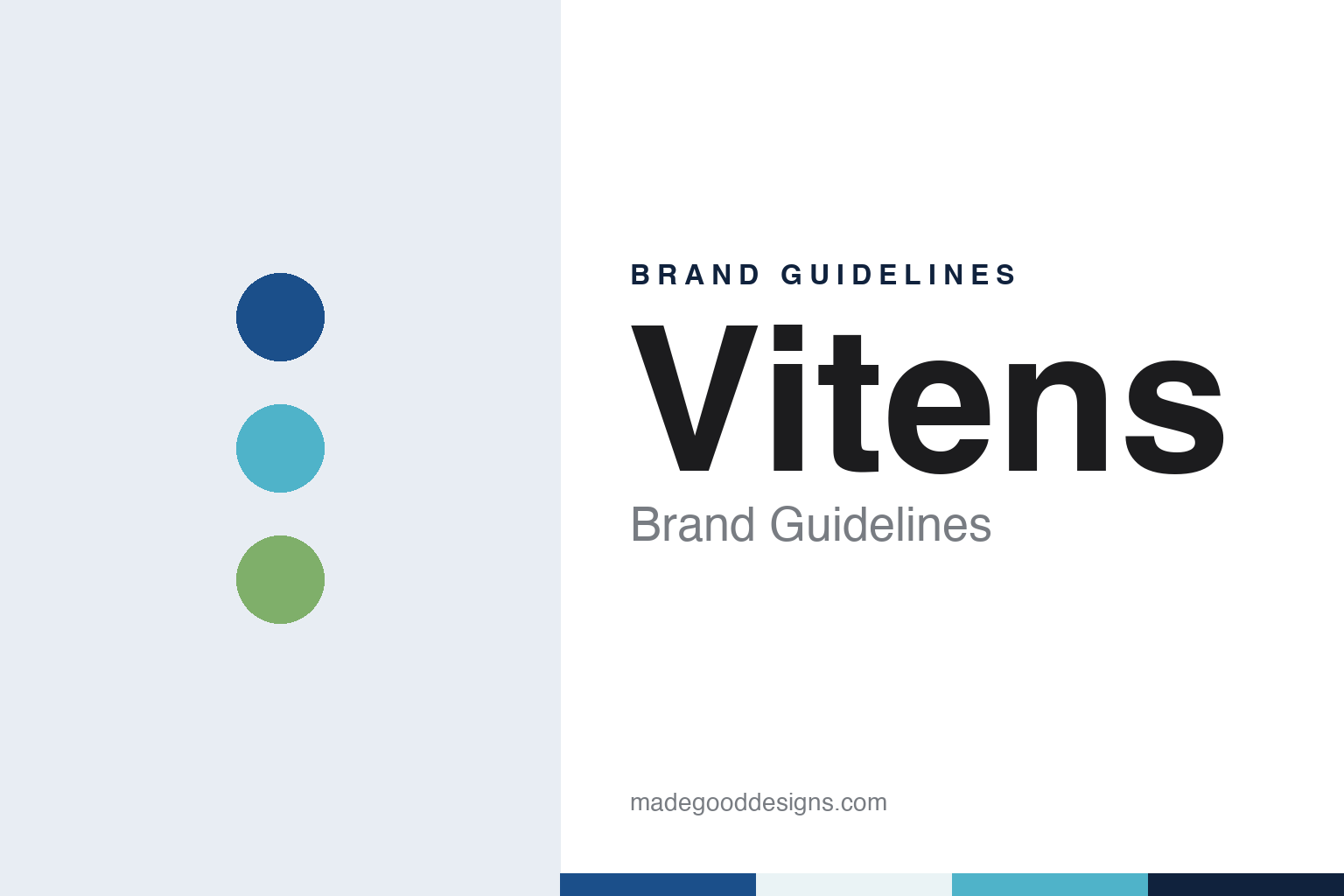
Two constants: a deep blue, aqua and meadow green palette and a friendly sans register. Abstract homage — not a Vitens asset; no logo, wordmark or mark is reproduced.
Three companies, one name
A 2002 merger in the east and north.
Vitens is a Dutch drinking-water company with its head office in Zwolle, in the province of Overijssel. Its name refers to life, from the Latin “vita,” Dutch Wikipedia says. It was formed in 2002, when three water companies decided to merge: Nuon Water, which supplied part of Gelderland and the province of Friesland through subsidiaries; Waterbedrijf Gelderland, owned by the province of Gelderland and many of its municipalities, which served the Achterhoek, the river district and the Veluwe; and Waterleiding Maatschappij Overijssel, owned by the province of Overijssel and 29 municipalities, which served Overijssel, the Noordoostpolder and some municipalities in Drenthe. The shareholders of the three became the shareholders of Vitens, according to the same article.
A second merger followed. Dutch Wikipedia says Vitens combined with Hydron Flevoland and Hydron Midden-Nederland, and from 1 October 2006 the three continued under the Vitens name. At that point the company had 2.3 million water connections in Flevoland, Friesland, Gelderland, Overijssel, Utrecht and some municipalities in Drenthe, and about 1,500 employees.
Ownership has stayed public. Vitens is a naamloze vennootschap, a public limited company, whose shares are held directly or indirectly by provincial and municipal governments. Dutch Wikipedia names the province of Overijssel as the largest shareholder, with 13.4 per cent, followed by Friesland, with 13.1 per cent.
Colour
Deep groundwater, provincial permits.
Most of Vitens’s work happens underground. Dutch Wikipedia says most of its drinking water comes from groundwater sources lying up to hundreds of metres deep, pumped in 104 abstraction areas. On the company’s figures for 2025, as listed there, it had about 2.8 million connections at the end of that year, around six million customers, roughly 1,900 permanent staff and a pipe network of about 48,000 kilometres. Its service area covers Flevoland, Friesland, Gelderland, Utrecht and Overijssel, together with Hilversum in North Holland and Meppel in Drenthe. Dutch Wikipedia describes Vitens as the largest drinking-water company in the Netherlands, as did NU.nl in September 2024.
Permits set the limits. The provinces issue the groundwater permits that fix how many cubic metres a drinking-water company may pump, weighing how much can be taken without harm to farming or nature, the AD explained in April 2024. Reporting on Vitens’s annual report for 2023, the paper said the company had delivered more than 340 million cubic metres of drinking water to about six million customers and had stayed within its permitted volumes everywhere except the Sint Jansklooster abstraction area. The paper added that permits had already been exceeded at several sites in the dry summers of 2018, 2019 and 2020, as the company met its legal duty to supply.
Demand is the company’s recurring theme. Its website says the climate is changing, more people live in the Netherlands and water use is rising, while space for new sources, pipes and production sites is limited. Vitens takes part in the national drinking-water saving plan, whose goals for 2035 are 100 litres per person per day for households and a 20 per cent saving by businesses, Dutch Wikipedia says. In September 2024 a Vitens spokesperson told NU.nl the company was studying a higher tariff for large users, a few dozen businesses such as food producers, though nothing had been decided.
The company also runs a laboratory in Leeuwarden, which carries out microbiological and chemical analysis of groundwater and drinking-water quality and is largely automated, according to Dutch Wikipedia.
Typography
Water utilities and their names.
Most of what the public sees of a water company is practical rather than promotional: the vans that turn up to fix a main, the signs on the gates of treatment works and pumping stations, the bill that arrives through the door, and the notices posted when roads are dug up. For a design reader, those everyday pieces carry the identity more often than any advertisement does, because they are seen by every household in a supply area.
A bill is a working document, setting out what is owed, how to pay and where to find help, and a customer campaign is usually a single request; for a design reader, both are worth studying as type, layout and tone. Group names matter too: Pennon, for example, lists South West Water, Bournemouth Water, Bristol Water and SES Water as separate businesses on its own website, so one owner can sit behind several regional brands.
Photography leans on the landscape the companies manage. Reservoirs, moorland catchments, rivers, coastlines and the buildings of treatment works appear again and again, and some sites double as visitor places: English Wikipedia notes public access to Southern Water’s Bewl Water and guided tours of the Victorian sewers of Brighton and Hove, and a charity, South West Lakes Trust, that manages inland water sites across Cornwall, Devon and West Somerset.
Corporate pages carry a different kind of information. In the UK, water companies sit under the economic regulator Ofwat and the Environment Agency, and the Environment Agency publishes dated press releases on prosecutions; owners, regulators and court outcomes are therefore part of the record. This guide treats them as dated facts, set out alongside the history of each company and the palette and type choices made for it.
Aa
A rounded, friendly sans. (Specimen set in Nunito Sans, a sans STAND-IN; NOT the Vitens logo.)
Vitens
A public company that also works abroad.
Beyond its own region, Vitens works abroad through VEI. Dutch Wikipedia says Vitens and Evides, the Rotterdam water company, set up VEI B.V. in 2005, called Vitens Evides International until June 2019, to support water utilities in developing countries, with projects in places including Ghana, Malawi, Mongolia, Mozambique, Kenya, Bangladesh and Vietnam. Vitens’s own website dates VEI’s work to 2006 and says Waterbedrijf Groningen, Brabant Water, WLN and Waterleidingmaatschappij Limburg also take part; its staff are seconded to countries such as Mozambique, Kenya and Bangladesh to help local utilities with their networks, billing and technical and financial systems. Customers can also give through Water for Life, a foundation set up by Dutch drinking-water companies including Vitens, by adding a regular donation to their water bill, the company says.
The company’s public voice is plain and practical. Its website talks about what it takes to bring water from source to tap, about investing in sources, production sites and pipes, and about drinking water as a shared responsibility with governments, businesses, nature organisations and customers, and it asks customers to use water carefully. It also says it is developing new techniques to abstract, treat and deliver water reliably, while taking nature and the surrounding area into account. Its published innovation and research agenda invites knowledge and education institutions, market parties, technology suppliers and other water companies to work with it, from devising experiments to carrying them out.
For a design guide, Vitens shows how a merged public company can carry one short, coined name across five provinces and parts of two more. Compare Scottish Water, formed from three authorities in 2002, and Uisce Éireann, another publicly owned utility. For this guide we use a deep water blue, a fresh aqua and a meadow green with a sans, an unofficial interpretation; no product or logo is reproduced.
Explore & save
Keep Vitens’s identity on hand — save it to a board in the Made Good inspiration library.
Vitens identity set
Pin the Vitens deep blue, aqua and meadow green palette and the friendly sans register to your own board.